Read this article in 中文 Français Deutsch Italiano Português Español
Texas regulators approve ExxonMobil Rose CCS project

September 16, 2026
Jefferson County development could inject up to 53 million metric tons of CO₂ through three storage wells
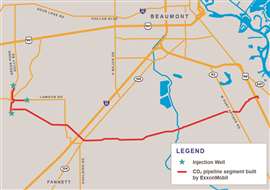
The Railroad Commission of Texas has approved ExxonMobil’s Rose Carbon Capture and Storage project in Jefferson County, clearing a major regulatory hurdle for a development designed to permanently store CO₂ captured from industrial facilities in Southeast Texas.
The commission approved the Class VI injection permits in a 2-1 vote Sept. 15, with Commissioner Wayne Christian voting against the permits. The project previously received three Class VI permits from the U.S. Environmental Protection Agency in October 2025, before Texas assumed primary regulatory authority over Class VI wells.
Rose is planned approximately 15 miles southwest of Beaumont and will include three CO₂ injection wells on a storage site encompassing more than 13,000 acres. An approximately 18-mile pipeline will connect captured CO₂ from industrial facilities with the storage area.
ExxonMobil plans to inject approximately 4 million metric tons of CO₂ annually during a 13-year operating period, according to Railroad Commission project documents. The permits allow a cumulative maximum of 53 million metric tons to be injected during that period.
The CO₂ will come from several large industrial emitters near the Rose facility. According to the Railroad Commission, captured CO₂ will be compressed into a nearly pure supercritical fluid before being transported and injected underground through the three wells.
The commission documents do not identify the compression equipment or suppliers that will be used for the project.
Storage at depths of up to 1.5 miles
The injection wells will place the CO₂ into the Fleming and Upper Frio formations. The seven shale-separated injection intervals range from approximately 3,400 to 7,525 ft below ground level.
ExxonMobil said storage will occur approximately 0.5 to 1.5 miles below the surface. The three deepest Upper Frio injection reservoirs are beneath approximately 400 ft of Anahuac Shale, while the shallower Fleming reservoirs are separated by shale layers and collectively covered by an approximately 500-ft confining zone.
The company will be required to monitor the storage facility during the 13-year injection period and for 50 years afterward, or until regulators approve a demonstration that the site no longer presents a threat to underground drinking water sources.
EPA’s permits allow injection rates averaging between 1.1 million and 1.67 million metric tons annually at each of the three wells, with total injection capped at 5 million metric tons annually.
The Rose project does not involve enhanced oil recovery. Instead, the captured CO₂ will be placed into geologic formations for permanent storage.
Part of larger Gulf Coast CCS development
Rose is a component of ExxonMobil’s broader effort to develop CO₂ capture, transportation and storage infrastructure along the Gulf Coast.
The project is also expected to provide dedicated permanent storage for CO₂ associated with CF Industries’ Donaldsonville, Louisiana, ammonia manufacturing complex. CF Industries said earlier this year that ExxonMobil was temporarily storing CO₂ captured from Donaldsonville through enhanced oil recovery while awaiting the Texas permits needed to transition to dedicated storage at Rose.
ExxonMobil has said Rose and related projects could enable approximately $3 billion in clean-energy investments in Jefferson County.
The Railroad Commission approval came after opposition to the project over safety and economic issues. Christian said after the vote that he was not convinced the regulatory record adequately established the project’s long-term safety and also questioned government subsidies supporting CCS development.
ExxonMobil maintains that Rose has been designed to meet regulatory requirements for permanent CO₂ storage and that monitoring and engineering safeguards will be used throughout its operating life. The company also has conducted CO₂ pipeline emergency-response training with local emergency service districts in Jefferson County.

CONNECT WITH THE TEAM