Read this article in 中文 Français Deutsch Italiano Português Español
Baker Hughes books $10.8 billion in orders as gas technology and power demand grows

October 28, 2026
Third-quarter results include major LNG compression and data center power generation awards, while acquisition of Chart Industries expands industrial equipment portfolio
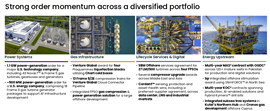
Baker Hughes reported $10.8 billion in orders during the third quarter of 2026, a 31% increase from a year earlier, as demand for natural gas infrastructure, LNG equipment and data center power generation systems continued to strengthen.
The company reported $8 billion in quarterly revenue, up 14% year over year, while its Industrial & Energy Technology (IET) business booked $5.9 billion in orders, an increase of 42%.
During the company’s third-quarter earnings call, Chairman and CEO Lorenzo Simonelli said data centers have emerged as a significant source of equipment demand, accounting for $4.9 billion in IET orders during the first nine months of 2026, an increase of approximately 500% from the same period in 2025.
However, demand has extended well beyond the data center market. Excluding those orders, IET booked approximately $13 billion during the first nine months, supported by LNG projects, pipelines, upstream gas processing, offshore production and aftermarket services.
Baker Hughes raised its full-year IET order outlook to between $21.5 billion and $23.5 billion and increased its cumulative 2026-2028 IET order target to more than $50 billion.
The company ended the third quarter with $46.4 billion in remaining performance obligations, including a record $39.4 billion in IET.
Simonelli attributed the expanding backlog to two major trends: accelerating demand for power generation, particularly in the United States, and continued investment in natural gas infrastructure to support energy security and diversified supplies.
LNG and gas compression orders strengthen
LNG equipment remains one of Baker Hughes’ largest growth opportunities.
The company booked approximately $4 billion in LNG equipment orders during the first nine months of 2026 and expects that total could reach approximately $5 billion for the full year.
During the earnings call, Simonelli said LNG project final investment decisions have accelerated beyond the company’s expectations.
Baker Hughes now believes LNG equipment orders could approach $10 billion during its 2026-2028 planning period, matching the approximately $10 billion booked during the preceding three-year period.
Among the third quarter’s major awards was an order from Venture Global for 13 Frame 5/2E gas turbine-driven compression systems for its Cloud Connector Pipeline project, which will transport natural gas to LNG export facilities.
Baker Hughes described the project as one of the largest deployments of gas turbine-driven compression equipment for LNG feed gas transportation in the United States.
The company also expanded its relationship with Venture Global through an equipment award for the Plaquemines LNG expansion. The order covers equipment for four liquefaction blocks comprising eight modules, along with cryogenic cold boxes supplied through Chart Industries.
Elsewhere, Baker Hughes secured an integrated equipment order for an offshore floating production, storage and offloading (FPSO) development. The package includes LM2500 gas turbine-driven centrifugal compressors for medium- and high-pressure gas service, electrically driven centrifugal compressors for low-pressure applications, and LM2500-powered generators.
Baker Hughes also reported a record quarter for compressor upgrade orders, with multiple awards in the Middle East and Asia.
The company’s Gas Technology Services business is benefiting from growing demand for equipment upgrades and transactional services as operators seek to improve reliability, performance and the operating life of installed compression equipment.
Gas Technology Services orders increased 26% year over year to $1.13 billion during the quarter, while revenue rose 12% to $897 million.
Baker Hughes expects another record year for Gas Technology Services bookings.
Data centers reshape power generation market
Demand for electricity to support artificial intelligence infrastructure is becoming an increasingly important driver of Baker Hughes’ equipment business.
The company secured an order to supply approximately 1.1 GW of power generation capacity for an unidentified U.S. technology company. The award includes 43 NovaLT and Frame 5 gas turbine packages, gearboxes and BRUSH generators.
A separate order covers approximately 500 MW of generation capacity for data center projects being developed by a U.S. energy company. That contract includes 18 Frame 5 gas turbine generator packages.
Together, the two awards represent approximately 1.6 GW of generation capacity.
During the earnings call, Simonelli said Baker Hughes expects power systems orders to approach $7 billion in 2026, driven primarily by data centers but also by distributed power requirements in oil and gas operations, LNG facilities and downstream markets.
Across the 2026-2028 period, the company sees a potential for power systems orders approaching $15 billion.
Simonelli also pointed to the relationship between expanding data center capacity and natural gas consumption.
He cited projections for approximately 100 GW of incremental data center capacity by 2035, potentially requiring about 18 Bcf/d of additional natural gas supply to meet associated electricity demand.
The projections illustrate the potential scale of additional demand for natural gas production, gathering, processing, transmission and compression infrastructure.
According to Simonelli, grid constraints are encouraging hyperscale data center developers and industrial customers to consider onsite and behind-the-meter generation rather than relying exclusively on utility connections.
He said the principal constraint for many projects is not demand for computing capacity but the ability to secure reliable power quickly enough to meet development schedules.
However, permitting, gas supply availability, site development and financing costs remain potential obstacles.
Baker Hughes said it is evaluating customer creditworthiness, project economics, permitting progress and infrastructure readiness when accepting new orders. The company also uses nonrefundable down payments and cancellation provisions to manage project risk.
Management said it has not seen evidence of widespread cancellations among its data center customers.
Chart acquisition expands LNG and industrial capabilities
Baker Hughes completed its acquisition of Chart Industries on July 16, expanding its portfolio of cryogenic equipment, heat transfer technologies and industrial products.
Chart contributed $888 million in revenue during the third quarter, its first reporting period under Baker Hughes ownership. The business recorded $831 million in orders and $156 million in segment EBITDA, representing a 17.6% margin.
The company’s order activity included cryogenic equipment for LNG projects, industrial cooling equipment and specialized equipment for space applications.
Chart secured an order from Golar LNG for two cryogenic cold boxes and two Peter Brotherhood steam turbines for Golar’s fourth floating LNG development.
Other awards included Howden exhaust gas recirculation blowers for Hanwha Engine and air coolers for an LNG export facility expansion on the U.S. Gulf Coast.
During the earnings call, management said integration activities are progressing, with actions representing approximately $70 million in annualized cost savings already implemented.
Baker Hughes expects to achieve $325 million in annualized cost synergies within three years of completing the acquisition.
The company also expects Chart’s EBITDA margins to improve to between 22% and 23% during the second half of 2028, supported by cost reductions, improvements in manufacturing operations and a more favorable equipment mix.
Management said it is using its operating improvement programs to expand manufacturing capacity, including efforts to double Chart’s dry cooler revenue by 2029.
The acquisition is also expected to create additional opportunities to combine Baker Hughes’ compression, power generation and digital technologies with Chart’s industrial equipment portfolio.
Longer lead times extend revenue outlook
Despite the substantial increase in equipment orders, Baker Hughes cautioned that much of its growing backlog will take longer to convert into revenue.
During the earnings call, management said the increasing proportion of long-lead-time orders for gas turbines, LNG equipment and offshore production systems is extending the company’s revenue outlook beyond 2027.
At the end of the third quarter, approximately 33% of the combined Gas Technology Equipment and Climate Technology Solutions backlog was scheduled for delivery or revenue recognition in 2027.
At the comparable point in 2025, approximately 46% of that backlog was scheduled to convert during the following year.
As a result, the company expects more moderate IET revenue growth in 2027, followed by stronger growth in 2028 as manufacturing capacity expands and equipment orders progress toward delivery.
Baker Hughes expects IET organic revenue to increase at a low- to mid-single-digit rate in 2027, with stronger performance during the second half of the year.
Additional turbine and generator manufacturing capacity is expected to come online during the first half of 2027.
Management also identified supply chain constraints, inflation and geopolitical disruptions in the Middle East as potential challenges to equipment deliveries and project execution.
Financial performance
Baker Hughes reported third-quarter net income attributable to the company of $411 million, down 33% from $609 million a year earlier, despite higher revenue.
Adjusted net income, which excludes certain acquisition-related and other charges, rose 2% to $695 million.
Adjusted earnings before interest, taxes, depreciation and amortization (EBITDA) increased 14% to $1.42 billion.
The IET business generated $3.48 billion in revenue, up 3% year over year, and $685 million in segment EBITDA, an 8% increase.
Gas Technology Equipment orders rose 43% to $3.12 billion, while revenue declined 7% to $1.58 billion, reflecting differences in project timing and equipment mix.
The company’s Oilfield Services & Equipment business recorded $3.66 billion in revenue and $4.05 billion in orders.
Baker Hughes generated $769 million in free cash flow during the quarter, up 10% from a year earlier.
Management said near-term financial priorities include reducing debt associated with the Chart acquisition while continuing to invest in manufacturing capacity and equipment development.
Baker Hughes expects company revenue of approximately $8.25 billion and adjusted EBITDA of $1.46 billion in the fourth quarter.
Looking further ahead, the company said its growing equipment backlog and expanding installed base should support additional demand for aftermarket services, spare parts, upgrades and digital monitoring technologies.
Simonelli said the company’s strategy is increasingly focused on providing integrated solutions across natural gas infrastructure, power generation and industrial applications, connecting equipment and services across what he described as the energy value chain from molecules to electrons.


CONNECT WITH THE TEAM