Read this article in 中文 Français Deutsch Italiano Português Español
ExxonMobil raises 2030 outlook as LNG, Permian and CCS portfolios drive long-term growth

December 09, 2025
Company highlights stronger gas-weighted upstream mix, new LNG project startups and expanded CCS deployment
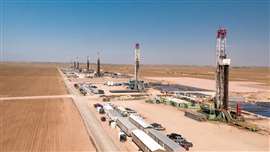 xxonMobil raises 2030 outlook as LNG, Permian and CCS portfolios drive long-term growth. Company highlights stronger gas-weighted upstream mix, new LNG project startups and expanded CCS deployment. (Image: ExxonMobil)
ExxonMobil has raised its 2030 corporate plan and sharpened the role of natural gas, LNG and carbon management in its long-term strategy, projecting higher earnings and cash flow without increasing capital spending. The company said advantaged assets—led by the Permian Basin, Guyana and its expanding LNG portfolio—will account for about 65% of upstream production by the end of the decade.
The updated plan forecasts $25 billion in additional earnings and $35 billion in additional cash flow by 2030 compared with 2024 results on a constant-price basis, a $5 billion increase in each metric over prior guidance. ExxonMobil expects to generate about $145 billion in surplus cash flow through 2030 at a $65 Brent case, driven by continued portfolio optimization and a more gas-heavy production slate.
Chairman and CEO Darren Woods said the transformation efforts launched several years ago are now delivering industry-leading performance and enabling stronger returns with lower emissions intensity.
“We’re extending that leadership position,” Woods said. “By 2030, we now expect significant earnings and cash flow growth with no increase in capital, while achieving our emissions-reduction plans across the portfolio.”
LNG becomes a growth pillar as upstream volumes rise
The company expects upstream production to reach 5.5 million oil-equivalent barrels per day by 2030. Within that total, LNG stands out as a major contributor to the “advantaged assets” category—alongside the Permian and Guyana—which together are projected to produce nearly 3.7 million oil-equivalent barrels per day by decade’s end.
ExxonMobil identified new LNG project startups in Papua New Guinea and Mozambique as key growth drivers beyond 2030. These projects are part of a broader strategy to expand global gas supply, leverage integrated value chains and support long-term LNG demand in Asia and Europe.
The company’s improved outlook is also shaped by ongoing changes across global gas markets. Persistent demand from Asian utilities, opportunities to displace coal in power generation and the need for flexible supply in Europe continue to elevate LNG as a strategic asset class. ExxonMobil emphasized that its mix of long-term offtake contracts and low-cost upstream feedgas positions it well for market cycles.
Permian gas strengthens the supply base
Doubling Permian production by 2030—from about 1.3 million to 2.5 million oil-equivalent barrels per day—will add significant gas and NGL volumes into ExxonMobil’s midstream and LNG value chains.
The company highlighted early results from its proprietary lightweight proppant technology, which has improved recovery rates by roughly 20%. Integration of Pioneer Natural Resources’ assets is expected to deliver $4 billion in annual synergies, feeding more low-cost gas into ExxonMobil’s Gulf Coast processing and export systems.
Gas-driven product solutions and integration
Downstream and chemical businesses also factor into gas economics. ExxonMobil expects more than $9 billion in earnings growth from its Product Solutions segment by 2030, with advantaged fuel and chemical projects—many of which depend on natural gas liquids and refinery off-gas—already contributing higher-margin volumes.
Projects that began operating in recent years support increased production of high-value fuels, lubricants and performance chemicals. These facilities, primarily on the U.S. Gulf Coast, rely on abundant local gas supply and benefit from efficient integration with ExxonMobil’s LNG and pipeline networks.
CCS and low-carbon projects expand alongside LNG
ExxonMobil also underscored the central role of carbon capture and storage in maintaining the competitiveness of natural gas in a carbon-constrained environment. The company now has roughly 9 million metric tons per year of third-party CO2 under contract—positioning it as the most advanced large-scale CCS provider globally—and began operating its first CCS project along the U.S. Gulf Coast this year.
Additional CCS projects with Linde, Nucor and New Generation Gas Gathering will start up in 2026. Many of these initiatives are tied indirectly to gas processing and LNG infrastructure, where CO2 separation and handling are essential to meeting product specifications and regulatory requirements.
The company is also advancing what it calls “CCS-enabled low-carbon data center projects,” targeting final investment decisions in 2026. Such projects rely heavily on firm natural gas power generation paired with CO2 capture to meet hyperscale reliability needs.
LNG remains central to long-term value
Beyond 2030, ExxonMobil expects its platform of gas, LNG and carbon management businesses to create long-lasting growth opportunities. The company sees as much as $13 billion in potential earnings from emerging low-emission businesses by 2040, supported by about $20 billion in planned investments from 2025 through 2030.
The combination of new LNG project startups, maturing CCS markets, and a large, structurally lower-cost upstream resource base gives ExxonMobil a diversified natural gas strategy that extends well beyond the current planning horizon. As markets continue to shift toward flexible LNG contracts and coal-to-gas switching in Asia accelerates, ExxonMobil said its portfolio is positioned to support those trends.
“With advantaged LNG, leading CCS capabilities, and a deep upstream pipeline, we believe our business is set up to create substantial long-term value,” Woods said.

CONNECT WITH THE TEAM