Read this article in 中文 Français Deutsch Italiano Português Español
Shell approves LNG Canada Phase 2, doubling export capacity

September 29, 2026
Project will add two LNG processing trains to the existing two-train facility
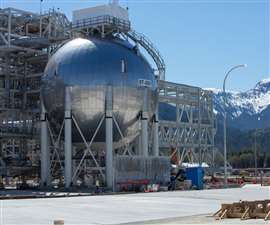 Shell Canada Energy, an affiliate of Shell plc, announced a final investment decision on LNG Canada Phase 2, which will double production capacity at the facility in Kitimat, British Columbia. (Image: LNG Canada)
Shell and its partners have taken a final investment decision on the second phase of LNG Canada, clearing the way for an expansion that will double the Kitimat, British Columbia, facility’s production capacity to 28 million tonnes per annum (mtpa).
The project will add two LNG processing trains to the existing two-train facility, taking LNG Canada from 14 mtpa to 28 mtpa. Commercial operations from Phase 2 are expected to begin in the early 2030s.
Shell holds a 40% interest in LNG Canada and expects to receive nearly 6 mtpa of additional LNG from the expansion. The other joint venture participants are PETRONAS with 25%, PetroChina with 15%, Mitsubishi Corp. with 15% and Korea Gas Corp. with 5%.
Expansion extends beyond liquefaction trains
In addition to the two new trains, Phase 2 will include another LNG storage tank, a condensate tank, a loading berth and expanded utility and process systems at the Kitimat site.
Engineering and construction planning for the expansion has already been under way. In June, the JGC Fluor BC LNG II joint venture received a limited notice to proceed for Phase 2. JGC and Fluor also delivered the engineering, procurement, fabrication management, construction and commissioning work for the first phase, including the original two trains and supporting infrastructure.
The expansion is also expected to produce a significant compression project upstream of the LNG plant.
Coastal GasLink, the 670-km pipeline supplying the Kitimat facility with natural gas from northeastern British Columbia, will increase its transportation capacity primarily by adding compression rather than constructing another mainline. Shell said the expansion will require five new compressor stations.
Front-end engineering work disclosed earlier this year called for five additional stations, each using about 30 MW of gas compression, along with modifications to other facilities on the system. That would represent roughly 150 MW of new compression capacity if the FEED configuration carries through into final construction. The compressor and driver suppliers have not been publicly identified.
The additional compression is intended to substantially increase throughput on the existing pipeline. Earlier project information indicated Coastal GasLink could increase from roughly 2.1 Bcf/d to as much as 5 Bcf/d through added compression and associated system modifications.
LNG Canada and Coastal GasLink reached commercial agreements in March covering the proposed pipeline expansion. Under the execution model outlined at the time, LNG Canada would lead construction of the Phase 2 facilities while Coastal GasLink would provide technical advisory services.
Asia remains primary market
Shell said the location on Canada’s Pacific Coast gives LNG Canada relatively direct access to Asian markets and forms part of its strategy to connect Canadian natural gas production with its global LNG portfolio.
“LNG Canada is a core part of our Integrated Gas portfolio, helping to supply LNG to customers in Asia at a time when diversity of energy supplies and energy security are increasingly important,” said Cederic Cremers, Shell’s Integrated Gas president.
LNG Canada operates under an equity-lifting structure, meaning each partner provides its proportionate share of feed gas and markets its corresponding share of LNG production.
Shell cited its 2026 LNG Outlook in support of the expansion, forecasting global LNG demand will increase from 422 mtpa in 2025 to nearly 700 mtpa by 2050.
The Phase 2 decision follows the startup of LNG Canada’s first phase and represents one of the largest LNG expansion projects now moving into execution in North America. Reuters reported that the expansion is expected to involve investment of about C$33 billion and would significantly increase Canada’s position in the global LNG export market.

CONNECT WITH THE TEAM