Global CCS projects rise 13% as transport and storage infrastructure expands

October 28, 2026
Global CCS Institute reports 113 operating facilities and growing investment in CO₂ networks, although permitting and financing challenges continue to affect development
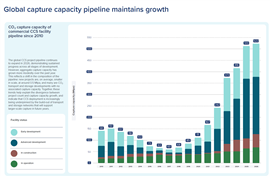
The number of carbon capture and storage (CCS) projects worldwide increased 13% over the past year, with 113 commercial facilities now operating and another 59 under construction, according to the Global CCS Institute’s Global Status of CCS 2026 report.
The report identifies 832 projects worldwide in various stages of operation and development, up from 734 in 2025. Combined CO₂ capture capacity across the project pipeline increased more modestly, from 513 million tonnes per annum (Mtpa) to 522 Mtpa.
The difference reflects a changing project mix, with more developments focused on CO₂ transportation and storage infrastructure rather than individual capture facilities. New capture projects are also generally smaller, averaging approximately 0.5 Mtpa.
For equipment suppliers, the trend points to an expanding market for the infrastructure needed to collect, condition, compress, transport and store captured CO₂.
The report, which uses project data through July 31, 2026, found that operating CCS facilities have a combined capture capacity of 68 Mtpa, up from 64 Mtpa in 2025.
An additional 56 Mtpa of capture capacity is under construction. If those projects enter operation as planned, global operating capacity would exceed 100 Mtpa.
“Over one hundred CCS projects are now in operation, and we expect to surpass 100 million tonnes per annum (Mtpa) of capacity when projects now under construction enter service,” said Jarad Daniels, CEO of the Global CCS Institute.
However, the institute cautioned that investment and regulatory uncertainties continue to complicate the development of new projects.
Transport and storage networks gain importance
One of the report’s more significant findings is the growing share of CCS projects dedicated to CO₂ transportation and storage.
The institute identified 266 such developments, accounting for approximately 32% of the global project pipeline.
These projects are intended to provide shared infrastructure capable of serving multiple industrial facilities rather than requiring each emissions source to develop its own transportation and storage system.
The approach could lower development costs and make CCS more accessible to smaller industrial emitters.
It also creates opportunities for compression equipment, dehydration systems, pipeline infrastructure and other technologies required to move captured CO₂ from industrial facilities to geological storage sites.
CO₂ transportation can present different equipment requirements from conventional natural gas transmission, including operation at elevated pressures, management of water content and phase behavior, and materials compatibility.
Although the institute does not quantify the compression equipment required by the expanding project pipeline, the development of shared CO₂ networks represents a potential source of demand for compressor manufacturers and related equipment suppliers.
The report also highlights increasing interest in CO₂ shipping, particularly in regions where pipelines are impractical or where captured emissions must be transported across national boundaries.
Natural gas processing leads operating capacity
Natural gas processing and LNG facilities remain the largest category of operating CCS projects by capture capacity, accounting for approximately 42 Mtpa worldwide.
Across projects in operation and development, the sector represents approximately 111 Mtpa of potential capture capacity.
However, power generation and heat production have emerged as the largest category in the overall development pipeline, with approximately 160 Mtpa of existing and proposed capture capacity.
The change reflects growing interest in applying CCS to natural gas-fired power plants.
The institute identified increasing electricity demand from artificial intelligence data centers as one factor supporting development of gas-fired generation equipped with carbon capture.
In the United States, the report cites estimates that additional natural gas-fired generation serving data centers could reach 130 to 220 terawatt-hours annually by 2030.
Without emissions controls, that additional generation could produce an estimated 50 million to 80 million tonnes of CO₂ annually, according to the research cited by the institute.
The report cautions that permitting, power availability, equipment supply and opposition to new infrastructure could delay or prevent some proposed data center developments.
Nevertheless, the institute identified gas-fired generation with CCS as a potential market for additional carbon capture, transportation and storage infrastructure.
United States remains a major CCS market
The Americas continue to lead global CCS development, with 63 operating facilities and another 18 under construction.
The region accounts for approximately 48 Mtpa of existing capture capacity, with a potential increase to 282 Mtpa if announced projects proceed.
The United States remains central to that growth, supported by the federal 45Q tax credit and increasing activity in CO₂ pipeline and storage development.
However, the institute said uncertainty surrounding federal funding, environmental reporting requirements and permitting continues to complicate investment decisions.
The report noted that 33 CCS-related laws were enacted across 17 U.S. states between January 2025 and July 2026.
Those measures address issues including pore space ownership, pipeline regulation, long-term storage liability, landowner compensation and the permitting of geological storage wells.
Six states have received primary authority to administer federal Class VI underground injection well permitting programs, while additional states and tribal authorities have applications under review.
The institute identified the Gulf Coast and Midwest as the principal areas of activity for new Class VI permit applications.
It also noted that more than three-quarters of Class VI projects remain in regulatory review, underscoring the importance of permitting timelines to the development of transportation and storage infrastructure.
Among the U.S. projects highlighted were ExxonMobil’s New Generation Gathering system, Tallgrass Energy’s Trailblazer CO₂ pipeline and California Resources Corp.’s Carbon TerraVault development.
Europe expands CCS infrastructure
Europe has 15 operating CCS projects and another 21 under construction, according to the report.
The institute estimates that the region’s total capture capacity could reach approximately 141 Mtpa if all announced developments proceed.
European CCS development is increasingly organized around shared transportation and storage networks, supported by public funding, carbon pricing and cross-border cooperation.
The report highlighted funding initiatives in Denmark, the Netherlands and other European markets, along with agreements supporting the transportation of captured CO₂ between countries.
The growth of these networks is also supporting interest in marine CO₂ transportation, with specialized vessels and terminal facilities becoming important components of the emerging infrastructure.
Financing and policy remain obstacles
Despite increasing project activity, the Global CCS Institute emphasized that the development pipeline should not be mistaken for committed operating capacity.
Many projects remain in early development and face uncertainties involving financing, permitting, commercial agreements and access to storage infrastructure.
The institute identified dependable revenue streams, coordinated infrastructure development and supportive regulatory policies as important requirements for additional CCS investment.
Daniels said that while commercial carbon capture technologies are available, project economics remain a central challenge.
“Policy and financing remain the key constraints limiting broader deployment of carbon management,” he said.
The report also noted that CCS deployment remains well below the scale envisioned in many long-term emissions reduction scenarios.
Still, the increase in operating projects and continued expansion of transportation and storage networks indicate that the industry is progressing beyond individual capture facilities toward more integrated carbon management systems.


CONNECT WITH THE TEAM