Read this article in 中文 Français Deutsch Italiano Português Español
Hanwha Ocean sees growing LNG carrier demand despite near-term market pressures

October 28, 2026
South Korean shipbuilder expects U.S. LNG exports, aging vessels and offshore gas development to support longer-term growth, while expanding its interest in FLNG and gas-fired power projects
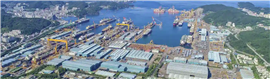 Hanwha Ocean’s shipbuilding facility in South Korea. The company expects expanding U.S. LNG exports and demand for newer, more efficient vessels to support LNG carrier orders through the next decade, despite near-term market pressures. (Hanwha Ocena)
Hanwha Ocean expects expanding U.S. LNG exports and the replacement of aging vessels to support demand for new LNG carriers through the next decade, although an oversupply of available ships and weak spot charter rates are creating near-term challenges.
During its third-quarter 2026 earnings conference call, the South Korean shipbuilder said major U.S. export developments, including Port Arthur LNG and Rio Grande LNG, are supporting demand for LNG transportation capacity, particularly on long-haul routes to Asia.
The company also identified floating LNG (FLNG) facilities, floating production, storage and offloading (FPSO) vessels and gas-fired power generation as potential areas for growth within its Energy & Plant business.
Hanwha Ocean reported consolidated third-quarter revenue of approximately $2.57 billion and operating profit of $366 million.
Revenue declined 37% from the second quarter, primarily because of the timing of revenue recognition for a major offshore project delivered during the previous quarter and fewer operating days. Revenue increased 13% compared with the third quarter of 2025.
LNG carrier demand expected to strengthen after 2030
Hanwha Ocean said the expansion of U.S. LNG export capacity is increasing demand for shipping over longer distances, particularly between North America and Asia.
The company expects LNG projects approaching or beginning commercial operations to require additional vessels with delivery dates beginning around 2030.
During the earnings call, management said substantial medium- and long-term demand is expected for LNG carriers delivered from 2030 onward.
Replacement demand is also expected to support newbuild orders.
Hanwha Ocean estimates that approximately 31% of the existing LNG carrier fleet will be at least 25 years old by 2038. Older steam turbine-powered and dual-fuel diesel-electric (DFDE) vessels are becoming less economically competitive, while tightening environmental requirements are encouraging investment in newer, more efficient ships.
However, the shipbuilder acknowledged that near-term market conditions remain challenging.
Approximately 281 LNG carriers, equivalent to about 33% of the existing fleet, are scheduled for delivery following heavy ordering in previous years.
Management also estimated that approximately 42 LNG carriers are currently without charters, a historically high number.
Disruptions to LNG production facilities in Qatar have added to the pressure by reducing export volumes and making additional vessels available in the spot market.
Hanwha Ocean said spot charter rates currently range from approximately $20,000 to $40,000 per day, depending on the region, substantially below the mid-$70,000-per-day levels shipowners generally seek.
The company emphasized that long-term contracted charter rates have remained more resilient than spot rates, although it said reliable data on contracts exceeding 10 years was not available.
Despite the near-term supply imbalance, Hanwha Ocean expects expanding LNG trade and fleet replacement requirements to support new vessel orders over the longer term.
During the first nine months of 2026, the company secured orders for eight LNG carriers, along with 18 very large crude carriers, six very large gas carriers and six containerships.
FLNG opportunities emerge in new markets
Hanwha Ocean also expects demand for floating LNG production facilities to expand as major energy companies develop offshore gas resources.
During the earnings call, the company’s Energy & Plant business identified LNG developments in North America, Qatar and Africa as drivers of investment in export infrastructure.
The company pointed to Eni’s plans to expand its LNG portfolio to approximately 20 million tonnes per annum (MTPA) by 2030, including potential developments using FLNG technology.
Hanwha Ocean said FLNG is being considered for Eni’s offshore gas assets in Venezuela, including the Perla field in the Cardón IV Block, where future gas exports are under evaluation.
The company also cited developments in Mozambique and growing interest in diversifying LNG supply sources as potential drivers of additional floating liquefaction projects.
These developments could create opportunities for equipment manufacturers supplying gas processing, compression, power generation and cryogenic systems used aboard FLNG vessels.
Hanwha Ocean said it intends to build on its experience constructing offshore production facilities as it evaluates opportunities in FLNG and other energy infrastructure markets.
FPSO projects support offshore outlook
The company expects continued investment in deepwater oil and gas developments to support demand for FPSOs, particularly in Brazil and West Africa.
Hanwha Ocean highlighted activity in Namibia’s Orange Basin, where TotalEnergies is advancing the Venus and Mopane developments.
The company cited a development outlook targeting combined production of approximately 350,000 barrels of oil equivalent per day from 2030 onward.
Petrobras’ continued investment in offshore production facilities is another source of potential demand.
During the earnings call, Hanwha Ocean confirmed that it is participating in the competitive bidding process for the Venus FPSO project but declined to provide additional details.
Management said that if the company secures the project, revenue would likely be recognized between 2027 and 2030.
Hanwha Ocean’s Energy & Plant business recorded third-quarter revenue of approximately $397 million, down 74% sequentially because of the recognition of revenue associated with an FPSO delivery in the second quarter.
However, operating profit increased to approximately $69 million, supported by additional change orders associated with the completed project and contributions from drilling and operations and maintenance subsidiaries.
The business expects revenue to increase gradually during the fourth quarter as ongoing project work advances.
Gas-fired power generation offers another opportunity
Hanwha Ocean also identified growing electricity demand from artificial intelligence data centers as a potential driver of investment in gas-fired power generation.
The company said major U.S. data center operators are increasingly considering dedicated generation facilities, including gas-fired plants located at or near computing sites, to secure reliable electricity supplies.
Battery energy storage systems are also being considered as part of these projects.
Hanwha Ocean said it intends to use its experience in offshore energy facilities and power plant development to pursue opportunities in the market.
The company’s comments reflect a broader convergence of natural gas infrastructure, industrial power generation and data center development.
Hanwha Ocean is also evaluating floating data center concepts. During the earnings call, management said it is continuing development of a floating data center design that has received approval in principle.
The company said it is discussing potential opportunities with customers but has not established a timetable for an initial contract.
Shipbuilder maintains selective order strategy
Hanwha Ocean said its commercial shipbuilding business has approximately three years of work in its backlog.
The company has secured roughly 80% of its approximately $8 billion annual commercial vessel order target and said it has sufficient opportunities under discussion to avoid accepting lower-priced orders simply to maintain production volumes.
Management emphasized that profitability, project economics and available construction capacity will remain central to its contract decisions.
The company’s Commercial Ship business generated approximately $2.05 billion in third-quarter revenue and $356 million in operating profit.
Although a growing share of production is shifting toward crude carriers and containerships, Hanwha Ocean said vessels contracted since 2024 generally carry higher prices than earlier orders, supporting its expectations for continued profitability.
Looking ahead, the company expects expanding LNG exports, offshore development and demand for dedicated power generation to create opportunities across several of its businesses.

CONNECT WITH THE TEAM