Read this article in 中文 Français Deutsch Italiano Português Español
EU moves to permanently end Russian gas imports

December 03, 2025
Brussels advances long-planned REPowerEU goal, setting definitive deadlines for LNG and pipeline gas phaseout
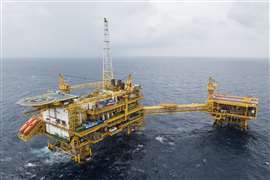 A Gazprom platform in the North Sea. The European Union has reached an agreement on plans to fully end Russian gas imports by mid-2027. (Image: Gazprom)
The European Union took a decisive step toward ending its reliance on Russian fossil fuels, announcing a provisional political agreement that will permanently halt Russian gas imports and accelerate the phaseout of Russian oil. The deal, reached between the European Parliament and the Council, represents the bloc’s most sweeping energy-security action since the start of the war in Ukraine.
EU leaders framed the agreement as the final chapter in a multiyear strategy to unwind decades of dependence on a supplier that repeatedly disrupted markets and jeopardized the bloc’s energy security.
“Today, we enter the era of Europe’s full energy independence from Russia,” Commission President Ursula von der Leyen said. “REPowerEU has delivered. It shielded us from the worst energy crisis in decades, and it helped us to transition from Russian fossil fuels at record speed. Today, we are stopping these imports permanently.”
Permanent ban with staged deadlines
The agreement phases out Russian gas in two major steps: liquefied natural gas (LNG) imports must cease by Dec. 31, 2026, while pipeline gas will end by Sept. 30, 2027. Member States that encounter storage-filling challenges may extend pipeline imports until Oct. 31, 2027.
The timeline varies based on the type and duration of existing contracts:
- Short-term supply contracts signed before June 17, 2025: – LNG imports banned starting April 25, 2026 – Pipeline gas banned starting June 17, 2026
- Long-term LNG import contracts signed before June 17, 2025: – Prohibition takes effect Jan. 1, 2027 (aligned with the EU’s 19th sanctions package)
- Long-term pipeline gas contracts: – Imports allowed only until Sept. 30, 2027, with a potential extension to Nov. 1, 2027, if storage targets cannot be met
- Existing contracts may be amended only for narrowly defined operational needs and may not increase volumes or prices. By November 2027 at the latest, Russian gas will be eliminated from the EU energy mix.
Stronger safeguards against circumvention
The agreement includes a detailed compliance and monitoring system designed to prevent Russian gas from being rerouted into EU markets under different designations. Importers will be required to disclose extensive documentation on contract terms, gas origins and volumes tied to historical deliveries.
During the transition period, any Russian gas allowed under existing contracts will require prior authorization, with regulators verifying that imports strictly match historic volumes. For non-Russian natural gas, importers must provide production-country information, with exemptions limited to countries that exported at least 5 Bcm to the EU in 2024 and either have sanctions in place or lack infrastructure capable of receiving Russian gas.
The Commission, ACER, OLAF and the European Public Prosecutor’s Office will jointly monitor compliance and market effects, while Member States must coordinate closely to detect and prevent circumvention.
To ensure security of supply beyond 2027, Member States must submit national diversification strategies by March 1, 2026, outlining plans to reduce exposure to Russian gas and oil. Within one month of the regulation taking effect, governments must also declare whether they maintain Russian supply contracts or domestic legal bans.
The Commission will assess each plan and may issue recommendations within three months of submission. Officials emphasized that the phaseout will be staged carefully to minimize market shocks and maintain predictable, competitive supply conditions.
Oil imports—already reduced from 27% of EU supply in early 2022 to 2% today—are set for full elimination by the end of 2027. A formal legislative proposal to ban remaining Russian oil flows is expected early next year.
From crisis response to long-term independence
The decision caps more than two years of accelerated diversification under the REPowerEU framework. Russian pipeline gas accounted for 45% of EU imports prior to the invasion of Ukraine, falling to 13% in the first half of 2025 as LNG, Norwegian supplies and pipeline imports from North Africa increased. Still, Russia supplied about 35 Bcm of gas to the EU in 2024, worth an estimated €10 billion at current prices.
Russian coal is already fully banned, and long-term LNG contracts with Russia will cease in 2027 under the sanctions package adopted in October.
The political agreement now moves to translation and formal approval by the Parliament and Council. Following adoption, the regulation will be published in the Official Journal and enter into force.
EU officials characterized the phaseout as a structural reset of Europe’s energy architecture—intended not only to end dependence on Russian supplies but also to strengthen market stability, ensure long-term competitiveness and deepen energy partnerships across the globe.
MAGAZINE
NEWSLETTER


CONNECT WITH THE TEAM