Read this article in 中文 Français Deutsch Italiano Português Español
TotalEnergies sees tighter LNG markets, firmer gas pricing through 2026

April 29, 2026
The company said the closure of the Strait of Hormuz has fundamentally altered the market outlook
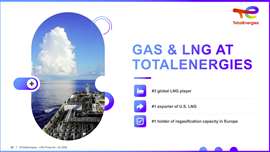
TotalEnergies expects tighter global LNG balances, firmer gas prices and stronger demand for long-term supply contracts through the rest of 2026 as disruptions in the Middle East continue to ripple through global energy markets, executives said during the company’s first-quarter earnings call.
The company said the closure of the Strait of Hormuz has fundamentally altered the market outlook for both oil and LNG, erasing the surplus scenario many had expected at the start of the year and creating a more constructive backdrop for global gas producers.
“This conflict also has some impacts on the LNG markets and prices,” CEO Patrick Pouyanné said, noting European gas prices have risen to about $15/MMBtu as Europe enters storage refill season while Asia approaches peak summer demand. He added that QatarEnergy is unlikely to restart liquefaction quickly, choosing instead to wait for “real stabilization” in the Strait before bringing plants back online.
That matters because Qatar represents nearly 20% of global LNG supply, and TotalEnergies expects the delay in restarting Qatari LNG production to support stronger prices into the summer. Pouyanné said LNG markets could remain tight even if the regional conflict eases soon because liquefaction plants cannot be turned on and off quickly and shipping delays will extend the market impact.
For TotalEnergies, however, the tighter market is expected to improve LNG realizations. CFO Jean-Pierre Sbraire said the company expects its average LNG selling price to rise to about $10/MMBtu in the second quarter, up from $8.5/MMBtu in the first quarter, reflecting the lagged impact of stronger oil and gas prices in LNG contract formulas.
That pricing uplift comes after a strong first quarter for the company’s integrated LNG business. LNG production rose 12% quarter over quarter, supported by stronger output from Australia, the United States and Malaysia, while LNG sales reached 12.4 million tons, putting the company on pace to exceed its full-year guidance of more than 44 million tons. Integrated Energy generated $1.3 billion in adjusted net operating income and $1.8 billion in cash flow during the quarter, aided by strong spot activity and LNG trading.
TotalEnergies said one of its biggest advantages in the current market is portfolio diversity. Pouyanné emphasized that the company’s LNG production footprint across 11 countries has allowed it to reroute cargoes and avoid declaring force majeure to customers, even as Qatari supply was disrupted.
That supply flexibility, he said, is reinforcing the value of portfolio LNG and contract reliability with Asian buyers, many of whom are now reconsidering long-term procurement strategies after a second major LNG supply shock in four years.
Executives said the market disruption is already strengthening buyer interest in long-term, oil-linked LNG contracts, particularly in Asia, where affordability and supply security have become top priorities.
Pouyanné said the latest disruption could accelerate support for long-term LNG contracting while also improving the commercial outlook for new export projects such as Papua LNG, which TotalEnergies is targeting for sanction before year-end.
He said Asian buyers are showing stronger interest in Papua LNG not only because of its contract structure, but also because of its location outside the Middle East chokepoint. That geographic diversification is becoming more valuable as buyers look to reduce exposure to supply disruptions tied to the Gulf.
The company also pointed to Mozambique LNG as another strategic piece of its long-term gas portfolio. TotalEnergies fully restarted construction on the project in January, and Sbraire said more than 6,000 workers are now on site. The project is expected to provide another major source of non-Middle East LNG supply when it comes online later this decade.
Pouyanné said the crisis has underscored the strategic value of geographic diversification in LNG, and he suggested that the company’s expanding portfolio outside the Middle East is becoming a larger competitive advantage as buyers reassess security of supply.
For North American gas markets, TotalEnergies struck a notably different tone. Pouyanné said U.S. domestic gas remains insulated from global LNG volatility because of structural oversupply and expanding pipeline takeaway, describing it as one of the few energy markets largely untouched by the current disruption.
That divergence reinforces a view increasingly shared across the LNG sector: global gas markets may remain tight and supportive for exporters through 2026, even as abundant North American gas continues to anchor feedgas economics for U.S. LNG developers.

CONNECT WITH THE TEAM