Read this article in 中文 Français Deutsch Italiano Português Español
Europe, Asia LNG prices climb on Hormuz closure

April 28, 2026
Disruption causing sharp divergence in global pricing
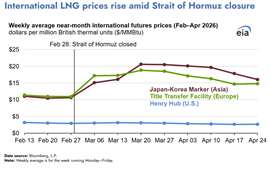
Disruption to LNG flows through the Strait of Hormuz has driven a sharp divergence in global natural gas pricing, lifting benchmark gas prices in Europe and Asia while leaving U.S. prices relatively insulated due to limited near-term export flexibility and ample domestic supply. U.S. Energy Information Administration (EIA) data show the pricing split has widened significantly since the Feb. 28 closure of the strait, underscoring the regional impact of constrained LNG trade and the limits of U.S. export responsiveness.
For the week ending April 24, futures prices for LNG delivered to Europe’s Title Transfer Facility rose to $14.80 per million British thermal units (MMBtu), up 35% from pre-closure levels. In Asia, the front-month futures price for the Japan-Korea Marker climbed 51% over the same period to $16.02/MMBtu. By contrast, U.S. benchmark Henry Hub prices fell 9% as domestic inventories remained strong and LNG export growth remained constrained.
The closure of the Strait of Hormuz has disrupted more than 10 Bcf/d of global LNG supply, or about 20% of the world’s traded LNG, largely tied to Qatar’s Ras Laffan export complex. According to Kpler, no laden LNG tankers crossed the strait between March 1 and April 24, effectively sidelining a major share of Qatari exports and tightening global spot markets.
The resulting supply shock has forced buyers in Asia and Europe to compete more aggressively for available spot cargoes. QatarEnergy declared force majeure on March 4, leaving Asian importers — which typically take more than 80% of Qatari LNG volumes — scrambling to replace contracted deliveries. In Europe, the disruption has compounded seasonal supply concerns as the region begins the summer refill season with storage inventories at just 28% full, well below the five-year average of 41%, according to Gas Infrastructure Europe.
That combination of reduced Qatari supply and low European inventories has kept upward pressure on TTF, even after prices eased from a three-year high reached in mid-March. In Asia, tighter storage capacity and weather-driven demand swings continue to support elevated JKM pricing, with buyers remaining exposed to spot market volatility.
The United States has seen little of that price pressure spill into the domestic market. While U.S. LNG exports are expected to increase modestly, terminal utilization remains high and available incremental capacity is limited. U.S. LNG exports averaged an estimated 17.9 Bcf/d in March, according to EIA, the second-highest monthly total on record behind December 2025’s 18.4 Bcf/d. Export terminal utilization reached 94% of DOE-approved capacity in March, up from 91% in February, leaving little room for a material near-term increase in exports.
The U.S. Department of Energy has approved two recent increases in LNG export authorizations to non-free trade agreement countries since the closure, including 0.5 Bcf/d for Plaquemines LNG in March and 0.1 Bcf/d for Elba Island LNG in April. Nearly all U.S. LNG cargoes are sold into non-FTA markets, making those approvals commercially significant, but still insufficient to materially offset lost Qatari volumes.
Additional U.S. LNG capacity is expected later this year, with roughly 2.4 Bcf/d of DOE-authorized export capacity projected to come online between April and December through Golden Pass LNG Trains 1 and 2 and Corpus Christi Stage 3 Trains 5 through 7. Even so, U.S. supply additions are expected to replace only a fraction of the volumes lost from Qatar.
For now, the result is a widening disconnect between U.S. and international gas markets. While Europe and Asia continue to absorb the pricing shock of reduced LNG availability and heightened competition for cargoes, Henry Hub remains anchored by seasonal demand weakness, strong storage and limited export upside — reinforcing the growing separation between domestic and global gas pricing.

CONNECT WITH THE TEAM