Read this article in 中文 Français Deutsch Italiano Português Español
Hanwha Ocean, POSCO plan LNG carrier with high-manganese steel cargo tanks

October 16, 2026
Companies sign agreement to develop demonstration vessel
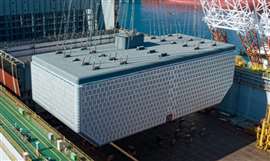 Photo of a high-manganese steel fuel tank applied to a Hanwha Ocean LNG-powered vessel. (Image: Hanwha Ocean)
South Korea’s Hanwha Ocean and POSCO have signed a memorandum of understanding (MOU) to develop a demonstration LNG carrier equipped with high-manganese steel cargo tanks, marking a step toward commercializing the material for large-scale LNG transportation.
The agreement calls for the companies to construct a vessel that will evaluate the safety, durability and operating efficiency of high-manganese steel cargo containment systems under actual operating conditions.
Hanwha Ocean will lead vessel construction, while POSCO subsidiaries POSCO International and POSCO Flow will support the project through their LNG trading, terminal operations and logistics capabilities.
The companies intend to establish an operational track record that could support wider commercial adoption of high-manganese steel cargo tanks by international shipowners.
Alternative to nickel-alloy steel
Developed by POSCO, high-manganese steel is designed to maintain strength and impact toughness at cryogenic temperatures below minus 163 degrees Celsius, making it suitable for LNG storage and transportation.
POSCO said the material offers potential cost and supply-chain advantages over conventional nickel-alloy steels, including Invar, which are used in LNG cargo containment systems. Manganese is more abundant than nickel, potentially reducing material costs and improving supply stability.
The project represents an expansion of high-manganese steel applications from LNG fuel tanks, which store fuel for vessels’ propulsion systems, to the much larger cargo tanks used to transport LNG commercially.
According to POSCO, an LNG-fueled vessel typically requires approximately 1,000 metric tons of material for its fuel tanks, while the cargo containment system of a large LNG carrier can require more than 10,000 metric tons.
POSCO said its proposed cargo containment system could accommodate different boil-off rate requirements, from ultra-low boil-off designs to more economical configurations.
The company also cited the material’s structural rigidity as an advantage in managing sloshing, the movement of liquid cargo that can impose significant loads on tank structures.
An independent tank configuration, in which cargo tanks are manufactured separately and installed aboard the vessel, could also shorten construction schedules compared with conventional systems, according to POSCO.
Building on existing applications
The agreement builds on more than a decade of joint research and development between the companies.
High-manganese steel has already been incorporated into LNG storage tanks at POSCO’s Gwangyang LNG terminal and into marine fuel tanks, including those installed aboard Hanwha Ocean-built vessels.
POSCO said the material has been used on 51 vessels to date, including applications in LNG fuel tanks.
However, applying the material to the much larger cargo tanks of LNG carriers requires additional validation under commercial operating conditions. The demonstration vessel is intended to provide that experience and establish the performance record needed to support wider adoption.
The companies also see potential applications beyond conventional LNG carriers, including LNG bunkering vessels and floating storage and regasification units (FSRUs).
Longer-term opportunities could include cryogenic cargo containment systems for hydrogen, ethane and ammonia transportation.
The agreement establishes a framework for developing and validating the demonstration vessel but does not constitute a confirmed commercial shipbuilding order. The companies did not disclose a construction schedule, vessel capacity or anticipated delivery date.

CONNECT WITH THE TEAM