Read this article in 中文 Français Deutsch Italiano Português Español
GTT leads consortium to design next-gen 200,000 m³ LNG carrier

July 09, 2025
Innovative design targets efficiency, decarbonization—and reinforces GTT’s market dominance
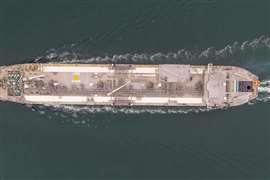
 GTT announced the signing of a Joint Development Project with seven major players in the maritime industry to design a next-generation LNG carrier. (Image: GTT)
GTT — the French engineering powerhouse and global leader in membrane containment systems for liquefied gases — has spearheaded a significant Joint Development Project alongside seven major maritime stakeholders to design a next-generation LNG carrier boasting a 200,000 m³ capacity. GTT, which dominates around 80 % of the world’s LNG storage tank market with its patented membrane technologies such as Mark III and NO96, will contribute its cryogenic containment and cargo-handling expertise to the vessel’s innovative design.
Sector-leading credentials underpin ambition
Robust order pipeline: GTT recorded 72 orders for LNG carriers in 2024—alongside 12 ethane carriers, two FSRUs, and one FLNG unit—and has continued momentum into 2025.
Financial growth: Revenue surged by 50 % in 2024 to €641 million, with EBITDA up 65 % to €388 million. The company now boasts a €2 billion order book, with 2025 revenue expected to reach between €750–800 million.
Innovation pipeline: GTT continues to file patents—62 in 2024—and has debuted its NEXT1 containment technology, received approvals for liquid hydrogen systems, and enhanced “LNG as fuel” applications including Recycool reliquefaction.
A collaborative design with sustainability at its core
The JDP brings together charterer Sinochem Oil Shipping (Singapore), shipowners COSCO Shipping LNG Investment and Shandong Marine Energy, shipyard COSCO Shipping Heavy Industry, and ship-designer MARIC. Classification societies DNV China and CCS will independently review the plan, aiming for an Approval in Principle by year-end to verify compliance with international safety, environmental, and operational standards.
Key innovations include:
- Three identical large-capacity tanks—streamlined versus the conventional four-tank layout.
- “Slow steaming” optimization, reducing fuel use and CO₂ output per cargo unit.
- Operational expenditure efficiencies built without increasing capital costs.
- A response to industry pressures
This vessel design directly addresses escalating decarbonization mandates in global shipping while aligning with tighter economic constraints. By refining tank architecture and embracing lower-speed operation, this project offers a sustainable and cost-effective response to evolving industry pressures.
As the backbone of this initiative, GTT is reinforcing its position as a beyond-tank specialist—integrating advanced engineering, digital enhancements, and decarbonization solutions. The company’s diversification into digital services (Ascenz Marorka, VPS) and hydrogen technologies (via Elogen) complements its core capabilities and underscores its strategic shift toward comprehensive maritime energy solutions.
An Approval in Principle from leading classification societies will signal the vessel’s readiness for future-proof shipping markets.

CONNECT WITH THE TEAM