Read this article in 中文 Français Deutsch Italiano Português Español
U.S. natural gas production hits record in July

October 02, 2026
Permian growth and expanding takeaway capacity pushed gross withdrawals
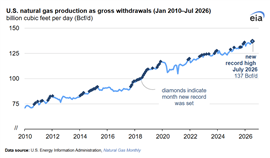
U.S. natural gas production reached a record high in July, driven primarily by increased output from the Permian Basin and continued expansion of pipeline takeaway capacity.
Gross withdrawals — the total volume of natural gas produced at the wellhead — averaged 137 Bcf/d in July 2026, the highest monthly level on record. It marked the first new monthly record of 2026 following five record-setting months during 2025, according to the U.S. Energy Information Administration (EIA)
The increase was led by Texas and New Mexico, where new wells continued to come online across the Permian Basin. Combined gross withdrawals in the two states rose by 1.7 Bcf/d, or 3.2%, from June to July. Production also increased by more than 0.1 Bcf/d in Louisiana, Oklahoma and North Dakota.
The Permian remains one of the largest sources of U.S. natural gas growth, even though much of the region’s development is driven by crude oil production.
Rising gas-to-oil ratios in the basin are contributing additional associated gas volumes as wells mature. Production growth during 2025 was also supported by higher natural gas prices, improving well productivity and increased operating efficiency.
The July increase comes as new pipeline infrastructure begins easing transportation constraints that have periodically limited Permian gas takeaway and pressured regional prices.
The Hugh Brinson Pipeline began interstate flows ahead of schedule during the summer, adding another route for gas moving out of West Texas. Additional pipeline capacity is expected to improve access from the Permian to Gulf Coast markets, including LNG export terminals, the EIA said.
For the compression industry, continued production growth and additional takeaway capacity can translate into demand for gathering, processing and transmission compression as larger gas volumes move from producing areas toward downstream markets.
July also established records for both marketed natural gas production and dry gas production.
Marketed production excludes gas used for repressuring, vented and flared gas and nonhydrocarbon gases removed from the well stream. Dry production further excludes natural gas plant liquids, leaving consumer-grade natural gas available for pipeline transportation and end use.



CONNECT WITH THE TEAM