Read this article in 中文 Français Deutsch Italiano Português Español
Rising gas-oil ratios drive Permian natural gas production growth

June 18, 2026
EIA says associated gas output is expanding faster than oil production as basin matures
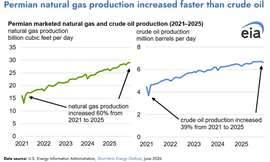
Natural gas production in the Permian Basin is growing significantly faster than crude oil output as rising gas-oil ratios (GOR) increase the volume of associated gas produced from the region’s wells, according to new analysis from the U.S. Energy Information Administration (EIA).
The EIA reported that marketed natural gas production in the Permian increased from 17.2 Bcf/d in 2021 to 27.6 Bcf/d in 2025, a 60% increase. During the same period, crude oil production rose from 4.7 million b/d to 6.6 million b/d, an increase of 39%.
The widening gap between oil and gas production growth reflects changing reservoir conditions across the basin. As oil and gas are produced, reservoir pressure declines, allowing natural gas to flow more readily and increasing the amount of gas produced with each barrel of oil.
According to the EIA, the Permian’s average gas-oil ratio increased from 3,628 cubic feet per barrel in 2021 to nearly 4,200 cubic feet per barrel in 2025, a 16% increase.
The agency expects the trend to continue as the basin matures, resulting in natural gas production growth rates that outpace crude oil growth.
The increase in GOR is already having a measurable impact on supply volumes. The EIA estimates that if the Permian’s GOR had remained at its 2021 level, natural gas production in 2025 would have been approximately 23.8 Bcf/d rather than the actual 27.6 Bcf/d reported. The difference—roughly 3.8 Bcf/d—represents additional associated gas production generated by the higher gas-oil ratio.
The continued growth in associated gas production has significant implications for midstream infrastructure development. Pipeline operators, gas processors and compression providers have invested heavily in recent years to keep pace with rising gas volumes from the basin, even as oil production remains the primary economic driver for many producers.
The Permian remains the largest source of associated natural gas production in the United States and has become a critical supply basin for Gulf Coast LNG export facilities, industrial consumers and power generation markets.
As gas production continues to rise, the basin will require additional gathering, processing, compression and transportation capacity to move increasing volumes of associated gas to downstream markets.
The EIA’s analysis suggests that future growth in Permian gas production may be driven not only by additional drilling activity but also by changing reservoir characteristics that increase gas output from existing oil-producing areas.

CONNECT WITH THE TEAM