Read this article in 中文 Français Deutsch Italiano Português Español
U.S. pipeline additions in 2025 target Gulf Coast LNG demand

February 25, 2026
EIA data shows 6.3 Bcf/d of new capacity, with intrastate projects dominating buildout
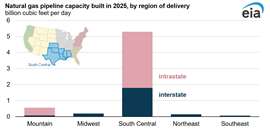
Natural gas pipeline projects completed in the United States in 2025 added approximately 6.3 billion cubic feet per day (Bcf/d) of capacity, with the majority aimed at serving growing demand along the Gulf Coast, according to the U.S. Energy Information Administration (EIA).
The EIA reported that about 85% of the new capacity—roughly 5.3 Bcf/d—was directed to the South Central region, which includes key LNG export hubs and industrial demand centers. The buildout reflects continued infrastructure alignment with rising liquefied natural gas (LNG) export activity and associated feedgas requirements.
A notable trend in 2025 was the continued dominance of intrastate pipeline development. Approximately 65% of the total capacity additions came from intrastate projects, which operate within state boundaries and are not regulated by the Federal Energy Regulatory Commission (FERC). This marks a continuation of recent years in which intrastate systems have outpaced interstate pipeline expansions.
Much of the new intrastate capacity functions as gathering infrastructure, connecting upstream production to larger transmission networks. Two major projects—the Louisiana Energy Gateway and the New Generation Gas Gathering system—together added 3.5 Bcf/d of capacity to move natural gas from the Haynesville formation to the Gillis Hub in southeastern Louisiana. The Louisiana Energy Gateway contributed 1.8 Bcf/d, while the New Generation system added 1.7 Bcf/d. Both projects entered service in October 2025.
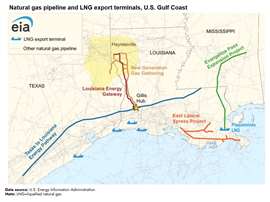
Downstream, pipeline expansions tied directly to LNG export facilities accounted for a significant portion of new capacity. Three projects added a combined 1.8 Bcf/d to serve Gulf Coast demand centers. The Evangeline Pass Expansion delivered 1.1 Bcf/d, and the East Lateral Xpress project added 0.3 Bcf/d—both supplying feedgas to Plaquemines LNG, which began exporting cargoes in 2025. The Texas to Louisiana Pathway project contributed an additional 0.4 Bcf/d of interstate capacity, linking supply from Texas to eastern Louisiana markets.
The EIA data underscores how pipeline development is increasingly concentrated around LNG corridors, with infrastructure designed to connect prolific shale basins such as the Haynesville to export terminals and coastal demand hubs.

CONNECT WITH THE TEAM