Read this article in 中文 Français Deutsch Italiano Português Español
EIA: Nearly 45 Bcf/d of new U.S. natural gas pipeline capacity planned through 2027

June 01, 2026
Texas projects dominate expansion as industry adds takeaway and LNG feedgas infrastructure
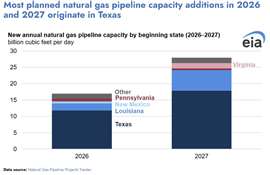
Developers plan to bring approximately 44.9 billion cubic feet per day (Bcf/d) of new natural gas pipeline capacity online in the United States during 2026 and 2027, with most of the additions concentrated in Texas and tied to growing LNG exports and Permian Basin production, according to the U.S. Energy Information Administration (EIA).
In its latest Natural Gas Pipeline Projects Tracker, EIA reported that roughly 70%, or 31.6 Bcf/d, of the planned capacity is already under construction. Texas accounts for more than two-thirds of the planned additions, with 29.7 Bcf/d of new capacity expected to originate in the state. Louisiana ranks second, representing 8.4 Bcf/d, or 19%, of the total planned expansion.
The buildout reflects continued investment in infrastructure needed to move growing volumes of natural gas from producing regions to LNG export facilities, industrial users, power generators and residential markets.
According to EIA, the Texas projects are designed primarily to increase takeaway capacity from the Permian Basin and alleviate constraints at the Waha Hub, a key pricing and trading point in West Texas that has experienced periodic bottlenecks as production growth has outpaced available transportation capacity.
Among the largest projects currently under construction is the Rio Bravo Pipeline Project, a 138-mile pipeline with capacity of up to 4.5 Bcf/d. The pipeline will transport feedgas to the under-construction Rio Grande LNG export facility in South Texas. Developer NextDecade is targeting startup during the second half of 2026.
Another major project is the Blackcomb Pipeline, a 365-mile system capable of transporting 2.5 Bcf/d from the Permian Basin. Scheduled to enter service in the third quarter of 2026, the pipeline will move gas from the Waha Hub to the Agua Dulce Hub near the Texas Gulf Coast, helping relieve congestion in West Texas while supplying growing Gulf Coast demand.
The Hugh Brinson Pipeline project is expected to add a combined 2.2 Bcf/d of takeaway capacity from the Permian Basin. The first phase is slated to begin operations in the fourth quarter of 2026, with the second phase scheduled for startup during the first quarter of 2027.
LNG-driven demand also is fueling pipeline development in Louisiana, where the Port Arthur Pipeline Louisiana Connector is expected to enter service during the second half of 2026 with 2.0 Bcf/d of capacity. The state will see additional growth when the Pelican Pipeline comes online by the end of 2027, bringing Louisiana’s total planned capacity additions to 8.4 Bcf/d.
Outside the Gulf Coast region, Virginia is expected to see the third-largest increase in natural gas transportation capacity. EIA said 1.6 Bcf/d of additional capacity is expected to enter service in 2027 through Williams’ Southeast Supply Enhancement Project.
The project is an expansion of Williams’ Transcontinental Gas Pipe Line system, commonly known as Transco, and will increase capacity along the corridor stretching from Virginia to Alabama. The expansion is intended to enhance supply reliability and support growing demand across the southeastern United States.
The planned pipeline additions come as U.S. natural gas production remains near record levels and LNG export capacity continues to expand. Several new export terminals are expected to begin operations over the next few years, increasing demand for feedgas and reinforcing the need for additional pipeline infrastructure linking producing basins to Gulf Coast markets.
According to EIA, the concentration of projects in Texas and Louisiana underscores the growing importance of the Gulf Coast as the center of North America’s natural gas export and industrial demand growth, while continued investments in takeaway infrastructure are expected to support further development of the Permian Basin, the nation’s largest natural gas-producing region.
CONNECT WITH THE TEAM