Read this article in 中文 Français Deutsch Italiano Português Español
EIA: U.S. natural gas exports to surge through 2027 on LNG growth

April 16, 2026
New liquefaction capacity and rising pipeline flows to Mexico drive double-digit gains
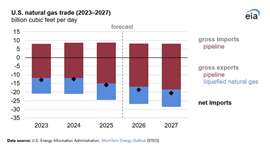
U.S. natural gas exports are set to expand sharply through 2027, led by new liquefied natural gas (LNG) capacity and steady growth in pipeline shipments, according to the latest Short-Term Energy Outlook from the U.S. Energy Information Administration.
The EIA forecasts that net U.S. natural gas exports will rise 18 percent to 18.7 Bcf/d in 2026, followed by another 10 percent increase to 20.5 Bcf/d in 2027. The gains are expected to be driven primarily by LNG export growth as several major projects enter service and ramp up production.
LNG exports alone are projected to increase by 1.9 Bcf/d in 2026 to average 17.0 Bcf/d, with a further 9 percent (1.5 Bcf/d) increase in 2027. Pipeline exports are also expected to grow, rising 4 percent (0.4 Bcf/d) in 2026 and an additional 2 percent (0.2 Bcf/d) the following year.
Capacity additions underpin outlook
The export growth outlook reflects a wave of new U.S. liquefaction capacity. Current peak LNG export capacity stands at 18.3 Bcf/d, with multiple projects scheduled to come online over the next two years.
Among the key developments, Corpus Christi Stage 3 is expected to bring trains 5–7 online in 2026, adding about 0.6 Bcf/d of capacity, while Golden Pass LNG is set to start its first two trains, contributing another 1.4 Bcf/d. In 2027, additional volumes are expected from Port Arthur LNG Phase 1 (1.6 Bcf/d), Rio Grande LNG Trains 1 and 2 (1.4 Bcf/d), and the final Golden Pass train (0.7 Bcf/d).
The EIA also noted incremental capacity increases at existing facilities, including approvals for Plaquemines LNG and Elba Island LNG to expand permitted exports by a combined 0.6 Bcf/d.
Global disruptions shift demand
The outlook also reflects shifting global dynamics. The EIA expects U.S. LNG terminals to operate at slightly higher utilization rates in 2026, supported by increased demand from buyers seeking supply outside the Strait of Hormuz.
Disruptions to LNG flows through the strait—largely tied to Qatar—have affected more than 10 Bcf/d of global supply, or roughly 20 percent of the market. Damage sustained during a March 18 attack on the Ras Laffan export complex has further constrained output, with repairs to affected liquefaction trains expected to take years.
These factors are expected to reinforce demand for U.S. LNG cargoes, particularly in Europe.
In 2025, U.S. LNG exports to Europe reached a record 10.3 Bcf/d, accounting for 68 percent of total export volumes, according to EIA data. Italy and Poland posted the largest increases, while exports to Asia declined to 2.5 Bcf/d, or 16 percent of volumes.
Shipments to China dropped to zero in 2025 from 0.6 Bcf/d in 2024 amid ongoing trade tensions, with cargoes redirected to other markets. Exports to Egypt rose sharply, quadrupling to 1.2 Bcf/d and driving much of the growth in shipments to other regions.
Pipeline exports to Mexico continue to rise
Pipeline exports are expected to remain a steady contributor to overall growth, reaching 9.8 Bcf/d in 2026 and 10.0 Bcf/d in 2027. The increase is largely tied to rising Mexican demand for natural gas in power generation and LNG exports.
Two new LNG export projects in Mexico—Energía Costa Azul LNG and the Fast LNG Altamira FLNG2 facility—are expected to come online over the next two years with a combined capacity of about 0.6 Bcf/d, supported by U.S. pipeline gas.
Meanwhile, U.S. pipeline imports from Canada are projected to decline to 8.0 Bcf/d by 2027 as new Canadian LNG export capacity comes online and Appalachian production increasingly meets demand in the U.S. Northeast.

CONNECT WITH THE TEAM