Read this article in 中文 Français Deutsch Italiano Português Español
Archrock sees long-term compression growth as LNG, AI power demand reshape natural gas market

May 09, 2026
CEO says tightening equipment supply chain reflects a market “coiled for growth”
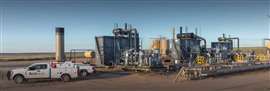 Archrock expects strong long-term demand for natural gas compression as LNG export growth, rising associated gas production and power demand tied to AI data centers continue driving infrastructure expansion across the U.S. (Image: Archrock)
Archrock expects strong long-term demand for natural gas compression as LNG export growth, rising associated gas production and power demand tied to AI data centers continue driving infrastructure expansion across the U.S.
During the company’s first-quarter earnings call, President and CEO Brad Childers said the compression market remains exceptionally tight, with equipment lead times continuing to stretch as operators prepare for additional natural gas production and transportation growth.
“Cat lead times continue to extend out,” Childers said. “We’re seeing an extreme tightness in the supply chain.”
Childers said lead times for some equipment are approaching 160 weeks, which he described as evidence of a market preparing for sustained expansion.
“This is a market that’s just poised right now for that accelerated growth for the future and candidly for years,” he said.
 Brad Childers
Archrock, one of the largest U.S. contract compression providers, said its fleet remained highly utilized during the quarter, exiting the period at 95% utilization. The company said demand remains strongest in large-horsepower and electric motor-drive units used primarily in midstream applications.
The company pointed to several long-term natural gas demand drivers supporting its outlook, including LNG exports, pipeline expansions and rising electricity consumption tied to AI-driven data center development.
Childers said about 2 Bcf/d of additional LNG export capacity is expected online in 2026, while previously sanctioned projects represent another 14 Bcf/d of incremental export capacity through 2030.
At the same time, Archrock expects associated gas production in the Permian Basin to continue rising at mid-single-digit rates, supported by higher gas-to-oil ratios and roughly 4.6 Bcf/d of new takeaway capacity expected later this year.
The company also cited the U.S. Energy Information Administration’s Annual Energy Outlook 2026, which increased its long-term forecasts for U.S. gas production and demand due in part to LNG growth and power demand from AI infrastructure. Archrock highlighted EIA projections showing U.S. gas production potentially rising from 107 Bcf/d in 2025 to between 133 Bcf/d and 151 Bcf/d by 2050.
Beyond the Permian, Childers said Archrock is seeing improving compression demand in the Northeast, Midcontinent, Rockies, East Texas and Haynesville regions. About 35% of the company’s bookings during the quarter came from the Permian, with the balance spread across other gas-focused basins.
Archrock executives also suggested the broader natural gas infrastructure buildout could face supply chain bottlenecks in coming years.
“For the United States to deliver all of the LNG we’re targeting to export and all the power we expect to fuel through natural gas, we have a lot of power plants, pipelines, gas plants and compression to build,” Childers said. “It is not all going to happen without some bottlenecks and delays along that entire supply chain.”
The company said it plans to continue investing aggressively in new compression equipment while maintaining financial flexibility for potential acquisitions and shareholder returns.
Archrock reaffirmed its 2026 adjusted EBITDA guidance range of $865 million to $915 million and maintained its fleet growth capital spending outlook of $250 million to $275 million.
Executives also said the company expects continued industry consolidation opportunities as operators seek to secure equipment availability in an increasingly constrained market.


CONNECT WITH THE TEAM