Read this article in 中文 Français Deutsch Italiano Português Español
Report: LNG enters next growth phase

July 13, 2026
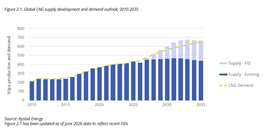
The global liquefied natural gas (LNG) industry entered 2026 from a position of exceptional strength. Trade reached a record high, investment in new export capacity accelerated, and developers sanctioned the largest wave of liquefaction projects in six years. Yet just months later, conflict in the Middle East reminded the industry that energy security remains as important as market fundamentals.
According to the International Gas Union (IGU) 2026 World LNG Report, global LNG trade reached a record 436.98 million tonnes (Mt) in 2025, up 6.3% from the previous year. Liquefaction capacity expanded by 30.1 million tonnes per annum (Mtpa), while developers approved 68.4 Mtpa of new liquefaction projects, the second-highest annual total ever recorded.
For companies serving the natural gas compression industry, the report tells a broader story than LNG volumes alone. Every new liquefaction train, pipeline expansion, floating LNG (FLNG) facility, regasification terminal and LNG carrier represents demand for compressors, gas turbines, electric motors, seals, valves, controls and long-term aftermarket services.
While geopolitical instability has disrupted short-term markets, the report concludes that LNG’s long-term growth trajectory remains intact, with global liquefaction capacity projected to exceed 700 Mt by 2030 under projects already operating or under construction.
U.S. cements its position as LNG powerhouse
Perhaps the most significant development for the compression industry is the continued rise of the United States.
The U.S. exported 110.74 Mt of LNG during 2025, maintaining its position as the world’s largest LNG exporter. American facilities accounted for 22.3 Mt of the year’s 25.7 Mt increase in global LNG exports, far outpacing every other producing nation.
That growth reflects the startup and ramp-up of major Gulf Coast projects, including:
- Plaquemines LNG
- Corpus Christi Stage 3
- Golden Pass LNG (first LNG in early 2026)
- Additional brownfield expansions
The report also notes that North America now represents the largest pipeline of future LNG development, with 650 Mtpa of proposed pre-final investment decision capacity, including 384 Mtpa in the United States. Although only a portion of those projects will ultimately proceed, the scale illustrates how central North America has become to global LNG supply.
While trade volumes established a new record, perhaps the more important statistic for equipment suppliers was the resurgence in project approvals.
Developers sanctioned 68.4 Mtpa of liquefaction capacity during 2025, the strongest year since 2019. Over the 2021-2025 period, approximately 206 Mtpa received final investment decisions—roughly double the volume sanctioned during the previous five-year period.
Among the year’s largest approvals were:
- Woodside Louisiana LNG
- Calcasieu Pass 2 LNG
- Port Arthur LNG Phase 2
- Rio Grande LNG Phase 2
- Corpus Christi Midscale Trains 8-9
Outside North America, Coral North FLNG in Mozambique and Southern Energy FLNG in Argentina also moved forward, highlighting continued investment in offshore liquefaction.
Because most LNG facilities operate for several decades, they also create long-term aftermarket opportunities involving overhauls, spare parts, upgrades and digital monitoring.
Floating LNG continues to mature
One of the report’s more significant observations is the continued maturation of floating LNG technology.
Operational FLNG capacity reached 16.6 Mtpa by the end of 2025 across eight facilities, with Tortue/Ahmeyim FLNG entering service and Coral North FLNG reaching final investment decision. Overall, approximately 172 Mtpa of proposed liquefaction capacity is now linked to floating developments.
For compressor manufacturers, floating facilities present unique engineering challenges.
Unlike onshore plants, offshore systems must deliver high reliability within severe weight and space constraints while operating in corrosive marine environments. Equipment must also withstand vessel motion and minimize maintenance requirements because offshore interventions are considerably more expensive than land-based repairs.
Those requirements have driven continued development of compact centrifugal compressors, screw compressors, dry gas seals, integrated control systems and predictive maintenance technologies.
Trade patterns shifted significantly during 2025.
Although Asia remained the world’s largest LNG-importing region overall, Europe emerged once again as the market’s balancing destination.
European LNG imports increased by 26.1 Mt as countries replenished storage and replaced declining Russian pipeline supplies. Meanwhile, imports into China declined by nearly 9 Mt, reflecting increased domestic production and pipeline imports.
The changing trade flows reinforced Europe’s importance as a destination for flexible Atlantic Basin cargoes.
For midstream infrastructure providers, Europe’s continued investment in LNG receiving terminals, storage facilities and regasification plants supports sustained demand for compressors used in boil-off gas handling, vapor recovery and terminal operations.
Regasification expands worldwide
Receiving infrastructure continued expanding almost as rapidly as export capacity.
Global regasification capacity reached 1,113.5 Mtpa during 2025 after the commissioning of 20 projects across 13 markets. Thirteen were entirely new receiving terminals while seven represented expansions of existing facilities.
China remained the largest growth market, while Europe, Africa and the Middle East also added significant capacity.
Floating Storage and Regasification Units (FSRUs) continued gaining market share because of their relatively low capital cost and shorter deployment schedules.
Operational floating regasification capacity reached 216.1 Mtpa across 55 projects, representing nearly one-fifth of global regasification capability.
Many emerging economies are choosing FSRUs as their first LNG import solution, creating additional opportunities for compressor suppliers serving marine and offshore markets.
Technology shifts reshape LNG facilities
The report highlights several technology trends with direct implications for compressor manufacturers.
One is the increasing adoption of electric-drive liquefaction.
Developers are incorporating electrically driven compression systems where reliable low-carbon electricity is available. Electric drives eliminate combustion emissions associated with gas turbines while reducing methane losses and feed gas consumption. Projects in Canada and parts of the United States increasingly favor this approach.
At the same time, carbon capture and storage (CCS) continues moving from demonstration toward commercial deployment.
Several LNG developers now plan integrated carbon capture systems that require additional CO₂ compression, dehydration and transportation equipment. Existing facilities such as Hammerfest LNG and Gorgon LNG have demonstrated the approach, while newer projects continue incorporating CCS into their designs.

CONNECT WITH THE TEAM