Woodside to reduce investment in Beaumont ammonia facility following strategic review

October 22, 2026
Production disruptions and slower development of the lower-carbon ammonia market prompt portfolio reassessment, while the Texas facility targets lower-carbon production in 2027
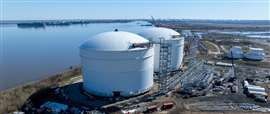 Woodside Energy plans to reduce its investment in the Beaumont New Ammonia (BNA) facility, seen here, in Texas following a strategic review. (Image: Woodside Energy)
Woodside Energy plans to reduce its investment in the Beaumont New Ammonia (BNA) facility in Texas following a strategic review, citing the evolving pace of development in the lower-carbon ammonia market.
The Australian energy company announced the decision in its third-quarter 2026 report, released Oct. 21, saying it will initiate a formal process to reduce its investment in the facility and deliver value for shareholders.
The announcement follows production challenges at Beaumont, including a 30-day shutdown triggered by a Tier 1 process safety event during the third quarter.
Woodside reported that no personnel were injured, no equipment was damaged and there was no lasting environmental impact from the incident. Operations resumed following an internal investigation and implementation of corrective actions.
Production during the quarter was constrained to 69% of the facility’s nameplate capacity because of the shutdown and limited availability of feedstock from third parties.
Beaumont produced approximately 72,400 metric tons of ammonia during the quarter, compared with substantially higher production in the second quarter. Sales totaled 94,200 metric tons, with Woodside securing third-party ammonia cargoes to meet customer commitments on similar financial terms.
For the first nine months of 2026, the facility produced approximately 351,300 metric tons of ammonia.
The company also revised its full-year production guidance to reflect lower expected volumes from Beaumont, reducing the facility’s contribution to 1.5 million to 2.5 million barrels of oil equivalent from the previous estimate of 2 million to 3 million barrels of oil equivalent.
Lower-carbon production targeted for 2027
Despite the decision to reduce its investment, Woodside said the Beaumont facility remains on track to begin lower-carbon ammonia production in 2027.
That transition depends on the commissioning of Linde’s low-carbon hydrogen facilities and the start-up of ExxonMobil’s carbon capture and storage (CCS) infrastructure.
The planned integration of hydrogen production, ammonia manufacturing and CO₂ sequestration is central to the facility’s lower-carbon production strategy.
Woodside reported progress on a key regulatory requirement during the quarter, when the Railroad Commission of Texas voted to approve a permit for ExxonMobil’s Rose carbon storage project.
The approval moved the project into the final stages of a multiyear regulatory process.
The timing of lower-carbon ammonia production remains dependent on the availability of both the hydrogen supply facilities and the carbon storage infrastructure.
Those systems are particularly relevant to the compression industry, given the role of gas compression in hydrogen production, ammonia manufacturing and CO₂ transportation and injection.
Woodside has not disclosed the size of the investment it intends to divest or identified prospective buyers or partners.
Louisiana LNG construction advances
Woodside’s reassessment of the Beaumont investment comes as the company continues executing major LNG developments, including its Louisiana LNG export project.
The Louisiana LNG project was 32% complete at the end of September and remains on budget, with first LNG production targeted for 2029.
Construction is progressing across all three liquefaction trains.
Train 1 was 41% complete at quarter-end, with structural steel and above-ground piping installation advancing. Train 2 was 27% complete, while Train 3 had reached 22% completion.
Woodside reported continued construction of marine facilities, site infrastructure and LNG storage tanks. Concrete construction of the first LNG storage tank wall was 50% complete.
The company said it continues to address structural steel supply challenges associated with disruptions in the Middle East through alternative logistics routes and fabrication sources.
Woodside is also pursuing additional equity participation and LNG offtake arrangements for the development.
Elsewhere, the company’s Scarborough Energy Project in Australia was 99% complete at quarter-end, with first LNG cargo expected during the fourth quarter of 2026. Woodside reported that mechanical runs of the Pluto Train 2 compressors had been completed.
Stronger quarterly revenue
Woodside reported third-quarter operating revenue of US$4.28 billion, an increase of 2% from the previous quarter and 27% from the corresponding period in 2025.
Production increased 12% quarter over quarter to 46.2 million barrels of oil equivalent, supported by improved performance at its Australian LNG operations following planned maintenance.
Woodside CEO Liz Westcott said the company continued to advance its major developments while reviewing its investment portfolio.
“Following completion of the Beaumont New Ammonia strategic review, we will now initiate a formal process to reduce our investment and achieve value for our shareholders,” Westcott said.
She added that the company remains focused on investments capable of delivering long-term shareholder value.

CONNECT WITH THE TEAM