Read this article in 中文 Français Deutsch Italiano Português Español
Copeland targets changing RNG market with standardized compressor platform

August 25, 2026
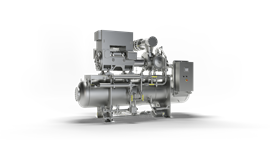 Copeland’s Vilter VSGX single-screw compressor is designed for mid- to large-scale biogas digester applications. (Image: Copeland)
The growing renewable natural gas market is creating a wider range of compression requirements as developers pursue food waste projects, co-digestion and centralized processing models alongside traditional landfill and dairy digester applications.
Copeland is targeting those changing requirements with its new Vilter VSGX compressor, a standardized single-screw platform designed for mid- to large-scale digester projects.
The company said the compressor was developed in response to two persistent challenges in renewable natural gas development: upfront capital costs and equipment lead times.
Caroline Limbaugh, product manager for Copeland’s Vilter brand, said the company focused on packaging and standardization rather than redesigning the core single-screw compressor.
“The design changes really come down to unit packaging changes and product standardization,” Limbaugh said. “The single-screw compressor, which sets the industry standard for reliability, remains the same.”
Copeland said the changes can reduce initial capital costs by double-digit percentages compared with previous configurations while retaining the core compressor technology already used across the company’s renewable gas installations.
Standardization targets cost and lead times
The VSGX incorporates several manufacturing and packaging changes intended to simplify the compressor package.
Those include optimization of the oil circuit, new oil filters and a simplified programmable logic controller and human-machine interface. Copeland also developed a cold-weather design that eliminates the oil cooler heater while allowing the unit to start at temperatures as low as -20 F.
The larger change, however, is the move to a configure-to-order model.
VSGX packages use standardized drawing packages and predefined equipment configurations. That allows individual units to bypass much of the custom engineering process typically associated with industrial compressor packages.
The approach also gives Copeland greater economies of scale on standardized components.
“Standard drawings will allow the customer’s engineering to proceed without having to wait for custom drawings to be completed,” Limbaugh said.
Copeland currently is offering a 30-week lead time for the VSGX and intends to shorten that schedule further.
Equipment delivery has become an increasingly important issue for RNG developers as projects compete for compressors, gas upgrading equipment and other specialized components.
By completing standard drawings in advance, project engineers can move forward with portions of facility design while the compressor package is being manufactured.
Designed around changing biogas conditions
Gas quality presents another challenge for digester operators.
Unlike conventional pipeline natural gas, raw biogas can experience changes in flow and composition based on feedstock, digester conditions and other operating variables. Moisture and contaminants also can create difficulties for compression equipment.
Copeland said more than 700 Vilter compressor units currently are operating in RNG applications, providing the company with an installed base for evaluating compressor performance under varying gas conditions.
The Vilter single-screw design uses slide valve technology to adjust compressor capacity as flow changes. The compressor can turn down to 20% of maximum flow without requiring a variable frequency drive, according to Limbaugh.
That capability can be particularly important at digester projects where gas production fluctuates.
The compressor’s internal design also differs from conventional twin-screw technology. Vilter’s single-screw rotor does not have metal-to-metal contact between the primary compression components — the rotor and gate rotor.
Limbaugh said the configuration provides greater resilience when contaminants enter the gas stream.
The compressor uses Ryton-to-metal contact at the rotor interface and is designed with balanced forces. Copeland said the arrangement reduces loads on the bearings and contributes to longer bearing life and lower overhaul frequency.
Compression technology choices
RNG developers generally evaluate single-screw, twin-screw and reciprocating compressor technologies, depending on flow, pressure and project requirements.
Limbaugh said reciprocating compressors have a relatively large number of moving and wearing components, which can increase parts replacement requirements and the risk of unplanned downtime. Oil consumption and gas pulsation also can require additional consideration in RNG applications.
Twin-screw compressors are closer to single-screw technology in terms of application, but the designs have important mechanical differences.
According to Limbaugh, twin-screw compressors experience both axial and radial forces and use male and female rotors with metal-to-metal contact. Those characteristics can affect bearing life and overhaul frequency.
Twin-screw systems also may require a VFD to achieve the level of turndown needed for variable biogas flows.
By comparison, Copeland’s single-screw design uses balanced forces and can reduce capacity to 20% of maximum flow through its slide valve.
The design also provides access to key compressor components for inspection and is intended to operate with relatively low oil consumption.
Targeting a broad range of digesters
The VSGX has a compressor flow range of 800 to 2,100 scfm.
That corresponds to raw biogas flows of approximately 550 to 1,600 scfm, allowing the compressor to serve dairy, municipal wastewater and food waste digester applications, Limbaugh said.
The selected compressor sizes also allow VSGX packages to operate at 480 V.
Remaining at low voltage is desirable for many digester operators because it can simplify electrical infrastructure compared with equipment requiring medium-voltage systems.
Copeland sees the market for those compressor sizes expanding as RNG project development evolves.
“We’re seeing a trend toward smaller landfills, as well as the emergence of more co-digestion or food waste projects, which tend to be on the medium to large side of digesters,” Limbaugh said.
Developers also are evaluating new project structures intended to improve the economics of smaller gas sources.
One example is the hub-and-spoke digester model. Under that approach, gas or feedstock from multiple sites can be consolidated at a centralized processing facility.
The central facility handles higher gas volumes than an individual digester and can create compression requirements better suited to larger industrial equipment.
“We also see more ways to make projects feasible, such as hub-and-spoke digester models, where multiple digesters are combined into a centralized processing facility, which has a higher flow rate,” Limbaugh said.
Those trends helped shape the flow range selected for the VSGX.
Installed base supports service expansion
Copeland has installed Vilter equipment at more than 110 landfill-to-RNG projects and more than 45 digester-to-RNG projects.
The company said its experience in industrial refrigeration and process gas compression is also being applied to the renewable gas market.
Service capabilities can be particularly important for RNG facilities, which often are located in rural or remote areas and may not have extensive maintenance resources on site.
“We pride ourselves in customer service and subject matter expertise, so we have grown and will continue to grow our service and support capabilities,” Limbaugh said.
The company’s installed base has also provided experience with operating issues specific to renewable gas applications.
More than 43,000 organic waste sites could be developed across North America by 2050, according to RNG Coalition data cited by Copeland. The company said Vilter compression technology currently supports landfill and digester operations that process enough organic waste to avoid more than 20 million metric tons of carbon dioxide emissions annually.
As the RNG market expands beyond its early projects, compressor requirements are becoming increasingly shaped by project economics, variable gas flows and the need to standardize equipment.
For Copeland, the VSGX represents an effort to apply an established single-screw compressor design to a more standardized package — reducing engineering requirements and lead times while addressing the broader range of gas volumes emerging in the digester market.


CONNECT WITH THE TEAM