Read this article in 中文 Français Deutsch Italiano Português Español
The evolving role of diaphragm compressors
August 03, 2026
Several trends are driving broader adoption of diaphragm compressors
By: Patrick McCalley (Neuman & Esser USA Inc.) & Luiz Soriano
The diaphragm compressor is a unique type of reciprocating compressor that utilizes a diaphragm and head assembly instead of a piston and cylinder assembly. In this design, a hydraulically actuated diaphragm compresses the process gas, eliminating direct contact between the gas and moving mechanical components.
This configuration provides hermetically sealed, oil-free compression, making diaphragm compressors well suited for applications where gas cleanliness, containment, and high-pressure performance are critical. Typical uses include specialty gas production, chemical and petrochemical processing, semiconductor manufacturing, and high-pressure hydrogen service.
Technology Background
The industrial diaphragm compressor traces its origin to Henri Corblin’s 1920 patent, which established the principle of separating the gas from the mechanical drive using a flexible metallic membrane instead of a cylinder-piston assembly. This novel technology found a growing market in industrial gas, chemical, and petrochemical services.
Over the following decades, manufacturers in Europe and North America developed their own versions of the technology, introducing improvements in materials of construction, machining precision, hydraulic control systems, and cooling design. Recent advancements in drive systems, control strategies, and multi-head configurations have further expanded the flexibility and application range of diaphragm compressors. These developments have enabled larger machine configurations, with modern frames able to reach and exceed 300 hp and broadened the operating envelope to support reliable, continuous-duty performance in critical applications.
How Diaphragm Compressors Work
A diaphragm compressor operates as a reciprocating positive displacement machine in which hydraulic pressure drives gas compression indirectly. A piston pressurizes oil in the hydraulic cylinder through a perforated plate, thus creating a pressure differential that pushes the diaphragm toward the gas space. As the diaphragm moves forward, the gas pressure increases until the discharge valve opens, with hydraulic pressure reaching a peak near the end of the discharge stroke. During the suction stroke, hydraulic pressure is reduced from its peak and the diaphragm returns toward the hydraulic side, reducing the head internal pressure and allowing the suction valve to open and draw in fresh gas. This indirect hydraulic actuation compresses the gas without exposing it to moving mechanical components.
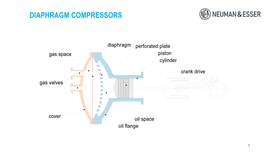 Fig. 1
Figure 1 shows a cross section of a diaphragm head assembly illustrating its main components.
One of the main features of diaphragm compressor technology is its fully sealed compression path. Metallic diaphragms separate the gas from the hydraulic oil, and all gas side sealing is performed by static elements rather than sliding components. Because the diaphragm flexes elastically instead of riding on wear surfaces, the gas remains isolated from lubrication and particulate sources. This design makes diaphragm compressors well suited for applications where gas purity and complete containment are essential.
Typically, diaphragm compressors use a triple diaphragm arrangement, with a small, monitored space between the diaphragms to indicate when one has ruptured on either the gas or oil side. A pressure rise in this space between the diaphragms provides rapid rupture detection, allowing the compressor to shut down before any loss of containment or contamination of the gas stream occurs.
Hydraulic stability is essential for reliable operation. A compensating pump maintains proper oil volume in the hydraulic chamber by replacing the small amount of oil that leaks past the hydraulic piston back to the crankcase, while an overflow valve regulates hydraulic pressure, returning a small flow of excess oil to the crankcase. The overflow valve controls hydraulic pressure such that it peaks above the gas discharge pressure at the end of the discharge stroke, ensuring complete gas displacement from the diaphragm head prior to reversal. Together, these elements keep diaphragm deflection consistent and help prevent overstress under varying operating conditions. Continuous monitoring of hydraulic conditions can provide early indication of abnormal operation.
Diaphragm compressors can operate at higher discharge temperatures than many piston compressors because no PTFE-based rings or packings are exposed to the gas. The diaphragm head and hydraulic oil distribute heat effectively, limiting metal temperature rise and reducing the potential for hot spots. These thermal advantages support higher practical per stage compression ratios, commonly up to 7:1 and, in some cases, as high as 10:1, depending on the gas, head design, and cooling effectiveness. These resulting pressure ratios allow a reduced number of stages compared to an equivalent piston compressor, simplifying system design and reducing overall equipment requirements.
Within the broader positive displacement compression landscape, diaphragm compressors fill a specific niche due to their inherent flow limitations, which are driven by diaphragm surface area, stroke constraints, and deflection limits. Piston compressors remain the workhorses for mid or high flow applications, and screw compressors are typically deployed in moderate pressure and high flow applications. Diaphragm compressors excel in low-flow, high-pressure applications where gas purity, and containment requirements are critical.
Where They Are Used Today
Diaphragm compressors are used across industries where gas cleanliness and containment are essential. In semiconductor gas production, they compress high-purity hydrogen, nitrogen, helium, fluorinated compounds, and other reactive mixtures without introducing oil, moisture, or particulates. High surface finishes and stable thermal behavior help maintain mixture integrity and minimize the risk of decomposition or unwanted reactions.
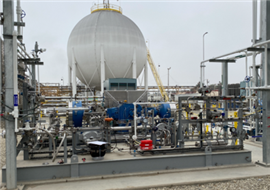 Fig. 2
Figure 2. Typical diaphragm compressor installation showing skid-mounted system and associated process equipment.
Specialty, calibration, and laser gas manufacturers rely on diaphragm compressors to preserve composition and prevent loss of high-value components. They are also applied in research, aerospace, and analytical systems requiring clean, high-pressure gas streams, and in containment-critical applications involving toxic, corrosive, or radioactive gases.
In petrochemical service, diaphragm compressors handle high-purity hydrogen and carbon monoxide for hydrogenation units, pilot processes, and small recycle circuits, avoiding the need for auxiliary sealing systems. They are also well suited for sour gas service with appropriate material selection.
High-pressure hydrogen bottle filling and tube trailer loading remain among the most common applications for diaphragm compressors across industrial gas infrastructure and hydrogen mobility applications. They are also used for recovery of hydrogen boil‑off streams, as well as high‑value gases such as helium, where loss minimization is critical.
Why Their Relevance Is Growing
Several trends are driving broader adoption of diaphragm compressors. Industrial gas and chemical processes continue to tighten specifications, especially where sensitive catalysts or high value intermediates are involved. With semiconductor features shrinking into the single digit nanometer range, even minute contaminants can disrupt wafer production, reinforcing the need for clean, fully contained compression systems.
Emission control has also become a stronger priority. Diaphragm compressors eliminate packing related vent streams, reducing not only fugitive emissions but also the utilities and treatment systems such as nitrogen purging, flares, and scrubbers required to handle those emissions. For gases such as carbon monoxide, hydrogen, or other tightly regulated streams, even small releases carry operational, economic, or environmental impact, making a sealed compression path advantageous in these facilities.
Modern monitoring capabilities have further increased the appeal of diaphragm compressors in demanding or remote applications. High speed hydraulic pressure monitoring provides real time insight into diaphragm loading and motion, giving operators a clear view of how the machine behaves each cycle. Subtle changes in these hydraulic signatures can indicate developing issues well before a component reaches a failure point, offering a leading indicator for maintenance intervention. This capability is especially valuable in unmanned or lightly staffed installations, including many hydrogen applications, where early detection directly supports safe and reliable operation.
Diaphragm compressors also continue to be used in nuclear related research, radiochemistry, and isotope laboratories, as well as in supporting systems for advanced reactor development where high purity gases such as deuterium must be handled with complete containment. Renewed activity in next generation and small modular reactor programs has increased interest in diaphragm compression systems.
Diaphragm compressors offer practical, maintainable reliability. While diaphragm life varies with operating conditions, replacement is often faster and less complex than changing piston rings and packings. In routine operation, predictable diaphragm behavior and stable hydraulics contribute to long service intervals, provided proper filtration and cooling are maintained.
As new industrial processes emerge, many begin with high integrity gas streams that move from laboratory evaluation to pilot operations and eventually to production. Diaphragm compressors are frequently used across these stages, providing the containment and reliability needed as processes scale and purity requirements remain stringent.
Conclusion
Diaphragm compressors have progressed from early laboratory units to established industrial machines used wherever gas quality and containment are critical. Their mechanical simplicity, indirect compression method, and fully sealed gas path make them well suited to high purity and high-pressure service across a range of industries. As more processes adopt stricter purity specifications and rely on high integrity gas streams, the use of diaphragm compressors is expected to continue growing.



CONNECT WITH THE TEAM