Read this article in 中文 Français Deutsch Italiano Português Español
Baker Hughes compressors support Yara’s 800,000-ton CO₂ capture project

September 08, 2026
Linde Engineering-designed liquefaction facility at Yara Sluiskil begins operations as part of cross-border CCS chain linking the Netherlands and Norway
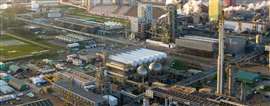 Yara International has inaugurated a carbon capture and storage facility at its Sluiskil ammonia and fertilizer complex in the Netherlands that will use Baker Hughes compressors as part of a system capable of processing up to 800,000 tons of CO₂ annually. (Image: Yara International)
Yara International has inaugurated a carbon capture and storage facility at its Sluiskil ammonia and fertilizer complex in the Netherlands that will use Baker Hughes compressors as part of a system capable of processing up to 800,000 tons of CO₂ annually.
Yara described the project as Europe’s largest operational industrial carbon capture facility and the first complete cross-border value chain for capturing, transporting and permanently storing CO₂ at industrial scale.
The approximately €200 million project expands the site’s existing CO₂ liquefaction capabilities. Linde Engineering was selected to provide engineering and procurement for the new liquefaction plant, while Baker Hughes supplied the compressors, according to a Yara project factsheet. Other equipment suppliers include Famet for air cooler banks, Geldof for storage tanks and Wiese for loading arms.
Yara’s published information does not identify the Baker Hughes compressor model, compressor type, number of units, driver configuration or installed power.
The new facility processes high-purity CO₂ generated as a byproduct of ammonia production at Sluiskil. Unlike many carbon capture applications requiring separation of CO₂ from dilute flue gas, ammonia production through steam methane reforming inherently produces a relatively concentrated CO₂ stream. Yara already has decades of experience capturing and handling CO₂ at the site.
Linde Engineering said its plant prepares the captured CO₂ for transportation through compression, drying and refrigerant-based liquefaction. The liquid CO₂ is then transferred to storage before being loaded onto specialized vessels.
The liquefaction system has a design capacity of 125 tons of liquid CO₂ per hour. Yara’s scope also includes approximately 15,000 tons of on-site CO₂ storage capacity, ship-loading equipment and shore power. Seven storage tanks are installed at the Sluiskil facility.
The storage capacity is sufficient to support the loading of two Northern Lights vessels per week. Each ship can transport approximately 7,200 tons of liquid CO₂, according to Yara.
Once loaded at Sluiskil, the CO₂ will be transported more than 800 km by ship to Northern Lights’ receiving terminal at Øygarden on Norway’s west coast. It will then be transferred to onshore storage tanks before being transported through an offshore pipeline and injected into a saline aquifer approximately 2,600 meters below the seabed.
Yara expects the system to capture and permanently store approximately 12 million tons of CO₂ over 15 years.
“This is an important day for Yara and for European industry,” Yara President and CEO Svein Tore Holsether said. “The carbon capture facility in Sluiskil proves that large-scale industrial decarbonization is possible today.”
Yara made the final investment decision on the project in November 2023 after signing a binding transport and storage agreement with Northern Lights.
The Sluiskil site is Europe’s largest ammonia and mineral fertilizer production complex. It produces approximately 3.2 million tons of CO₂ annually, according to Linde. About 1.4 million tons has historically been captured for commercial uses including greenhouses, carbonated beverages and urea-related applications, while approximately 1.8 million tons has been emitted.
The new CCS project targets 800,000 tons of those annual emissions. Yara has said the remaining emissions are more difficult to capture because they originate from different parts of the production process.
Northern Lights is a joint venture of Equinor, Shell and TotalEnergies established to provide commercial CO₂ transport and permanent storage services.
CONNECT WITH THE TEAM