Read this article in 中文 Français Deutsch Italiano Português Español
Archrock sees compression equipment shortages continuing as demand strengthens

November 04, 2026
Company plans up to $1.6 billion in growth investments through 2030, with extended engine lead times, fleet modernization and AI technology shaping its expansion strategy
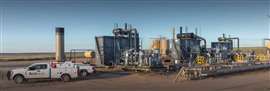 Archrock reported its strongest quarterly bookings since the second quarter of 2023, with bookings during the first nine months of 2026 running 13% ahead of the corresponding period last year. (Image: Archrock)
Archrock expects demand for natural gas compression equipment to strengthen through the end of the decade, driven by LNG exports, rising associated gas production and increasing natural gas requirements for power generation. However, extended equipment lead times could constrain the industry’s ability to respond to that growth.
During the company’s third-quarter 2026 earnings call, President and CEO Brad Childers said compression demand is beginning to accelerate following a period of relatively flat equipment utilization and horsepower growth.
The Houston-based contract compression provider reported its strongest quarterly bookings since the second quarter of 2023, with bookings during the first nine months of 2026 running 13% ahead of the corresponding period last year.
Archrock ended the quarter with fleet utilization of 94.3% and expects additional idle equipment to return to service before year-end.
Childers said the company remains confident in its long-term outlook despite uncertainty surrounding energy markets and infrastructure development.
“If I were to take the over/under, I still believe the market is more likely to be short of compression equipment than long on compression equipment,” he said.
 Brad Childers
Engine lead times extend into 2029
One of the industry’s most significant challenges remains the availability of new compression equipment, particularly large natural gas engines.
Archrock reported that lead times for Caterpillar engines remain above 180 weeks, or approximately 3½ years, although the company said the situation has improved.
“Lead times have come down,” Childers said. “Caterpillar has communicated that.”
He attributed some of that improvement to investments Caterpillar has made to increase manufacturing throughput and meet demand.
Nevertheless, Childers expects lead times to remain extended because of the strength of the equipment market.
“We’ve been in the position to be able to obtain equipment that we need, though we have ordered equipment in advance,” he said. “Lead times are out there, but Caterpillar is making deliveries and we’re receiving them.”
The unusually long manufacturing schedules are also changing the relationship between customer bookings and the time required for new compression equipment to begin generating revenue.
Under more typical conditions, Childers said a 52-week equipment lead time might result in approximately 15 months between an order and the start of revenue.
With current equipment delivery schedules extending into 2029, that period can be considerably longer.
Archrock said some customers are reserving compression equipment well in advance, while others continue to place orders closer to their anticipated requirements.
The company expects to receive approximately 50,000 hp of additional equipment during the fourth quarter, following deliveries of roughly 125,000 hp through the first nine months.
Some of the fourth-quarter deliveries are expected to begin generating revenue in early 2027.
Technology investments target uptime and efficiency
Alongside its investment in new equipment, Archrock is expanding its use of telemetry, automation and artificial intelligence to improve fleet reliability, field service productivity and operating margins.
Childers said the company’s entire compression fleet is connected through telemetry systems that continuously collect operating data.
“100% of our fleet is connected with telemetry,” he said.
That information is fed into a centralized data system, allowing Archrock to evaluate equipment performance, prioritize maintenance activities, diagnose problems and coordinate service responses.
The company has also invested in automated parts management and digital tools that provide field technicians with equipment information before they arrive at a location.
Childers said the objective is to integrate information from individual compressor packages with the company’s maintenance and service operations.
“It’s not just the units; it’s the entire system, and it’s working actually really well,” he said.
Archrock is also deploying AI in various components of its field organization, although Childers characterized those efforts as being in their early stages.
He expects further deployment to improve customer service and support additional gains in operating profitability.
Better access to equipment data and technical information should help technicians respond more quickly to problems, reduce downtime and improve compressor availability, he said.
Childers identified two potential financial benefits: greater operating efficiency within Archrock and an opportunity to capture additional business by helping customers maintain production.
He also emphasized that technology is only one contributor to improved profitability.
The company’s ongoing shift toward large-horsepower compression equipment and electric motor-driven packages has been another significant factor.
Archrock’s contract operations business recorded an adjusted gross margin of 72% in the third quarter, marking its eighth consecutive quarter at or above 70%.
Major fleet investments planned through 2030
Archrock reaffirmed plans to invest between $1.4 billion and $1.6 billion in growth capital from 2027 through 2030.
The program is expected to fund approximately 1 million hp of additional compression capacity, predominantly large-horsepower and electric motor-driven equipment.
For 2026, the company maintained its growth capital expenditure guidance of $250 million to $275 million.
Childers said the investment plans reflect expectations for continued growth in U.S. natural gas production and consumption.
Citing industry forecasts, he said LNG-related natural gas demand could increase from approximately 18 Bcf/d in 2026 to 34 Bcf/d by 2030 and 40 Bcf/d by 2035.
Demand from data centers and other electricity consumers represents an additional growth opportunity, although Childers emphasized that LNG remains the dominant driver.
The company expects new pipeline infrastructure to support additional production and compression activity in the Permian Basin.
However, its recent growth has not been limited to the Permian.
Childers said the Rockies represented Archrock’s largest growth area during the third quarter, with additional activity in the Haynesville and Midcontinent regions.
The Permian accounted for approximately 30% to 40% of the company’s growth during the period.
Archrock’s operations are concentrated in two major applications: centralized natural gas gathering systems, which primarily use larger compression equipment, and gas lift operations supporting oil production.
Childers said gas lift represents approximately 35% to 40% of the company’s business.
Aftermarket maintenance remains subdued
Despite stronger demand for contract compression, Archrock continues to experience weakness in its aftermarket services business as customers postpone major maintenance work.
Third-quarter aftermarket revenue declined to $40 million from $56 million a year earlier.
Childers said some operators are choosing to defer maintenance to maximize current production and revenue, even though the work may eventually become unavoidable.
He described the situation as a period in which some customers prefer a run-to-failure operating approach.
The company could not provide a reliable estimate of when deferred maintenance activity would recover.
Meanwhile, Archrock has been using some personnel from its aftermarket business to support contract operations, reducing its reliance on higher-cost outside labor.
The company has also worked to reduce lubricant consumption to offset higher lube oil prices and additional expenses associated with returning idle equipment to service.
Archrock reported third-quarter net income of $84.5 million, compared with $71.2 million a year earlier. Adjusted EBITDA increased to $228.4 million from $220.9 million.
Contract operations revenue rose 1.5% to $331 million, despite the sale of approximately 112,000 hp of nonstrategic operating equipment since the prior-year period.
Average contract operations revenue per horsepower per month increased 4% to $24.38.
Archrock reaffirmed its full-year adjusted EBITDA guidance of $865 million to $885 million and total capital expenditure guidance of $400 million to $445 million.
The company has not yet issued formal guidance for 2027, but management indicated that higher utilization and deliveries of additional horsepower could support growth next year.
Childers said the outlook for compression equipment demand remains favorable as customers prepare for increased natural gas production and expanding infrastructure requirements.
CONNECT WITH THE TEAM