Read this article in 中文 Français Deutsch Italiano Português Español
TotalEnergies: Continued natural gas growth through 2040s

November 02, 2026
The company’s 2026 Energy Outlook projects rising global gas consumption, an expanding U.S. share of LNG exports and accelerating electricity demand driven partly by data centers
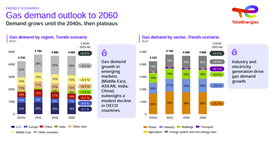
Global natural gas demand is expected to increase through the 2040s before leveling off, while U.S. LNG exports and rising electricity consumption are expected to create additional opportunities for gas infrastructure, according to the TotalEnergies Energy Outlook 2026.
Released Nov. 2, the report examines global energy consumption and investment trends through 2060, presenting three scenarios based on different assumptions about government policies, technology deployment and emissions reduction.
Under its Trends scenario, which assumes the continuation of recent energy policies and technology developments, TotalEnergies projects global natural gas demand will increase from an estimated 4,250 billion cubic meters (bcm) in 2025 to 4,780 bcm in 2035, an increase of approximately 12%.
Demand is then projected to moderate, reaching 4,680 bcm in 2050 and remaining at that level through 2060.
The company expects growth in emerging markets, particularly the Middle East, China, India and Southeast Asia, to more than offset declining demand in developed economies.
Industrial consumption and electricity generation are expected to remain the principal drivers of gas demand growth. In the Trends scenario, natural gas retains a relatively stable share of global primary energy consumption through 2060, even as renewable energy expands.
U.S. LNG exports to capture larger market share
The outlook reinforces expectations for continued U.S. leadership in the global LNG industry.
TotalEnergies estimates the United States accounted for approximately 25% of global LNG exports in 2025, compared with virtually no share in 2010. By 2035, the company projects the U.S. share will increase to 37%.
Qatar’s share, meanwhile, is projected to remain around 19% in 2035.
The outlook highlights the transformation of the United States from an energy importer to a major producer and exporter. The country became a net exporter of natural gas in 2017, supported by expanding domestic production.
For the natural gas compression industry, the projected increase in U.S. LNG exports points to continued requirements for gas gathering, processing, transmission and liquefaction infrastructure serving export facilities.
Data centers drive electricity demand higher
Rising electricity consumption represents another important development in the outlook.
TotalEnergies projects global electricity demand will increase from approximately 31,900 terawatt-hours (TWh) in 2025 to between 43,400 and 46,800 TWh in 2035, depending on the scenario.
Under the Trends scenario, global electricity demand is expected to increase by approximately 11,500 TWh over that period.
Industrial activity accounts for the largest portion of the increase, followed by buildings, data centers, air conditioning, transportation and other uses.
Data centers alone are projected to contribute approximately 1,200 TWh of additional annual electricity demand worldwide between 2025 and 2035.
Combined, data centers, cooling and transportation account for 33% of projected global electricity demand growth, according to the report.
The United States is expected to experience particularly strong growth after more than 15 years of relatively stable electricity consumption.
Under the Trends scenario, U.S. electricity generation is projected to increase from approximately 4,400 TWh in 2025 to 5,500 TWh in 2035, with data center expansion and industrial electrification among the principal drivers.
Natural gas is expected to remain an important component of the U.S. generation mix, even as renewable electricity capacity expands.
TotalEnergies projects gas will account for approximately 34% of U.S. electricity generation in 2035, compared with 39% in 2025. Although its share declines, the expansion of overall electricity generation indicates continued demand for gas-fired power.
The report also emphasizes the importance of dispatchable generation in maintaining electricity system reliability as variable renewable generation expands.
Energy transition presents different scenarios
TotalEnergies developed three scenarios to assess how energy consumption and emissions could evolve through 2060.
The Trends scenario assumes existing policy and technology trends continue. The Momentum scenario assumes countries with net-zero commitments for 2050 achieve their targets. The Rupture scenario explores a more accelerated transition intended to limit global warming to less than 2 degrees Celsius.
The company estimates these pathways would result in global temperature increases of approximately 2.6 to 2.8 degrees Celsius, 2.3 to 2.4 degrees Celsius and 1.8 to 1.9 degrees Celsius, respectively, by 2100.
Despite differences in energy consumption and technology deployment, all three scenarios envision continued natural gas use in industrial applications and electricity generation.
The outlook also identifies carbon capture and storage (CCS) as an increasingly important technology for reducing emissions.
By 2060, annual CO2 capture reaches approximately 2 billion metric tons in the Trends scenario, 3.3 billion metric tons in Momentum and 4.3 billion metric tons in Rupture.
The report suggests that the pace of energy system transformation will differ significantly among regions as governments balance energy security, affordability and emissions reduction.


CONNECT WITH THE TEAM