Read this article in 中文 Français Deutsch Italiano Português Español
AI growth opens new market for natural gas infrastructure

October 22, 2026
Grid constraints and soaring data-center power requirements are pushing developers toward dedicated pipelines and behind-the-meter natural gas generation
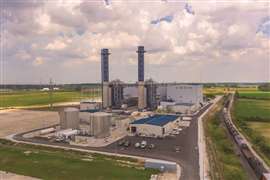 Williams is developing natural gas-fired generating facilities in New Albany, Ohio, to support growing electricity demand from data centers. Its Socrates North and South projects have a combined planned capacity of 400 MW. (Image: Williams)
Artificial intelligence may exist in the digital world, but the infrastructure required to support it is becoming an increasingly physical business for the natural gas industry.
As data centers expand in both size and number, developers are confronting a basic problem: they need enormous quantities of reliable electricity, and in many regions the power grid cannot provide it quickly enough.
That is opening a growing market for natural gas pipelines, onsite generation and the compression and measurement infrastructure needed to deliver fuel directly to large computing campuses.
“AI may be digital, but it really is grounded in a physical infrastructure,” said Kyle Flanagan, manager of pipeline integrity and compliance for Greylock Energy’s midstream group. Greylock Energy is an oil and natural gas, exploration, production, and midstream company backed by ArcLight Capital Partners. Greylock is headquartered in Charleston, West Virginia with offices in West Virginia, Pennsylvania, and Utah, and with operations scattered throughout Appalachia and the Rockies.
Speaking at the GPA Midstream Convention, Flanagan said Greylock is seeing increasing interest from developers evaluating dedicated gas infrastructure as an alternative or supplement to traditional grid connections.
The pace is significant enough that potential data-center projects now generate inquiries for the company on a near-weekly basis, he said.
For the midstream industry, Flanagan said, the growth represents an unusual convergence of increasing natural gas demand and customers whose overriding priorities include reliability and speed to market.
An enormous new load
Data centers already represent a significant share of U.S. electricity consumption, and projections point toward substantial growth.
U.S. data centers consumed an estimated 176 TWh of electricity in 2023, equivalent to about 4.4% of total U.S. electricity consumption, according to Lawrence Berkeley National Laboratory.
A 2026 update from the laboratory estimates data centers could account for about 11.8% of U.S. electricity consumption by 2030. Depending on assumptions surrounding server deployment, efficiency, cooling and other factors, the projected range is 9.5% to 15.3%.
The rise of artificial intelligence is a major contributor.
Unlike many industrial facilities, data centers operate essentially continuously. Servers process queries, train AI models, store information and deliver real-time results around the clock.
The computing equipment itself represents the largest power load, but cooling can consume another significant portion of a facility’s electricity. Additional demand comes from networking, storage, lighting and other auxiliary systems.
And as computing requirements increase, one of the most direct ways of increasing capacity is simply to install more servers.
“The bigger the facility, the more servers you have,” Flanagan said. “Obviously, the more power it’s going to use.”
The companies driving that expansion include some of the largest technology businesses in the world, including Amazon, Google, Meta and Microsoft.
For natural gas companies, however, the important question is increasingly becoming not who is building the data centers, but how those facilities will obtain enough electricity to operate them.
When the grid cannot move fast enough
Flanagan identified grid constraints as one of the primary reasons data-center developers are considering direct natural gas solutions.
Connection to the electric grid remains attractive when sufficient generation and transmission capacity are readily available. But the growth of large loads is moving considerably faster than transmission systems and new generation can be developed in some markets.
“The electrical grid right now cannot expand fast enough,” Flanagan said.
That creates a major problem for developers that may have billions of dollars invested in a data-center campus but cannot afford to wait years for sufficient grid capacity.
Natural gas-fired generation located at or near the data center offers another path.
Behind-the-meter generation can provide a facility with dedicated electricity without depending entirely on the public grid. For developers, that can provide control over both generation capacity and project timing.
It also addresses another fundamental data-center requirement: reliability.
AI and cloud-computing facilities operate continuously, and an interruption in electrical supply can have significant consequences. Natural gas generation provides dispatchable power that can operate regardless of weather conditions and can be designed specifically around a facility’s load.
“They want 24/7 runtime,” Flanagan said.
Developers also gain the ability to control their own generation rather than relying entirely on grid conditions, he said.
Pipelines become part of site selection
That shift is making natural gas infrastructure an increasingly important component of data-center site selection.
Proximity to both gas supply and pipeline capacity can make a location more attractive, particularly in producing regions with extensive transmission networks.
Flanagan pointed to Ohio and Texas as examples.
The Appalachian Basin provides large natural gas resources near rapidly developing data-center markets in Ohio and Virginia, while Texas combines major gas production with a rapidly expanding technology sector.
But having a pipeline nearby does not necessarily mean sufficient capacity will be available when a data center begins operating.
Greylock has encountered developers that initially identify one pipeline connection only to discover that the system is fully subscribed by the time the project advances, Flanagan said.
That can force developers to consider a second or third connection option, potentially increasing pipeline mileage, cost and project complexity.
The long development cycle for large data centers makes that particularly challenging.
A developer might initially identify a gas pipeline 15 miles from a proposed campus, for example, only to find several years later that available capacity has disappeared and the next viable connection is 20 miles away.
Some developers also seek two pipeline connections to improve fuel-supply reliability.
“The longer these development cycles, the more they have to turn to option B, C or D,” Flanagan said.
Midstream companies move behind the meter
Large midstream companies are already moving into the market.
Williams’ Socrates development in New Albany, Ohio, provides a particularly visible example.
The company’s Socrates North and South projects were designed as two separate 200-MW natural gas-fired generation facilities supporting data-center development in the Columbus area.
Williams said in August that the first 200-MW phase of Socrates had entered service less than 18 months after commercialization. The company is developing a broader portfolio of natural gas-fired power projects aimed at the rapidly expanding data-center sector.
But Flanagan said the opportunity extends beyond the country’s largest pipeline operators.
Smaller and midsized midstream companies can potentially develop shorter dedicated laterals connecting interstate or intrastate pipelines with individual data-center campuses.
Those projects may involve pipelines of only several miles rather than major interstate systems, making them potentially attractive to regional operators.
Greylock traditionally concentrated on gathering and midstream infrastructure associated with natural gas production. Flanagan said its direct-to-end-user pipeline work has expanded as data centers and other large energy users increasingly investigate dedicated gas supplies.
The typical inquiry begins with a high-level desktop study estimating pipeline routes and costs.
Many potential projects never advance beyond that point.
Those that do may proceed into a detailed feasibility study examining pipeline routing, steel costs, available capacity and commercial arrangements. Only after those issues have been resolved does the project begin moving toward permitting, contracts and procurement of long-lead equipment.
That progression illustrates both the opportunity and uncertainty surrounding the market.
Developers may be willing to spend significant amounts studying natural gas infrastructure before deciding whether a project is viable because the pipeline investment remains relatively small compared with the multibillion-dollar cost of a major data-center campus.
New customers, different language
Serving technology companies also presents challenges for traditional gas operators.
One is simply communication.
Pipeline companies typically discuss capacity in Mcf, MMcf/d or MMBtu. Data-center developers and power companies think in megawatts and gigawatts.
That creates opportunities for misunderstandings surrounding required volumes, operating conditions and schedules.
“There is a lack of familiarity sometimes with natural gas and the systems and the equipment,” Flanagan said.
Those differences can produce mismatched expectations involving capacity, technical requirements and construction timelines.
The physical environment can create further complications.
Many data centers are being developed on the outskirts of large metropolitan areas such as Columbus, Ohio, and Dallas. New pipelines serving those sites can encounter densely developed corridors, high-consequence areas and existing electrical infrastructure.
High-voltage transmission lines can also create AC interference issues requiring mitigation on nearby pipelines.
Routing a relatively short lateral can therefore become considerably more complicated than its mileage might suggest.
Infrastructure must keep pace
The gas industry’s challenge will be ensuring that its own infrastructure does not become the next bottleneck.
Flanagan said large new cross-country pipelines have become increasingly difficult to develop, placing more emphasis on expansions of existing systems and shorter projects connecting supply directly with new loads.
Pipeline companies must anticipate where demand is developing rather than wait until capacity is exhausted.
“We have to continue to expand infrastructure,” he said. “We have to be really proactive, and we have to avoid bottlenecks.”
There are also community and regulatory challenges.
Data centers are attracting increasing scrutiny over electricity consumption, water requirements and effects on surrounding communities. In some locations, Flanagan said, proposed developments are encountering the kind of “not in my backyard” opposition previously directed toward other large energy and industrial projects.
Pipeline infrastructure associated with those facilities can face similar concerns.
That makes early communication with communities increasingly important as developers move into areas with little previous experience with either data centers or large gas infrastructure projects.
Gas takes a larger role in AI
Natural gas is not the only solution being considered for the data-center power challenge.
Technology companies are pursuing renewable power, nuclear generation, energy storage and other alternatives. Several have backed development of small modular nuclear reactors or agreements associated with existing nuclear plants.
But natural gas currently offers a combination difficult for developers to ignore: existing domestic supply, large-scale dispatchable generation technology and an extensive pipeline network.
Natural gas supplied more than 40% of the electricity consumed by U.S. data centers in 2024, according to International Energy Agency estimates cited by Pew Research Center. The IEA also expects gas-fired generation to contribute substantially to incremental data-center power demand through the end of the decade.
The opportunity for the natural gas industry therefore extends beyond simply selling additional molecules.
New data centers can require gathering and transmission capacity, dedicated laterals, pressure regulation, measurement, compression and long-term operation and maintenance — infrastructure that may remain in service for decades.
For an industry accustomed to serving power plants, industrial facilities and local distribution systems, AI represents a potentially significant new class of customer.
“Natural gas isn’t replacing the grid, nor is it the only solution,” Flanagan said. “But it really is rapidly becoming one of the most critical enablers of AI.”

CONNECT WITH THE TEAM