
February 24, 2026
From first Sabine Pass cargo in 2016 to world’s largest exporter, U.S. LNG growth driven by shale supply, flexible contracts and rising global demand
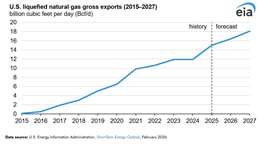
The United States has transformed from a marginal participant in global liquefied natural gas (LNG) trade into the world’s largest exporter in less than a decade, driven by abundant shale gas supply, competitive pricing and flexible contract structures, according to the U.S. Energy Information Administration (EIA).
Ten years ago, on Feb. 24, 2016, the first LNG cargo from the Lower 48 states departed the Sabine Pass terminal in Louisiana, marking the start of large-scale U.S. LNG exports. At the time, exports averaged just 0.5 Bcf/d. By 2025, U.S. LNG exports had reached approximately 15.0 Bcf/d, with projections indicating volumes could exceed 18.0 Bcf/d by 2027, EIA data show.
The rapid expansion has positioned the United States ahead of established LNG exporters such as Australia and Qatar, fundamentally altering global trade flows and pricing dynamics.
From import terminals to export hubs
The foundation of the U.S. LNG export boom lies in the shale revolution of the mid-2000s, which dramatically increased domestic natural gas production and reduced the need for LNG imports. Facilities such as Sabine Pass, originally designed as import terminals, were converted into export infrastructure as supply outpaced domestic demand.
Prior to 2016, U.S. LNG exports were limited. A small liquefaction facility in Kenai, Alaska, exported LNG primarily to Japan for decades, but overall volumes remained modest. The launch of Sabine Pass as an export facility marked a turning point, enabling large-scale shipments from the Gulf Coast to global markets.
Since then, Sabine Pass has become a cornerstone of U.S. LNG exports, shipping thousands of cargoes worldwide and accounting for a significant share of total volumes, according to EIA.
The United States now operates eight LNG export terminals, with additional capacity under development. Recent milestones include the startup of new facilities and expansions along the Gulf Coast, while additional projects are expected to come online over the next several years.
Export capacity is projected to nearly double by the early 2030s compared with 2025 levels, reflecting continued investment in liquefaction infrastructure and supporting pipeline networks, EIA reported.
This expansion has been supported by a favorable investment environment, strong international demand and access to low-cost feedgas, which has enabled U.S. LNG to remain competitive in global markets.
Flexible contracts reshape trade flows
One of the defining features of U.S. LNG has been its contract structure. Unlike traditional LNG suppliers that rely heavily on long-term, oil-indexed contracts, U.S. projects typically offer destination flexibility and pricing linked to Henry Hub natural gas benchmarks.
These terms allow buyers—including utilities, traders and LNG marketers—to redirect cargoes based on market conditions or resell capacity, providing greater optionality in a volatile global energy landscape.
U.S. LNG is commonly sold on a free-on-board basis, where buyers pay a liquefaction fee along with feedgas costs tied to Henry Hub pricing. This structure has often resulted in competitive pricing relative to oil-indexed LNG supplies, according to EIA.
Global demand growth has been a critical driver of U.S. LNG expansion, particularly in the wake of geopolitical disruptions.
Before 2022, Asia was the primary destination for U.S. LNG exports. However, following Russia’s invasion of Ukraine, European demand surged as countries sought to replace pipeline gas supplies. Europe quickly became the dominant destination for U.S. LNG cargoes, receiving the majority of exports in recent years, based on EIA data.
This shift highlights the role of U.S. LNG as a flexible supply source capable of responding to sudden changes in global demand.
Outlook: continued growth amid evolving markets
Looking ahead, the United States is expected to maintain its position as a leading LNG exporter as new projects come online and existing facilities expand.
The combination of abundant natural gas resources, competitive cost structures and flexible commercial terms is expected to support continued export growth. At the same time, increasing global demand for reliable and lower-emission energy sources is likely to sustain long-term interest in LNG.
As export capacity grows, U.S. LNG is expected to play an increasingly important role in balancing global gas markets, supporting energy security and providing supply flexibility across regions, EIA noted.

CONNECT WITH THE TEAM