Read this article in 中文 Français Deutsch Italiano Português Español
EQT expands Appalachian compression program after production gains

July 23, 2026
Producer identifies about 30 additional projects
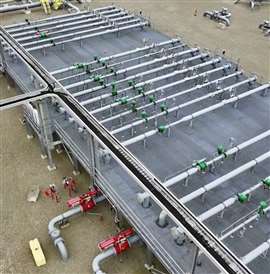 Piping and valve infrastructure at an EQT natural gas production facility. (Image: EQT)
EQT plans to expand its midstream compression program after initial projects delivered greater-than-expected production improvements across its Appalachian natural gas operations.
The company has six compression projects underway in 2026 and has identified approximately 30 additional opportunities of varying sizes and scopes, President and CEO Toby Rice said during EQT’s second-quarter earnings call.
EQT has evaluated more than 99% of its wells for potential compression projects. Over the next several years, the company expects to deploy compression on groups of wellbores representing approximately 0.5 Bcf/d of production annually.
“We’ve got a pretty integrated approach that we’re looking out through 2029 right now,” Rice said. “The returns that we’re expecting on compression — this is one of the best bang-for-the-buck opportunities that we can spend.”
The projects lower pressures on EQT’s gathering systems, allowing wells to sustain higher production rates for longer periods. EQT said the resulting improvements are extending the flat-production period of new wells and reducing decline rates among older wells.
Those results contributed to second-quarter production exceeding the high end of the company’s guidance. EQT subsequently raised its full-year 2026 production forecast by approximately 90 Bcfe at the midpoint.
Rice said the compression projects were among the operating synergies anticipated when EQT acquired Equitrans Midstream, but their impact has exceeded the company’s initial projections.
Lower pressures improve well performance
EQT is working with its reservoir and finance teams to recalibrate its production models to account for the benefits of lower gathering-system pressures.
“Our original expectations on the impact on our well performance and type curves from lower pressures have been kind of blown away,” CFO Jeremy Knop said. “We’re trying to recalibrate our hydraulic models and just how we forecast type curves and base declines.”
Knop said continued improvement could increase the company’s capital efficiency in coming years. EQT has not yet quantified the potential reduction in sustaining capital because it is still evaluating the performance data.
Compression is improving both base production and results from newly completed wells, according to Rice. Producing into lower gathering pressures has helped the company extend flat production periods and outperform its projected well-production curves.
The lower-pressure system could also make workovers economical on wells that were not attractive candidates under the previous operating conditions.
“We also have a number of wells that could benefit from workovers that maybe would not have been a prize in a high-pressure system, but now with the pressures lowered, those workovers make sense,” Knop said.
The timing of future compression investments will depend on well age, production profiles and when individual areas of the gathering system need additional capacity. EQT is coordinating the projects with its drilling schedule so existing wells can continue producing while making room for newly completed wells.
Appalachian demand outlook strengthens
The compression program comes as EQT anticipates substantial growth in Appalachian gas demand from power generation, data centers, industrial facilities and pipeline projects.
The company is tracking more than 45 demand and pipeline takeaway projects that are either under construction or being evaluated. Collectively, those projects represent nearly 20 Bcf/d of potential demand.
EQT does not expect all the proposed projects to advance. After assigning probabilities to individual developments, the company estimates that high-single-digit Bcf/d growth — approximately 40% of the total proposed demand — is a realistic outcome.
Much of that demand could emerge near the end of the decade because large power plants, pipelines and other infrastructure typically require three to five years to develop.
EQT said it would not attempt to match new demand with an immediate, equivalent increase in production. Instead, the company expects to add supply gradually as projects enter service and contractual commitments are secured.
Power project adds long-term gas demand
EQT recently signed a 10-year agreement to supply 325 MMcf/d of natural gas to a planned 2-GW combined-cycle power plant in Doddridge County, West Virginia.
The Competitive Power Ventures project is expected to enter service in early 2031 and will draw gas south from EQT’s core production area. It is the second combined-cycle project in West Virginia supported by an EQT gas supply agreement, following the previously announced Wolf Summit project.
The CPV agreement links the gas price to PJM electricity pricing rather than a conventional natural gas index. EQT said the structure gives it exposure to power-market economics without requiring the producer to invest capital in the generating facility.
The company expects to announce at least one additional Appalachian power-related supply agreement before the end of 2026, with other projects under discussion in West Virginia and southwestern Pennsylvania.
EQT is also accelerating construction spending on the MVP Southgate pipeline after receiving authorization from the Federal Energy Regulatory Commission to begin construction. The project will expand access for Appalachian gas into North Carolina and other southeastern markets.
Together, the compression investments, pipeline expansions and power supply agreements reflect a closer integration of Appalachian production with gathering, transportation and end-use demand. For EQT, lowering gathering pressures provides an immediate production benefit while preparing its system to serve the larger gas loads expected later in the decade.

CONNECT WITH THE TEAM