Read this article in 中文 Français Deutsch Italiano Português Español
Chevron greenlights Gorgon project

December 08, 2025
US$2 billion project will expand life of LNG operations
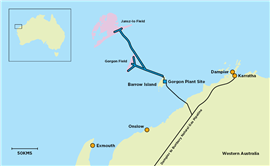
Chevron Australia and its partners in the Gorgon Joint Venture approved a final investment decision (FID) for the Gorgon Stage 3 development — a significant commitment of A$3 billion (approximately US$2 billion) to extend the life and output profile of one of the world’s largest liquefied natural gas (LNG) operations.
This next phase — aimed at connecting offshore gas fields in the Greater Gorgon Area to the existing processing and export infrastructure on Barrow Island — will backfill reserves and help sustain both export and domestic gas supply for decades to come.
Under Stage 3, the project will link the offshore Geryon gas field and Eurytion gas field to Gorgon’s existing subsea gas-gathering infrastructure and processing facilities at Barrow Island.
Specifically, the plan includes drilling six new wells across two offshore fields, installing subsea manifolds and a roughly 35-kilometer production flowline — the first of a series of planned tiebacks that could ultimately involve drilling up to 40 wells across as many as seven fields.
The expansion is intended as “backfill” to maintain and support Gorgon’s long-term LNG production and domestic gas output.
The Gorgon Project remains one of the marquee LNG developments globally — a three-train LNG facility capable of producing roughly 15.6 million metric tons per year, along with a domestic-gas plant supplying ~300 terajoules per day to Western Australia. Chevron says that Stage 3 will help ensure long-term supply both to international LNG markets (notably Asia) and to domestic customers in Western Australia, including households and businesses.
By maximizing existing infrastructure via subsea tiebacks rather than greenfield build-out, the investment aims to deliver a cost-efficient renewal of production — a prudent strategy given global energy market volatility and evolving regulatory environments.
According to Chevron, Gorgon Stage 3 will support “thousands of highly skilled jobs” during construction, installation, and commissioning — reinforcing the project’s role as a major employer and economic contributor in regional Western Australia.
More broadly, extending the operational life of Gorgon — which began LNG exports in 2016 and domestic gas deliveries the same year — helps anchor Western Australia’s domestic gas supply while maintaining a stable export avenue.
Analysts say the backfill plan could sustain Gorgon’s output and relevance for decades, with the project’s lifecycle now conceptually extended toward 2070 via a combination of the original trains, prior infill work and the newly sanctioned subsea expansions.

CONNECT WITH THE TEAM