Read this article in 中文 Français Deutsch Italiano Português Español
U.S. natural gas storage capacity edges higher in 2025

June 03, 2026
Growth concentrated in South Central and Mountain regions as operators expand storage capabilities
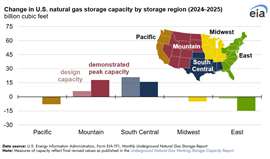
Underground natural gas storage capacity in the Lower 48 states increased modestly in 2025, marking the third consecutive year of growth and underscoring the industry’s continued focus on maintaining supply flexibility amid changing demand patterns, according to the U.S. Energy Information Administration (EIA).
The EIA reported that demonstrated peak capacity, a measure based on actual storage utilization over the previous five years, increased by 6 billion cubic feet (Bcf), or 0.1%, in 2025. The increase reflects greater use of both existing and newly developed storage facilities. Growth was concentrated in the South Central and Mountain regions, where demonstrated peak capacity rose by 16 Bcf and 18 Bcf, respectively.
Those gains were partially offset by declines elsewhere. Demonstrated peak capacity fell by 15 Bcf in the East region, 8 Bcf in the Pacific region and 5 Bcf in the Midwest.
The EIA defines demonstrated peak capacity as the sum of the highest volume of working gas stored in each storage field during the previous five-year period. Because it reflects actual operating experience rather than theoretical limits, demonstrated peak capacity is generally lower than design capacity.
Working gas design capacity, often referred to as nameplate capacity, also increased during the year. As of November 2025, Lower 48 storage facilities reported a combined working gas design capacity of 4,683 Bcf, up 26 Bcf from the previous year.
Design capacity is determined by the physical characteristics of the storage reservoir, installed equipment and operating procedures, and is typically certified by state or federal regulators.
The South Central region accounted for most of the increase, adding 21 Bcf of working gas design capacity. The Mountain region added another 6 Bcf. The East region recorded a 2-Bcf decline, primarily due to adjustments in base gas volumes, while capacity in the Midwest and Pacific regions remained unchanged.
The continued expansion of storage capacity in the South Central region reflects the area’s growing importance to North American natural gas markets. The region serves as a key hub for interstate pipeline networks, LNG export facilities along the Gulf Coast and major production basins including the Permian, Haynesville and Eagle Ford.

CONNECT WITH THE TEAM