Read this article in 中文 Français Deutsch Italiano Português Español
LNG and power systems lift Baker Hughes orders to record level

July 27, 2026
Company plans to double gas turbine capacity
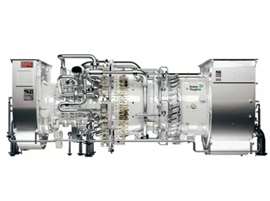 A Baker Hughes NovaLT 16 gas turbine. Strong demand for LNG equipment, compression systems and distributed power generation helped lift
Strong demand for LNG equipment, compression systems and distributed power generation helped lift Baker Hughes’ Industrial & Energy Technology orders to a record $7.1 billion during the second quarter.
Orders for the segment doubled from the same period last year and increased 45% sequentially. Gas Technology Equipment accounted for $4.9 billion of the total, compared with $781 million a year earlier, while Gas Technology Services orders rose 33% to $1.3 billion.
The quarter included approximately $1.8 billion of equipment orders associated with three major LNG projects. Through the first half, Baker Hughes booked $2.9 billion in LNG equipment orders, already exceeding its total for all of 2025.
The company also received orders for approximately 150 gas turbines for power generation applications during the quarter. Power Systems orders reached $2.6 billion, bringing the year-to-date total to nearly $4 billion, above the $3.2 billion booked during all of last year.
“We are seeing continued strength across data centers, LNG, gas processing and production infrastructure markets,” Chairman and CEO Lorenzo Simonelli said during the company’s earnings call.
LNG projects drive equipment demand
Among the quarter’s largest LNG awards was an order from Venture Global for six liquefaction blocks for the planned expansion of its CP2 LNG project in Louisiana. The scope comprises 12 single mixed-refrigerant liquefaction modules and associated centrifugal compressor trains, cold boxes, air coolers and integrated control systems.
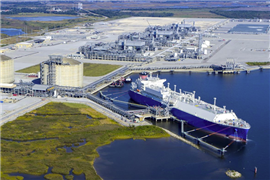
Baker Hughes also received orders from Cheniere Energy and Bechtel for equipment supporting Sabine Pass Train 7. The package includes liquefaction equipment, a boil-off gas reliquefaction unit and gas turbine upgrades across the Sabine Pass facility. The work is expected to support approximately 6 million tonnes per annum of additional LNG production capacity.
In floating LNG, Golar ordered four PGT25 gas turbine-driven refrigerant compressor trains for a planned 3.5 million-tonne-per-annum facility. It will be the fourth Golar vessel to use Baker Hughes liquefaction equipment.
The company also extended a multiyear service agreement with Nigeria LNG covering critical turbomachinery for Train 7.
Outside LNG, Baker Hughes received an order for nine electric motor-driven compressor trains for gas injection, gas lift and boosting at a mature offshore field in the Middle East. Another contract covers five motor-driven centrifugal compressor trains and associated auxiliary systems for Saudi Aramco’s Uthmaniyah conventional gas development.
Baker Hughes said the breadth of these orders demonstrates that equipment demand is not limited to a single market. Investment remains strong across LNG, gas processing, offshore production and other gas infrastructure applications.
Gas Technology Services recorded its highest quarterly order level, including a company record for equipment upgrades. Baker Hughes said operators continue to invest in improving efficiency, reliability and the operating life of installed turbomachinery.
Capacity expansion planned
Baker Hughes is expanding its Power Systems manufacturing capacity in response to growing demand from data centers and other behind-the-meter power applications.
The company expects to have approximately $5 billion in annual Power Systems revenue capacity by 2029, compared with about $1 billion in revenue generated by the business in 2025. Gas turbines are expected to account for roughly half of that opportunity, with generators supplied by its Brush business representing approximately one-quarter. The remainder includes steam turbines, turboexpanders, gearboxes, synchronous condensers and power-management systems.
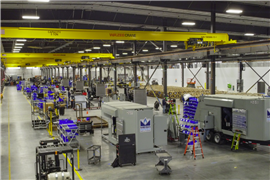
The first incremental NovaLT manufacturing capacity is scheduled to become available during the first half of 2027. Further additions are planned through 2028, with Baker Hughes expecting its gas turbine production capacity to double from 2026 levels by the end of that period.
The program will largely use existing manufacturing space rather than require new greenfield facilities. Baker Hughes said it will retain production of critical components internally while working with strategic suppliers for other equipment.
The company expects returns on the incremental capacity investments in less than two years. Revenue associated with new production capacity is generally expected to follow six to 12 months after the capacity becomes available, depending on equipment cycles and project schedules.
Baker Hughes said it still has some 2027 delivery positions available for Frame 5 gas turbines. Additional manufacturing investments are expected to create more NovaLT delivery positions beginning in late 2028.
Data centers reshape power market
Data center projects accounted for $2.2 billion of Baker Hughes’ Power Systems orders during the quarter. Demand is being driven by developers seeking generation that can be deployed more quickly than conventional grid infrastructure.
Among the awards was an order from Dynamis Power Solutions for 76 NovaLT16 gas turbines providing approximately 1.3 GW. The mobile generation systems are intended for data center and oil and gas applications in North America.
Baker Hughes also signed a multiyear agreement with Kodiak Gas Services that includes an initial order supporting 1 GW of power generation. The broader agreement provides a pathway to as much as 1.8 GW and incorporates NovaLT16 and Frame 5 gas turbines and Brush generators.
Simonelli emphasized, however, that the order increase extended beyond data centers. Excluding data center activity, Industrial & Energy Technology orders would still have totaled $4.9 billion, matching the segment’s previous quarterly record.
Chart adds compression capabilities
Baker Hughes completed its acquisition of Chart Industries in July. The transaction adds thermal-management, heat-transfer, cryogenic storage, air and gas handling, compression and aftermarket capabilities.
The combined portfolio will allow Baker Hughes to offer equipment across gas gathering, treatment, natural gas liquids recovery, compression, liquefaction, storage and transportation. Management identified natural gas infrastructure and data centers as two of the clearest near-term opportunities for combining the companies’ technologies.
For data centers, Baker Hughes expects to combine its power generation, controls and lifecycle services with Chart’s cooling and heat-transfer equipment. The company is also evaluating opportunities involving hydrogen, helium, CO₂, nitrogen and oxygen, as well as markets including geothermal energy, mining and space applications.
Backlog reaches $37.1 billion
Industrial & Energy Technology’s remaining performance obligations reached a record $37.1 billion at the end of the quarter, up $4 billion sequentially. Gas Technology Equipment accounted for $15 billion, while Gas Technology Services represented $16.7 billion.
Segment revenue was essentially unchanged from a year earlier at $3.29 billion. EBITDA increased 16% to $678 million, while the segment’s EBITDA margin improved from 17.8% to 20.6%.
Baker Hughes said favorable pricing, productivity improvements and cost reductions supported the margin increase. The company expects the pricing and project mix contained in its backlog to support further margin improvement as equipment orders convert into revenue.
Many of the major Power Systems and LNG orders booked in 2026 are not expected to become revenue until after 2027 because of manufacturing lead times and project schedules. However, the backlog provides the company with order visibility into 2030 and beyond.
Companywide, Baker Hughes reported second-quarter orders of $10.5 billion, an increase of 49% from a year earlier. Revenue declined 2% to $6.74 billion, while adjusted EBITDA increased 2% to $1.23 billion.

CONNECT WITH THE TEAM