Read this article in 中文 Français Deutsch Italiano Português Español
Baker Hughes CEO calls for expanded role of natural gas and LNG

February 02, 2026
Record Florence annual meeting highlights gas, digital optimization and geothermal as pillars of future energy balance
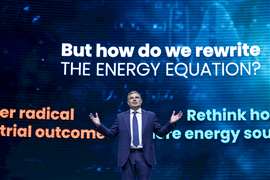 Lorenzo Simonelli, president and CEO of Baker Hughes, speaking during the company’s annual meeting in Florence, Italy.
Baker Hughes is positioning natural gas, LNG and technology-driven efficiency as central pillars of the global energy system, as rising electricity demand, AI growth and industrial expansion reshape long-term energy needs, CEO Lorenzo Simonelli said in keynote remarks at the company’s annual meeting in Florence, Italy.
Addressing a record audience of more than 2,500 participants from over 80 countries, Simonelli outlined what he called a need to “rewrite the energy equation” — balancing sustainability, affordability and security of supply — with natural gas and LNG playing a durable, not temporary, role.
The multi-day Baker Hughes Annual Meeting brings together customers, operators, EPCs, technology partners and policymakers across oil and gas, LNG, power generation, mining, fertilizers, cement and petrochemicals. The event combines executive sessions, technical showcases and technology demonstrations spanning turbomachinery, compression, digital systems and new energy solutions.
Natural gas and LNG framed as destination fuels
Simonelli told attendees that global energy demand is accelerating due to population growth, industrialization and the rapid expansion of data centers and generative AI, with electricity demand projected to double by 2040. Meeting that demand, he said, will require expansion across multiple energy sources — with gas and LNG firmly in the mix.
“We need to make sure that we encourage natural gas and LNG — a resource that is abundant and is not a transition fuel. It is a destination fuel,” Simonelli said. “As you look at the growing demand that’s out there, natural gas and LNG are a pathway to achieving success.”
He emphasized that future energy systems will not be built on a single source, but on an expanded and diversified portfolio that includes hydrocarbons, renewables and emerging lower-carbon technologies. The challenge, he said, is maintaining system balance amid geopolitical fragmentation, infrastructure strain and decarbonization pressures.
Gas infrastructure, storage and LNG were repeatedly cited as essential to delivering resilient industrial outcomes and grid reliability, especially as intermittent power sources grow.
Technology and compression central to energy expansion
Simonelli tied the company’s turbomachinery, compression and digital monitoring portfolio directly to higher recovery rates, lower energy intensity and improved uptime across gas and LNG infrastructure.
He highlighted growth in digital optimization and remote monitoring, noting that Baker Hughes’ condition monitoring centers now track more than 2,000 rotating assets worldwide on a 24/7 basis to reduce downtime and improve production continuity.
New digital product launches announced at the meeting included a production flow optimization solution for FPSOs designed to connect subsurface data with topside processing to increase throughput and efficiency. Additional digital deployments with major producers target electric submersible pump optimization and well performance gains through AI-driven tools.
“As you look at AI and the discussions that have happened over the last year, we are at the forefront implementing AI into our solutions,” Simonelli said, pointing to applications in drilling, completions and production optimization.
Energy storage and gas resilience projects advance
Simonelli also pointed to new partnerships tied to gas resilience and large-scale energy storage, including advanced compressed air energy storage projects and gas storage developments linking subsurface reservoirs with surface facilities.
He said these systems are designed to strengthen reliability as gas demand grows alongside power and industrial loads.
In the fertilizer sector, he cited projects focused on cleaner ammonia production and process optimization, describing them as examples of how gas-based value chains can be decarbonized while maintaining essential output for global food systems.
Permitting and policy reform needed
Beyond technology, Simonelli called for faster permitting, clearer regulatory frameworks and stronger alignment among governments, industry and local communities to accelerate gas, LNG and power infrastructure projects.
“We need to make sure that we have permitting that is fluid, quick and efficient,” he said. “We need alignment between governments, local communities and companies. We need to encourage the advancement of industrial outcomes and the sources of energy that allow that to be a reality.”
Using Florence — home of Brunelleschi’s Renaissance dome — as a metaphor, Simonelli said the global energy system must similarly find structural balance among competing forces.
“That’s the opportunity that we have in front of us — rethinking the energy equation and rewriting the energy equation for future generations,” he said. “We need more energy, more efficiency and more innovation — working together across industries.”

CONNECT WITH THE TEAM