Read this article in 中文 Français Deutsch Italiano Português Español
Enbridge sees gas pipeline opportunities growing despite political changes

November 06, 2026
Pipeline operator completes more than $2.1 billion in gas transmission projects as LNG exports, power demand and changing political priorities support additional infrastructure investment
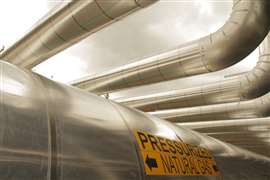 Images of Compressor Station 8A (CS-8A) at Kingsvale, BC, located along Westcoast Energy’s BC Pipeline natural gas transmission pipeline right-of-way, captured in October 2023. (Image: Enbridge)
Enbridge sees growing opportunities for natural gas pipeline and storage investments across North America, with executives pointing to increasing electricity demand, LNG exports and greater political interest in energy affordability following the U.S. midterm elections.
The Calgary-based pipeline operator placed more than $2.1 billion in gas transmission projects into service during the third quarter of 2026, including expansions in British Columbia and Tennessee. It is also advancing a $10.7 billion portfolio of sanctioned gas transmission projects and evaluating additional capacity along existing pipelines.
During the company’s third-quarter earnings call, President and CEO Greg Ebel said the changing political landscape has reinforced the importance of energy affordability and reliability, creating opportunities for natural gas infrastructure even in jurisdictions that have historically been reluctant to support pipeline development.
Ebel pointed specifically to Massachusetts, where state officials have expressed support for accelerating federal approval of additional gas pipeline capacity.
“Even in places like the Northeast on the gas side of things, governments that may not always have been entirely supportive of us,” Ebel said, state leaders are now seeking faster federal permitting decisions.
He said Enbridge’s diversified energy infrastructure strategy allows the company to pursue projects across different political and regulatory environments.
“We’re not typically following the shiny item. We’re following the fundamentals,” Ebel said.
Northeast pipeline prospects improve
The shift in political attitudes is particularly relevant to Enbridge’s plans to expand natural gas transmission capacity in the northeastern United States.
The company is advancing the previously sanctioned Algonquin Enhancement Project while working to secure commercial agreements for Project Beacon, a proposed additional expansion of the Algonquin Gas Transmission system.
Matthew Akman, executive vice president of Gas Transmission, said Enbridge completed a successful open season for Project Beacon earlier in 2026 and is continuing negotiations with customers.
The company is targeting commercialization of the project by early 2027.
Akman said the project is attracting growing interest from customers and policymakers because of its potential to improve natural gas supply and affordability in the region.
“It’s demand pull. It’s all about affordability. It’s got strong political support on both sides of the aisle,” Akman said.
He noted that governors have written letters seeking faster permitting decisions for natural gas infrastructure.
Enbridge said its existing pipeline network provides opportunities for expansions that could increase capacity without requiring entirely new pipeline corridors.
Ohio election brings focus to data center demand
The impact of the midterm elections was also raised during a discussion of Ohio, where Democrat Amy Acton was elected governor on Nov. 3.
Enbridge has identified approximately 10 GW of potential data center and power generation opportunities in the state, according to an analyst’s question during the call.
Michele Harradence, who will succeed Ebel as CEO in January 2027, said Enbridge does not expect the change in political leadership to undermine its investment outlook.
She characterized the incoming administration’s approach as balancing economic development with requirements that large electricity users contribute appropriately to infrastructure costs.
Harradence noted that Ohio has introduced a regulatory framework addressing large electricity loads, including concerns about how the costs of serving data centers should be allocated.
She said predictable regulatory policies remain important to attracting infrastructure investment.
Enbridge Gas Ohio is already undertaking a roughly $2.9 billion system modernization program, which Harradence described as the company’s primary investment activity in the state.
New data centers and gas-fired power generation could provide additional opportunities beyond that existing program.
“Data centers and power generation is kind of the gravy on top of that,” she said.
Enbridge also operates natural gas transmission assets in Ohio, including portions of its Texas Eastern Transmission system, giving the company opportunities across both utility distribution and interstate pipeline infrastructure.
Permian gas infrastructure expands
Enbridge executives highlighted growing opportunities to move natural gas from the Permian Basin to LNG export facilities, power generation customers and other markets.
The company’s Blackcomb Pipeline, developed through a joint venture, has entered service with capacity to transport up to 2.5 Bcf/d of natural gas from the basin.
Meanwhile, the 2.6 Bcf/d Bay Runner Pipeline has reached mechanical completion and is ready to supply natural gas to the Rio Grande LNG project in South Texas.
Akman said Enbridge is evaluating additional transportation opportunities both east and west of the Permian Basin as production and demand increase.
The company has received strong interest in its proposed West Texas Express project from LNG developers, utilities and power generation customers.
Enbridge believes its existing pipeline corridors, storage facilities and connections to major Gulf Coast markets could help support future expansions.
Akman said the company is considering projects that would use existing infrastructure where possible, along with new pipeline construction where needed.
The company also has nearly 90 Bcf of sanctioned natural gas storage expansions in development along the U.S. Gulf Coast and in British Columbia.
Canadian LNG expansion drives pipeline investment
In western Canada, Enbridge completed the Aspen Point expansion of its B.C. Pipeline system during the quarter, adding more than 500 MMcf/d of transportation capacity.
The approximately $860 million project was completed ahead of schedule and under budget, according to the company, and is supported by 25-year transportation contracts.
Enbridge is also advancing the approximately $2.9 billion Sunrise expansion, which is expected to enter service in 2028.
Akman said additional LNG export development along Canada’s Pacific Coast could create opportunities for further expansions of the system.
“We’re probably two or three LNG export facilities behind where we want to be in Canada off the West Coast,” he said.
He indicated that the company would seek higher returns on future expansions, particularly given competing opportunities for capital investment in the United States.
Enbridge is negotiating a new toll agreement for the B.C. Pipeline system, with the current settlement expiring at the end of 2026. Management expects to finalize an agreement by the end of 2026 or early 2027.
During the quarter, Enbridge closed a previously announced investment arrangement with KKR and Apollo to help finance the Aspen Point and Sunrise expansion programs.
The investors contributed approximately $500 million at closing and committed another $1.4 billion toward future expenditures. Their minority ownership interest in the Westcoast system is expected to reach 29% when Sunrise enters service.
Enbridge will retain majority ownership and operational control.
Gas transmission earnings increase
Enbridge’s Gas Transmission business generated third-quarter adjusted EBITDA of approximately $1.02 billion, compared with $902 million during the same period in 2025, an increase of approximately 13% in Canadian-dollar terms.
The company attributed the improvement primarily to higher revenues from rate settlements involving East Tennessee Natural Gas and Texas Eastern Transmission, favorable contracting and increased construction-related earnings.
Across the company, adjusted EBITDA increased to approximately $3.17 billion from $3.05 billion a year earlier. Earnings attributable to common shareholders rose to approximately $922 million from $488 million.
Enbridge reaffirmed its 2026 adjusted EBITDA guidance of approximately $14.4 billion to $14.9 billion.
The company reported a secured capital growth backlog of approximately $27.2 billion across its businesses and expects annual investment capacity of $7.1 billion to $7.9 billion.
Ebel, who is retiring at the end of 2026, characterized the natural gas transmission business as entering a significant period of growth.
“Our gas transmission business stands at the precipice of the largest demand cycle in recent history, driven by growing power, industrial, and LNG needs,” he said.
Enbridge expects to announce approximately $7.1 billion to $14.3 billion in additional growth projects through 2027, with gas transportation and storage among the principal areas of opportunity.


CONNECT WITH THE TEAM