Read this article in 中文 Français Deutsch Italiano Português Español
Mitsubishi Corp. to enter U.S. shale gas

January 14, 2026
Deal positions Japanese trading house across the Haynesville value chain
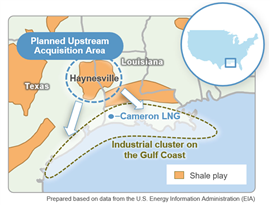
Mitsubishi Corp. has agreed to acquire Aethon Energy Management-backed Aethon III LLC, Aethon United LP and related entities in a $5.2 billion equity transaction that marks the company’s entry into the U.S. shale gas business across the full value chain, from upstream production through domestic sales and LNG exports.
The agreement, reached Jan. 16, includes Aethon’s existing stakeholders, Ontario Teachers’ Pension Plan and RedBird Capital Partners. The transaction is expected to close in the first quarter of Japan’s fiscal year, from April through June, subject to customary regulatory approvals.
Once completed, the acquisition will give Mitsubishi direct exposure to one of North America’s most strategically important natural gas basins at a time when U.S. LNG export capacity continues to expand and global buyers seek long-term supply security.
Haynesville scale and LNG proximity
Aethon’s assets are concentrated in the Haynesville Shale across Texas and Louisiana and currently produce about 2.1 Bcf/d of natural gas, equivalent to roughly 15 million metric tons per year of LNG. The basin has become a critical supply source for the southern U.S. market and is closely linked to the Gulf Coast LNG export corridor.
The Haynesville’s proximity to multiple LNG terminals is a central feature of the transaction. Aethon’s gas is currently sold into the southern U.S. market, with a portion of volumes under consideration for LNG export to Asia, including Japan, as well as to Europe. Mitsubishi already holds liquefaction capacity rights at Cameron LNG under a tolling agreement, giving the company a direct commercial pathway from upstream supply to export markets.
By acquiring Aethon, Mitsubishi gains control over a large, dry-gas production platform with established infrastructure access, allowing it to align upstream output more closely with downstream LNG and power-generation demand.
Mitsubishi has spent the past decade assembling a broad North American energy footprint. Its portfolio includes upstream shale gas development in British Columbia with Ovintiv, midstream marketing and logistics through Houston-based CIMA Energy, LNG exports via LNG Canada and Cameron LNG, and power generation investments through Diamond Generating Corp.
The Aethon acquisition builds on that platform by adding operated upstream scale in the continental United States, deepening Mitsubishi’s ability to optimize gas flows across production, marketing, liquefaction and end use.
Company officials have framed the transaction as a logical extension of Mitsubishi’s integrated energy and power strategy rather than a standalone upstream investment. Control over supply, the company has said, is increasingly important as gas markets become more globally interconnected through LNG.
Under its Corporate Strategy 2027, titled Leveraging Our Integrated Strength for the Future, Mitsubishi has outlined a value-creation framework built around three pillars: Enhance, Reshape and Create. The Aethon deal falls squarely within the Create pillar, which focuses on driving growth through synergies across existing business segments.
In practical terms, the acquisition is expected to strengthen the earnings base of Mitsubishi’s natural gas and LNG businesses while accelerating the development of a fully integrated U.S. value chain. Beyond upstream gas and LNG exports, Mitsubishi has identified opportunities to link low-cost natural gas supply to power generation, data center development, chemicals production and other gas-intensive businesses.
As data center load growth and electrification drive incremental power demand, particularly in the southern United States, access to reliable, scalable gas supply is becoming a competitive advantage. Mitsubishi’s expanded footprint positions the company to participate across multiple points in that emerging demand stack.
A long-term bet on gas
The transaction underscores Mitsubishi’s view that natural gas will remain a core component of the global energy system for decades, particularly as LNG plays a balancing role alongside renewable generation. By anchoring its U.S. strategy in the Haynesville, Mitsubishi is making a long-term bet on a basin that has proven resilient through commodity cycles and closely aligned with export growth.
If completed as planned, the Aethon acquisition would rank among the largest upstream investments by a Japanese trading house in the U.S. shale sector and signal a renewed push by global buyers to secure gas supply at the source as LNG markets tighten later this decade.

CONNECT WITH THE TEAM