Read this article in 中文 Français Deutsch Italiano Português Español
Cornerstones: Two-cycle gas engine-compressors

November 25, 2026
Part 2: Early U.S. Oil & Gas Applications
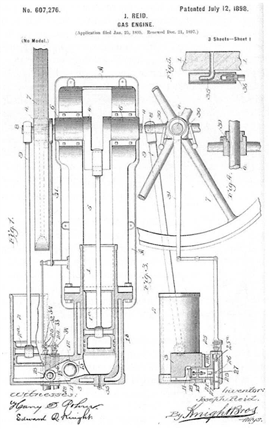 The 1898 Reid two-cycle gas engine was the first U.S. design for oil field use.
This is the second of a six-part series on the history of two-cycle gas engine-compressor development.
The last issue related the early development of two-cycle engines, which originated in Europe with the first commercially successful engine in 1858. European inventors including Étienne Lenoir, Nicholaus Otto, Dugald Clerk, Joseph Day and Karl Benz contributed to the development of two-cycle industrial internal combustion engines.
Small horsepower two-cycle engines began to appear in the U.S. by about 1890, with the first natural gas engine in oil field use built in 1893 by Joseph Reid of Oil City, Pennsylvania. Shown in Figure 1, it was patented in 1898. It was a modification of the two-cycle Clerk engine but simpler in design and operation. Similar to an 1886 patent by J.H. Clark, it had air and combustion cylinders in a one-piece jacketed casting, which prevented water from leaking into the cylinders. It also employed a speed governor and used hot tube ignition for more stable combustion. The success of this engine and the continued demand for it gave the two-cycle engine a firm and lasting grip on the oil and gas industry.
Other U.S. manufacturers entered the field using a modified Joseph Day design which accomplished the function of the pumping cylinder in the crankcase rather than using an extra cylinder. Most of the pioneering manufacturers, including the Bessemer Gas Engine Co., were located in Pennsylvania and Ohio, where oil and gas fields were prevalent at the time. Dozens of U.S. companies were manufacturing natural gas engines in the 5 to 25 hp range (4 to 19 kW) by 1900. Although belt-driving oil pump jacks and direct-driving pumping powers with rod lines that drove multiple oil pump jacks were the dominant applications at that time, some two-cycle engines were also finding use for belt-driving horizontal gas compressors to move natural gas through early pipelines to energy intensive industrial markets such as steel, glass, ceramic and cement manufacturing.
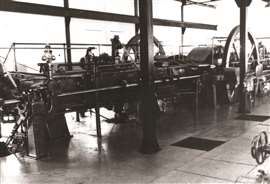 The first large horizontal spark-ignited gas engine-compressor was introduced in 1899 by National Transit, a Standard Oil Trust company, located in Oil City, PA.
While two-cycle engines were gaining popularity in oil and gas production applications, in the early 20th century, four-cycle (Otto) gas engines began to be used as power units for gas compressors. These were large horizontal double-acting engines, which could be installed either as a single or a twin engine with a single flywheel. The first large horizontal spark-ignited gas engine-compressor was introduced in 1899 by National Transit, a Standard Oil Trust company, located in Oil City, Pensylvania. Shown in Fig. 2, the 1000 hp (745 kW) unit was 74 ft. (22.6 m) long by 21 ft. (m) wide with a 13 ft. (4.0 m) diameter flywheel. This behemoth remained in gas compression service near Mt. Jewett, Pennsylvania into the 1950s.
By 1900, the Snow Steam Pump Works, a predecessor of Worthington, introduced a different type of horizontal gas-compressor as shown in Fig. 3. This unusual four-cycle design did not prevail, and Snow soon acquired the rights to the National Transit engine, producing several 4000 hp (2983 kW) monsters with tandem double-acting power cylinders on one side and a double-acting compressor on the other side. This size proved to be too large and heavy for practical use at remote pipeline stations, and, subsequently, most ranged in size from a few dozen horsepower up to about 2000 hp (1491 kW). Fig. 4 shows an installation of three 1300 hp (969 kW) Worthington horizontals. These would be the prevalent technology for Worthington, Cooper and other manufacturers of large four-cycle horizontal engine-compressors for gas pipelines until the late 1930s.
Thousands of smaller horizontal gas-engine compressors were used in other
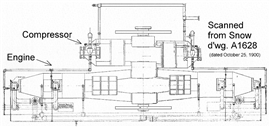 The Snow Steam Pump Works, a predecessor of Worthington, introduced this unusual horizontal gas engine-compressor in 1900.
phases of the oil and gas industry, such as flowing wells by air-gas lift, applying pressure to oil sands, placing vacuum on certain sands and for booster station service, as well as for all types of industrial service. These were manufactured by several companies. Most were four-cycle, except for the Bessemer Gas Engine Company, which was a dominant supplier in the gasoline recovery market with its two-cycle engine-compressors. In the early days, most of the smaller horizontals had the engine and compressor cylinders mounted on a single throw as shown in the two-cycle Bessemer Type VII gas engine-compressor in Figure 5.
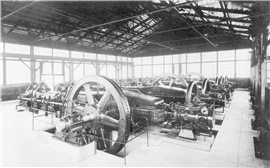 This installation of three 1300 hp (969 kW) Worthington horizontals is typical of the large four-cycle horizontal engine-compressor technology from Worthington, Cooper and other manufacturers for gas pipelines until the late 1930s.
By 1910 Bessemer had introduced the two-cycle Type X. Shown in Fig. 6, it had the engine and compressor cylinders on opposite sides of the crankcase like the larger four-cycle pipeline units. It operated at 180 rpm and produced 80 hp (60 kW) as a single-cylinder and 165 hp (123 kW) as a twin-cylinder configuration. It was a truly advanced design for its time, being a rugged, totally enclosed engine with large access covers for reaching internal components. The bed extended almost to the exhaust connection on the cylinder, thus doing away with the necessity of a secondary support. The cylinder was secured to the bedplate with external bolting, making it easier to assemble and disassemble. The engine had two independent rod packings or “stuffing boxes.” One was fitted with an oil drain ring and packed against the oil splash in the crankcase. The other packed against the air and gas mixture in the front end of the power cylinder. The compressor-end stuffing box was similar, and on both ends the stuffing box was independent of the cylinder, bolted to the bedplate.
Two-cycle gas engine-compressors, built by Bessemer and a few smaller manufacturers, were common in smaller horizontal sizes up to about 165 hp (123 kW), having fewer parts and being simpler to maintain. But they were less efficient and harder to start than their four-cycle cousins. As described in the next issue, this began to change in the early 1920s.
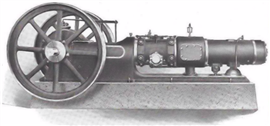 In the early days, most of the smaller horizontals had the engine and compressor cylinders mounted on a single throw as shown in this two-cycle Bessemer Type VII gas engine-compressor.
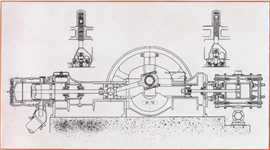 By 1910 Bessemer introduced the two-cycle Type X with engine and compressor cylinders on opposite throws like the larger four-cycle pipeline units. It operated at 180 rpm and produced 80 hp (60 kW) as a single-cylinder and 165 hp (123 kW) as a twin-cylinder configuration.
Next Issue: Better Efficiency and Emergence of Angle Configurations

CONNECT WITH THE TEAM