Read this article in 中文 Français Deutsch Italiano Português Español
Cornerstones: Worthington’s integrals
June 15, 2026
Part one of three: Large horizontal gas engine-compressors
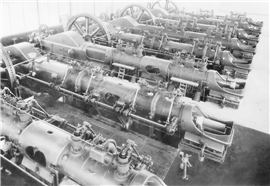 Four of six Worthington 1000 hp (746 kW) twin-tandem 22 in. (559 mm) bore x 36 in. (914 mm) stroke gas engine-compressors at a compressor station, c.1933.
Recent issues traced the early 20th century emergence of large horizontal gas engine-compressors and the evolution of C & G Cooper as the leading manufacturer of these huge machines. Close behind Cooper was the Worthington Pump and Machinery Company, formed in 1916 from the combination of several companies including the Snow Steam Pump Works, the early horizontal integral gas engine-compressor leader.
Worthington was a leader in industrial and marine compressors, pumps, reciprocating engines and other industrial machinery. In 1937, just three years before the company’s 100th anniversary, Worthington presented a paper (Fig. 1) to the American Gas Association. It highlighted the current practice in the design and construction of gas compressing equipment used on the major pipelines and in various other fields. This was at a time when horizontal gas engine-compressors had met the needs of the industry for over three decades, and smaller angle engine-compressors were just beginning to gain acceptance. The paper is quoted with minor edits.
“A review of the history of natural gas compression on pipelines immediately presents a most interesting situation. It is that the type of unit used in the first installations is, in its essentials, the standard unit of today. Likewise, the size and speed, after minor variations enduring for a greater or less length of time, has reverted to that of earlier engines. It might be legitimately asked if the development has been lax and has not kept pace with that of other types of prime movers and compressors. However, it can be shown that this continuance of a specific type for a specific field for a period of over 35 years is logical, and that development has kept well abreast of that of corresponding types in other fields.”
“Consider that, first, within a certain range of horsepower and speed, the horizontal double-acting twin tandem gas engine can be built at the lowest cost of any type, and this range is also the range which experience has shown is best adapted to pipeline service.” (Fig. 2 shows an installation of Worthington horizontals.)
“Second, the reciprocating compressor has maintained its superiority for the particular field. While centrifugal pumps and turbo blowers comprise a considerable percentage of installations in other fields, centrifugal compressors have made little headway in natural gas compression, due to the pressures involved, the flexibility required, and the lack of a suitable prime mover. Third, the type offers the simplest and most direct method of connecting the engine and compressor, resulting in maximum mechanical efficiency. Fourth, another minor advantage probably unrealized until the advent of the vertical diesel engine is the fact that the natural frequencies of the horizontal twin tandem type are above the operating range, and hence the unit can be run at any speed down to the lowest which the design and adjustment will permit.”
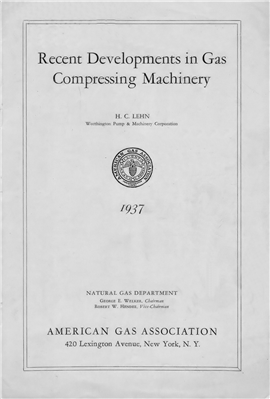 Cover page of 1937 AGA paper, Recent Developments in Gas Compressing Machinery, H.C. Lehn.
“These are the principal reasons for the type prevailing for over 35 years. The initial engineering selection was correct, a rare occurrence. The fact in itself has undoubtably contributed to the development, as thought and energy rather than having been diffused in experiments with various designs has been concentrated in the perfecting of one type in detail of design and selection of materials. In the process of this, development advantage naturally has been taken of advances in metallurgy and machine shop practice and also of the mass of field experience made available by the large number of these units installed since the recent revival in gas line construction.”
“A recent marked improvement affecting the engine control and regularity of operation is the use of a relay governor. Governors of this type have only recently come on the market, initially for the use of stationary diesel electric units and for submarines. This governor has been adapted with markedly improved results to gas pipeline engines, resulting in absolute uniform speed corresponding to the particular governor setting and regardless of the load condition. These governors are designed so that exactly the same speed is maintained at full load as at no load within the limits guaranteed by the makers. No particular care need be taken in putting on or removing the load as with governors of this type urging or racing of the engines with sudden load changes does not occur.”
“The ignition system on units of this type has been from the first, almost without exception, of the low-tension type. In the earlier engines mechanical, make and break type was standard, but for the last few years spark plugs have been used with individual spark coils close to the plug, reducing the length of the high-tension lead to a minimum. In high-tension distribution, there is a hazard in the length of high-tension cable required, and if conduits are used, trouble occurs from induction resulting in erratic ignition. Low-tension distributors have been developed and are now in use, on which the spark plug can be changed and the distributor unit for one cylinder end can be removed and replaced while the engine is in operation. These distributors permit advancing or retarding the ignition on the entire engine or that of any individual cylinder end.”



CONNECT WITH THE TEAM