Read this article in 中文 Français Deutsch Italiano Português Español
Cornerstones: Cooper Horizontals dominate

May 19, 2026
The Cornerstones of Compression series has highlighted many significant products over more than 160 years of continuous progress. This is the final of a three-issue series that traces the emergence of large horizontal gas engine-compressors at the turn of the 20th century and the emergence of the C & G Cooper Company and later, Cooper-Bessemer, as the primary manufacturer of these huge machines for four decades.
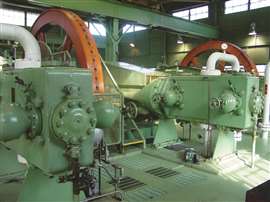 Cooper twin Type 22 compressor cylinders.
Within little more than a decade after producing its first large horizontal gas-engine compressor, it was dominating the natural gas pipeline compression market. The compressor end, shown in the tandem unit in Fig. 1, was a small part of the long and massive machines that were shipped in many pieces, requiring reassembly and careful alignment during installation at a compressor station.
The foundation and the care spent in leveling and alignment of each half of the engine was of particular importance. Indeed, the foundation was the only thing that held the two halves of a twin tandem engine in alignment. Therefore, engines of this type required truly massive foundations so that if any settling occurred, it would settle as a unit and not cause the two halves of the engine to become misaligned.
Due to the length of each side of these engines, there was a considerable amount of change in length when the engine was brought from a cold start to normal running temperature. This problem was solved by having only the main frame securely bolted to the foundation, with the center cylinder support (distance piece) and the tail guide resting on a sub-base with machined ways which allowed for perfect freedom to expand or contract due to temperature changes. A Cooper Type 22 tail guide shows this arrangement in Fig. 2.
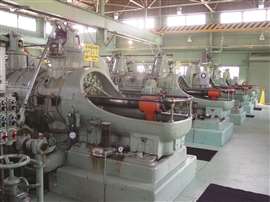 Cooper Type 22 tail guide on machined slide.
Another feature of these engines was that since the rods and pistons were fully supported on both ends and in the middle, none of their weight was brought to bear on the cylinder walls. Thus, the only wearing force on the cylinder was that of the piston sealing rings. This was one of the reasons for the exceptionally long life of the engines. The engines were originally equipped with low tension make and break ignition, with two ignitors used on each cylinder. Ignitions were upgraded as technology advanced over the life of the engines.
Although Cooper built horizontals in sizes from 50 hp (37 kW) up to 1600 hp (1193 kW), the most common were its 36 in. (mm) stroke Type 22 and its larger Type 24 and 26 cousins. The Type 22 twin was rated at 970 hp (723 kW) with the original eccentric design or 1000 hp (746 kW) with the next generation cam design. Both had a rated speed of 125 rpm. The twin engine-compressor was 52.5 ft. (16.0 m) long x 21.7 ft. (6.6 m) wide. The 14 ft. (4.27 m) diameter flywheel used on the twin weighed 30,000 lb. (13,605 kg). The shipping weight of the complete Type 22 engine was 260,000 lb. (117,914 kg), which is an astounding 260 lb./hp (158 kg/kW). Of course, for shipment, the engines were disassembled into many pieces that could be lifted onto rail cars and heavy wagons or sleds for transport to remote sites.
One of the last operating installations of Type 22 engines was at the Columbia Gas Transmission Corporation’s Rockport (West Virginia) Compressor Station. Three Cooper Type 22 horizontals were still being used at this station for injection and withdrawal of gas into underground storage until 2013, when they were retired. A crew of six, plus a station superintendent, kept the station and equipment in spotless condition and operating on demand. They also did all the maintenance work, including taking the engines apart for inspection and repairs after every 20 to 30 thousand operating hours. The big engines had been installed at Rockport in 1954, although they had been moved from an earlier compressor station that was built in 1916. So, the oldest engines operated at two different stations for almost an entire century.
Smaller models were also developed, and 1926 was a record production year of 269 Cooper horizontal engine-compressors. From 1909 until the 1929 merger with Bessemer, Cooper built a total of 1618 horizontal gas engine compressors producing 379,400 hp (282,923 kW). Bessemer’s huge factory supported increased production, which grew as the early interstate pipelines were built. One year after the merger, the larger Type 24 and Type 26 horizontals were introduced. Fig. 3 shows three twin tandem Type 24s at a Panhandle Eastern pipeline station in Kansas.
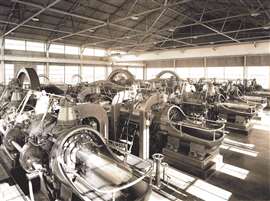 Three Type 24 twin tandem double-acting horizontals at Panhandle Eastern Pipeline in Greensburg, Kansas, 1936.
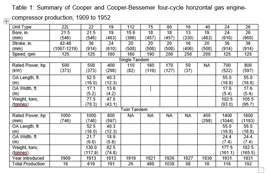
Production of most of the horizontal models continued well into the 1940s. Cooper-Bessemer horizontal gas engine-compressor production finally ended in 1952, 43 years after the first unit was shipped and 16 years after the more compact integral vee-angle engine-compressors first penetrated the market. The conservatively designed and robust horizontals were extremely reliable, but eventually, the cost and complexity of installing them took its toll in favor of the lighter and lower cost vee integrals. Table 1 summarizes the Cooper and Cooper-Bessemer four-cycle horizontal gas engine-compressor production from 1909 through 1952, totaling 2802 units with an aggregate power of approximately 1,362,100 hp (1,015,735 kW).
An interesting footnote is that in 1955 and 1956, twenty Type 22s and 47 Type 24s were field turbocharged, increasing the ratings to 1500 and 1800 hp (1119 and 1342kW), respectively.

CONNECT WITH THE TEAM