Read this article in 中文 Français Deutsch Italiano Português Español
The Emergence of Large Horizontal Gas Engine-Compressors
March 10, 2026
The Cornerstones of Compression series has highlighted many significant products over more than 160 years of continuous progress. This is the first of a three-issue series that traces the emergence of large horizontal gas engine-compressors at the turn of the 20th century and the emergence of the C & G Cooper Company and later, Cooper-Bessemer, as the primary manufacturer of these huge machines for four decades.
In the very early days of the natural gas industry, the gas was transmitted through short pipelines to nearby towns and consumers using the natural pressure from wells. After a short time this natural “rock” pressure declined so it became necessary to use compressors to raise the gas pressure to a level that overcame line losses for delivery to the consumer. At first, these were relatively small compressors that were steam driven. The first gas compressor, driven by a 580 hp (433 kW) steam engine in 1883, provided a discharge pressure of 6 psig (0.4 bar). Technological breakthroughs such as screwed connections and Dresser couplings enabled gradually higher pressure pipelines. The earliest compressor stations used a reciprocating steam engine and a separate reciprocating compressor connected by a flat belt or strands of rope. The compressors were adapted air compressors manufactured by companies such as Rand & Waring Drill and Compressor, Ingersoll-Sargeant Rock Drill, Westinghouse Machine and Laidlaw-Dunn-Gordon. The compressors were adapted air compressors manufactured by companies such as
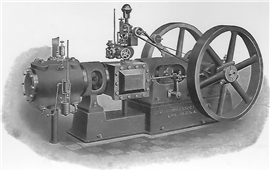 Typical steam engine driven gas compressor, c.1904.
Some horizontal integral steam engine gas compressors were in use by the late 1880s. Fig. 1 is a Bury horizontal steam engine gas compressor that was similar to many others in use around 1900. As new gas fields were discovered in remote areas well away from markets, a demand was created for ever larger direct-driven steam engine-compressors. Manufacturers of these larger machines included Allis-Chalmers, Bury, C. & G. Cooper, Laidlaw-Dunn-Gordon, and Westinghouse. But steam engines required boilers that were usually fired with coal or wood, required constant attention and consumed water, all of which added cost and created logistical challenges for operation in remote areas.
By the last decade of the 19th century, small natural gas engines were being produced by a number of companies. These were prevalent at the wellheads and some were replacing steam engines as drivers for belt-driving compressors.
The National Transit Company, which manufactured most of the pump machinery used by its parent company, Standard Oil, built the first large horizontal gas engine-compressor. The huge machine, shown in Fig. 2, was installed in 1899 near Mt. Jewett, Pennsylvania. The twin tandem engine had four 25 in. (635 mm) diameter by 48 in. (1219 mm) stroke single-acting power cylinders on one side of the crankshaft. On the opposite side was a 31 in. (787 mm) diameter by 24 in. (610 mm) stroke low pressure compressor cylinder and a 15.25 in. (388 mm) diameter by 24 in. (610 mm) stroke high pressure compressor cylinder. National Transit nameplated the original engine at 1000 hp (746 kW), but it is doubtful that the four two-cycle cylinders produced that much power. Only two of these engines were built in National Transit’s Oil City, Pennsylvania shops.
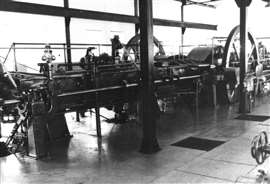 Early Cooper Corliss horizontal steam engine.
The Snow Steam Pump Works of Buffalo, New York manufactured its first gas engine-compressor in 1901 using the National Transit drawings and patterns. By 1902, Snow had developed its own four-cycle horizontal integral gas engine-compressor. Two huge 38 in. bore x 60 in. stroke (965 x 1524 mm), 4000 hp (2983 kW) machines were built for Hope Natural Gas Company’s Hastings Station in West Virginia. Some years later, these behemoths were cut apart and made into four single units. In 1904, three large Snow horizontal engine-compressors were built for the Ohio Fuel Gas compressor station in Homer, Ohio. Interestingly, these were manufactured for Snow by the C. & G. Cooper Company in nearby Mount Vernon, Ohio.
A few other companies entered the gas pipeline market with large horizontal gas engine-compressors. One that had early success was Westinghouse, which introduced its first horizontal integral gas-engine compressors for natural gas compression in 1905. Allis-Chalmers of Milwaukee, Wisconsin also produced a few for pipelines. Snow remained the early leader in supplying large horizontal gas engine-compressors, growing to become part of the Worthington Pump and Machinery Corporation in 1916.
The C. & G. Cooper Company, founded in 1833, was a leading manufacturer of large Corliss steam engines. It had built large vertical and horizontal steam engines, such as the example shown in Fig. 3. By the early 1900s, it had also built a number of horizontal steam engine gas compressors for industrial applications. But Cooper faced a crossroads. It had built approximately 15,000 steam engines throughout its history, and demand for Corliss engines was still robust. However, steam turbines, growing rapidly in size and efficiency, seemed destined to dethrone the large Corliss reciprocating steam engines. At the same time, large engines fueled by natural gas were proving successful in the mushrooming steel industry and held promise for the compression of natural gas in pipelines. The company decided to evolve into the production of natural gas internal combustion reciprocating engines. Since no one in the company was familiar with gas engines, a wide survey was conducted, and Cooper decided to build an engine that employed the best engineering features of several engines in its own design. A German engineer, Martin A. Thiel, was hired to lead the effort.
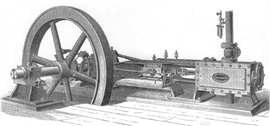 National Transit horizontal gas engine-compressor, 1899.
Cooper introduced its first horizontal integral gas engine-compressor in 1909. The 730 hp (544 kW), 90 rpm machine had a single-throw with tandem double-acting 20 in. (508 mm) bore x 42 in. (1067 mm) stroke horizontal power cylinders and an opposed double acting Wilson-Snyder compressor cylinder of the same bore and stroke. Installed in West Virginia to compress natural gas for the Wheeling Natural Gas Company, it was a complicated machine, and one salesman described its slow speed by saying its piston “goes today and comes back tomorrow.” Nevertheless, it provided long, faithful service and initiated Cooper’s entry into the gas pipeline transmission industry, an industry that it would soon dominate for much of the 20th century. It is probable that some of Cooper’s early gas engine experience was “inherited” from the Snow Engine Works of Buffalo, New York, as the records show that Cooper had built four 920 hp (686 kW) 22 in. (559 mm) bore x 48 in. (1219 mm) stroke twin-tandem double-acting gas engine-compressors of the Snow design by 1910. That same year, Cooper built a 455 hp (339 kW), 150 rpm, 21 in. (533 mm) bore x 30 in. (762) stroke single-throw, double-acting gas engine driving a DC generator.

CONNECT WITH THE TEAM