Cornerstones: History of two-cycle gas engine-compressors
October 12, 2026
Part 1: European Origins
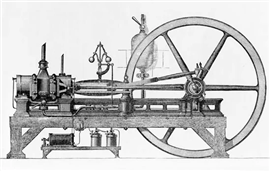 The two-cycle Lenoir engine in 1858 was the first commercially successful internal combustion engine.
From the very early days when internal combustion engines replaced steam engines, two-cycle gas engine-compressors have played a critical role in success and reliability of the oil and gas industry. This is the first of a six-part series on the history of two-cycle gas engine-compressor development.
Earliest development of the internal combustion engine can be traced back as far as the 17th century, a time of growing scientific curiosity and mechanical innovation. In the 19th century, the limitations of steam power were becoming evident. Steam engines, while revolutionary, were bulky, inefficient and required a constant water supply, limiting their applicability. Visionaries of the time began to conceive a more compact and efficient means of harnessing power, envisioning an engine that could operate on the principles of internal combustion – a radical idea at the time.
This period also saw advancements in metallurgy and mechanics, which were essential for the eventual construction of the internal combustion engine. The ability to craft more precise and durable engine components allowed for the intricate designs necessary for an internal combustion mechanism. The creation of such an engine was a collaborative effort, marked by groundbreaking contributions of numerous European inventors.
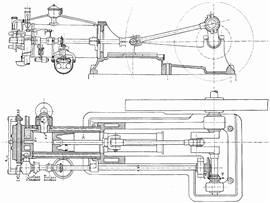 Original patent drawings of Otto’s 1876 four-cycle engine, which improved efficiency and became the foundation for modern internal combustion engines.
The Lenoir engine, invented by Belgian-French engineer Étienne Lenoir in 1858 was the first commercially successful internal combustion engine. Shown in Figure 1, it featured a horizontal power cylinder with a two-stroke cycle (“two-cycle”), double-acting design that converted a steam engine to burn a mixture of coal gas and air, ignited by a spark from a coil. Similar to a steam engine, slide valves admitted the air-fuel mixture and discharged exhaust gases. The air-fuel mixture was not compressed before ignition, which made the engine relatively quiet and durable, but inefficient.
The two-cycle combustion process completes a power cycle in only one revolution of the crankshaft. During the first, outward (from the crankshaft), stroke, the end of the exhaust/intake (i.e., scavenging) is completed along with the compression of the air-fuel mixture. The second, inward (toward the crankshaft), stroke encompasses the combustion of the mixture, the expansion of the hot gases, and near the end of the stroke, the beginning of the scavenging flows that use fresh air or air-fuel mixture to sweep exhaust gases out of the cylinder.
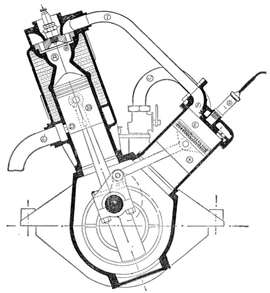 The 1878 Clerk design was the first successful two-cycle gas engine that used a separate charging cylinder (right) to compress the air-fuel mixture before combustion.
Although the Lenoir engine was inefficient and prone to overheating, it inspired subsequent inventors, including German engineer Nicholaus Otto, whose four-stroke cycle (“four-cycle”) engine greatly improved efficiency and became the foundation for modern internal combustion engines. Otto’s engine, invented in 1876, is shown in his original drawings in Figure 2. The single-acting piston compressed the fuel before ignition and used a connecting rod and crankshaft similar to those in modern engines. Subsequently, Otto invented the electric ignition in 1884. These inventions greatly improved efficiency and power. The engines used the four-stroke Otto cycle with an intake stroke where the piston moves inward (toward the crankshaft), drawing in a mixture of air and fuel; then a compression stroke where the piston moves outward (away from the crankshaft), compressing the trapped air-fuel mixture; then a power stroke where the mixture is ignited, causing an explosion that pushes the piston again inward; and finally an exhaust stroke where the piston moves outward, expelling the burned gases. The process requires two complete revolutions of the engine crankshaft, producing power on every other revolution.
The first successful two-stroke gas engine that compressed the air-fuel mixture before combustion is attributed to Scottish engineer Dugald Clerk in 1878. Shown in Figure 3, Clerk’s engine used a separate charging cylinder, which distinguished it from later crankcase-scavenged designs.
Other engineers, including Joseph Day of England and Karl Benz of Germany made significant contributions to two-cycle engine evolution. Day pioneered crankcase compression, which used the area below the piston as a charging pump, and later, valveless designs. In reality, his initial 1891 “valveless” engine design, shown in Figure 4, included a simple check valve in the inlet port communicating directly with the crankcase. Shortly after introduction of the new engine, one of Day’s workmen, Frederick Cock, patented a modification that enabled it to become genuinely valveless. An additional port lower in the cylinder wall allowed the skirt of the piston to control the inlet phase, thus doing away with the check valve and giving rise to the classic three-port layout. The inlet port admits a fresh air-fuel mixture into the combustion chamber, the exhaust port vents the burned gases out of the cylinder, and the transfer port connects the combustion chamber to the crankcase, allowing the compressed fresh charge from the crankcase to enter the cylinder during the compression stroke.
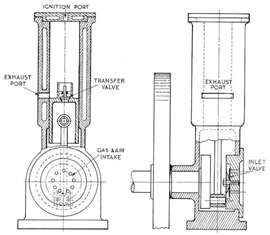 The 1891 Day engine pioneered two-cycle gas engine crankcase compression, which used the area below the piston as a charging pump.
Development of early designs without intake and exhaust valves made two-cycle engines more attractive for many industrial applications, being simpler and easier to maintain, albeit with lower efficiency.
The first natural gas engine in oil field use was built in 1893 by Joseph Reid of Oil City, Pennsylvania. The next issue will continue the history of two-cycle gas engine-compressor development in the U.S. oil and gas industry.
Next issue: Early U.S. Oil & Gas Applications


CONNECT WITH THE TEAM