Read this article in 中文 Français Deutsch Italiano Português Español
Cornerstones: Worthington Pump and Machinery

August 31, 2026
Worthington developed “unibloc” integral gas engine-compressors
The Worthington Pump and Machinery Company was a leader in industrial and marine compressors, pumps, reciprocating engines and other industrial machinery. It was a major supplier of large horizontal gas engine-compressors.
In c.1920, with substantial experience in vertical engines as well as in compressors, Worthington developed “unibloc” integral gas engine-compressors. Shown in Fig. 1, these machines had vertical 11.5 in. (292 mm) bore, 12.0 in. (305 mm) stroke power cylinders and vertical 12.0 in. (305 mm) stroke compressor cylinders in an inline configuration, forward of the power cylinders on a common frame.
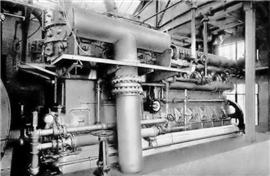 Fig. 1.
Although they were a novel, space-saving idea, these types were limited to one or two compressor cylinders with modest diameters and pressure ratings. Reeves Gas Engine Company was thought to have been the first to introduce such machines in c.1915. But in 1927-1928, Worthington pioneered the industry’s first angle-type integral gas engine-compressor.
Shown in Fig. 2, this design had vertical power cylinders and horizontal compressor cylinders on a common frame. These four-cycle, spark-ignited 300 rpm angle integral engine-compressors were much more compact than the horizontals, but they averaged only 37.5 hp (28 kW) per cylinder. They were built with four, six or eight power cylinders and typically half that number of compressor cylinders. These machines gradually gained favor over horizontals for applications under about 300 hp (224 kW), but it would be more than another decade before longer stroke, large-bore angle engine-compressors threatened the bigger horizontals used on long-haul natural gas pipelines.
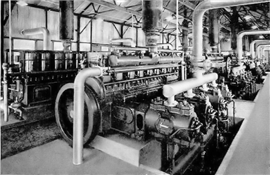 Fig. 2.
In 1937, just three years before the company’s 100th anniversary, Worthington’s H. C. Lehm presented a paper to the American Gas Association in New York. Lehm’s paper highlighted the (then) current practice in the design and construction of gas compressing equipment used on the major pipelines and in various other fields. The last Cornerstones of Compression article focused on excerpts that highlighted Worthington’s assessment of large gas engine-compressor technology in 1937 – a time when horizontal gas engine-compressors had met the needs of the industry for over three decades and angle engine-compressors were still in their infancy. In this article, excerpts from the 1937 paper compare some of the “new” vertical and angle integral gas engine-compressors. The paper is quoted with minor edits.
“These standard (horizontal) units used on the pipelines are equally adapted to compression in other fields such as manufactured gas distribution at comparatively low pressures, compression of refinery gas and of the synthetic gases developed in chemical processes. In most cases, however, service of this sort calls for lower unit capacity than that of the pipeline compressor, a requirement which is met by several designs of fairly recent development. Prominent among these are the so-called angle types, in principle an adaptation from the old horizontal vertical blast furnace blowing engine but with the relative positions of the power and compression ends reversed. These units are built with the vertical power connecting rod and the horizontal compressor rod coupled to a common crank pin box or with separate power and compressor boxes side by side on a common crank pin. The design provides for considerable range in capacity as any particular size of power cylinder may be combined in units of from one to four compressor cylinders which may be of any diameter within a reasonable range to suit the particular conditions.”
“The vertical power end in combination with the compactly connected horizontal compressors results in all parts being in locations where they are most accessible, both for connection of the compressor suction and discharge piping and intercoolers where the latter are required, and for attendance and field adjustments. The floor space and foundation requirements are small, resulting in a fairly low station cost per horsepower. Where the cooling water supply is a problem, fans with a closed system may be used, reducing the water requirements to a minimum. An installation of this type is adapted to temporary locations as the entire station may be moved at minimum expense.”
“Another type is the vertical multi-cylinder gas engine, with the compressor forming a separate unit, driven through a coupling from the end of the engine shaft, or with the compressor cylinders and running gear carried in an extension of the engine main frame. The latter forms a self-contained and compact unit and has nearly all the advantages of the angle type. It is not adapted to quite so wide a range in number and size of compressor cylinders but requires no more and in some cases less foundation and floor space. The inertia forces of this type of unit may be more completely balanced than those of the angle type, the degree depending upon the number and arrangement of the cylinders, power and compressor. For example, a unit consisting of four power cylinders and two compressor cylinders at one end has only slight unbalance remaining, and by placing a compressor cylinder at each end may be put in complete balance, corresponding to the six-cylinder power engine. In general, the free forces and unbalance couples of the vertical unit of five or more total cylinders are of minor magnitude compared to those of the horizontal compressor and, hence, the type has a decided advantage for installation on poor soil or in localities where transmission of vibration would be objectionable.”
“Where the power required approaches that of the standard horizontal double-acting unit, the advantages of these types disappear to some extent, as they are inherently more expensive per horsepower in the large sizes and the saving in floor space and foundation is absorbed by the higher engine cost.”
To be continued...

CONNECT WITH THE TEAM