Read this article in 中文 Français Deutsch Italiano Português Español
Natural gas demand from power sector expected to hit record high in 2027

May 31, 2026
Growing data center, manufacturing and oilfield electrification loads drive forecast increase
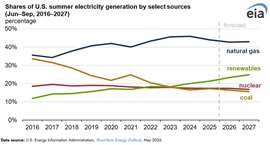
U.S. natural gas consumption for electricity generation is expected to remain near record levels this summer before reaching a new high in 2027, according to the U.S. Energy Information Administration’s (EIA) latest Short-Term Energy Outlook.
The EIA forecasts natural gas consumption by the electric power sector will average 43.7 billion cubic feet per day (Bcf/d) during the summer months of June through September 2026, matching the level recorded during the summer of 2025 and remaining 4% above the five-year summer average.
Looking ahead, the agency expects power-sector natural gas demand to climb to 46.1 Bcf/d during the summer of 2027, a 6% increase from 2026 levels and 3% higher than the previous record set in 2024.
The projected increase comes despite growing contributions from renewable energy sources. The EIA forecasts overall U.S. electricity demand will rise about 2% this summer, while natural gas-fired generation remains essentially flat as additional renewable generation, particularly solar, meets a larger share of demand growth.
According to the agency, record gas consumption in 2027 will be driven primarily by rising electricity demand in the commercial and industrial sectors, particularly in the West South Central and Mid-Atlantic regions.
The EIA cited rapid growth in data centers and large manufacturing facilities as major contributors to increasing commercial electricity demand. Texas and Virginia are expected to be among the largest drivers of load growth, with new facilities requiring substantial amounts of power for both operations and cooling.
In the West South Central region, commercial and industrial electricity demand is forecast to increase 20% between the summers of 2025 and 2027. Industrial demand is also expected to rise as electrification expands within oil and natural gas operations and other industrial projects.
The Electric Reliability Council of Texas (ERCOT), which manages the grid serving most of Texas, is expected to meet growing demand through a combination of additional natural gas and solar generation.
The EIA forecasts ERCOT’s natural gas-fired generation will increase 22% between the summers of 2025 and 2027, underscoring the continued importance of gas-fired generation even as renewable capacity expands.
The PJM Interconnection, which operates the power grid across much of the Mid-Atlantic region, is also expected to increase its reliance on natural gas generation.
According to the EIA, natural gas consumption for electricity generation within PJM has steadily increased over the past decade as electricity demand has risen and natural gas has become increasingly competitive with coal-fired generation.
The agency forecasts natural gas generation within PJM will increase 6%, or about 9 billion kilowatt-hours, during the summer of 2027 compared with the summer of 2025. Over the same period, solar generation is expected to grow 32%, or approximately 4 billion kilowatt-hours.
Nationally, the U.S. power generation mix continues its long-term shift away from coal and toward natural gas and renewable energy sources.
Over the past decade, summer electricity generation has increasingly relied on natural gas and renewables, particularly solar power, while coal’s share of generation has steadily declined.
The EIA forecasts renewables will account for 25% of U.S. summer electricity generation in 2027, up from 21% in 2025.
For the natural gas industry, the outlook highlights how rising electricity demand from data centers, advanced manufacturing and electrified industrial operations is creating additional demand for gas-fired generation, even as renewable energy deployment accelerates.
The forecast suggests natural gas will continue to play a central role in supporting grid reliability and meeting growing power demand in major load centers across the United States.

CONNECT WITH THE TEAM