Read this article in 中文 Français Deutsch Italiano Português Español
Hanwha Power, Pembina explore waste heat recovery at compressor stations

May 27, 2026
Companies to evaluate supercritical CO2 technology for lower-carbon power generation across Canadian midstream infrastructure
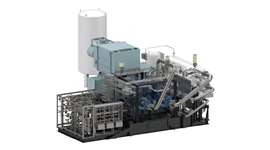 A Hanwha Power Systems’ CO2 power system. Hanwha and Pembina are exploring waste heat recovery at compressor stations and other infrastructure. (Image: Hanwha)
Hanwha Power and Pembina Pipeline Corp. have signed a memorandum of understanding to evaluate deployment of waste heat recovery power generation technology at natural gas compressor stations and other energy infrastructure across Canada.
The non-binding agreement calls for the companies to jointly assess the technical and economic feasibility of deploying Hanwha Power’s supercritical carbon dioxide-based waste heat recovery systems at facilities operated by Pembina, one of North America’s largest energy transportation and midstream service providers.
The collaboration targets a growing opportunity in the midstream sector: capturing waste heat from gas turbines and other industrial equipment and converting it into electricity without additional fuel consumption.
Under the agreement, the companies will identify potential pilot projects, evaluate their commercial viability and explore broader opportunities for lower-carbon power generation within the North American midstream market.
For compressor station operators, the concept offers the potential to improve energy efficiency while reducing greenhouse gas emissions from existing assets.
Hanwha’s technology utilizes supercritical carbon dioxide as the working fluid in a closed-loop power cycle. In a supercritical state, carbon dioxide exhibits characteristics of both a liquid and a gas, allowing for more compact equipment designs and improved thermal efficiency compared with conventional systems.
According to Hanwha, the technology operates without water consumption and is designed for unmanned operation, characteristics that could be particularly attractive in remote pipeline and gas gathering locations where water availability is limited and staffing requirements can add operating costs.
The system generates electricity by recovering waste heat that would otherwise be released to the atmosphere. In compressor station applications, that heat could be sourced from natural gas turbine exhaust streams or other industrial processes.
Waste heat recovery has long been viewed as a potential pathway for improving efficiency in the oil and gas sector, but deployment has often been constrained by equipment size, economics and site-specific operating requirements. Hanwha believes its supercritical CO2 approach can address some of those challenges through improved performance and a smaller physical footprint.
The company also noted that carbon dioxide is non-flammable and non-toxic, eliminating some of the safety concerns associated with alternative working fluids used in certain waste heat recovery systems.
Pembina, headquartered in Calgary, Alberta, operates an extensive network of natural gas pipelines, liquids pipelines, gas gathering and processing facilities, natural gas liquids infrastructure and export terminals across Western Canada and North America.
If successful, the collaboration could provide Pembina with an opportunity to improve the energy efficiency of existing compressor stations and processing facilities while supporting corporate emissions-reduction objectives.
Chris Rousch, Pembina’s senior vice president of Commercial, said evaluating technologies that can enhance the performance of existing infrastructure aligns with the company’s long-term strategy.
“Actively exploring opportunities to enhance the efficiency and long-term value of our operating assets is core to our business at Pembina,” Rousch said. “Our collaboration with Hanwha creates further opportunities to deliver differentiated value for our customers and stakeholders.”
The initiative also aligns with Hanwha Power’s broader strategy to expand its presence in North America.
The company said the project is being pursued alongside industrial and technological benefits programs linked to Hanwha Ocean’s participation in Canada’s Patrol Submarine Project and could serve as a platform for broader deployment of Hanwha’s energy technologies in the region.
Michael Sicker, head of the Americas for Hanwha Power, described the agreement as an important step in expanding the company’s green energy portfolio in Canada.
“This collaboration is a meaningful first step toward expanding our green energy solutions business in the Canadian market,” Sicker said. “By combining industrial cooperation with lower-carbon technology, we will contribute to mutual growth with local industry and create long-term business value.”
For the natural gas industry, the project highlights growing interest in technologies that can extract additional value from existing infrastructure. As pipeline operators and midstream companies seek to improve efficiency, reduce emissions and support sustainability goals, waste heat recovery systems may offer a way to generate additional power from assets already in service without increasing fuel consumption.
The proposed pilot evaluations will determine whether the technology can be deployed economically at compressor stations and other midstream facilities, potentially opening a new avenue for emissions reduction and energy efficiency improvements across North America’s natural gas infrastructure network.


CONNECT WITH THE TEAM