Read this article in 中文 Français Deutsch Italiano Português Español
ExxonMobil, GHGSat launch satellite methane monitoring partnership

September 04, 2025
Collaboration to cover operations in North America and Asia
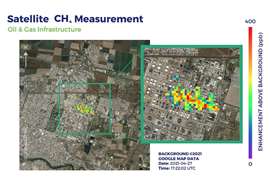
ExxonMobil Corp. has partnered with GHGSat, a Montreal-based leader in satellite emissions monitoring, to expand methane detection and mitigation efforts across ExxonMobil’s onshore operations in the United States, Canada, Papua New Guinea, and Indonesia.
The agreement marks ExxonMobil’s largest investment in satellite-based emissions tracking and reflects its broader strategy to cut methane emissions intensity by 70 to 80 percent by 2030.
Under the partnership, GHGSat’s satellite network will provide near-real-time emissions data to ExxonMobil’s Center for Operations and Methane Emissions Tracking (COMET). The center, launched in 2022, integrates satellite and ground-based measurement tools with ExxonMobil’s Vantage team to monitor upstream operations and guide targeted mitigation strategies.
ExxonMobil has already cut methane emissions intensity more than 60 percent since 2016 and eliminated routine flaring at its operated assets in the Permian Basin. The GHGSat data is expected to enhance that progress by pinpointing leaks as small as 100 kilograms per hour, down to individual pieces of equipment.
“With GHGSat’s cutting-edge satellite constellation—and the comprehensive data and insights it delivers—we are able to monitor assets at scale via satellite for the first time, informing mitigation strategy and action,” said Matt Kolesar, ExxonMobil’s chief environmental scientist.
GHGSat operates 14 satellites that provide near-continuous monitoring of industrial facilities worldwide. The company said its monitoring cadence and ability to deliver data within hours give operators the tools to respond quickly and effectively. Since its first launch in 2016, GHGSat has supported the mitigation of more than 20 million metric tons of carbon dioxide equivalent of methane.
“This partnership demonstrates the power of the intersection of innovative technology and industry leadership to truly move the needle on methane,” said Stephane Germain, GHGSat CEO.
Methane, which has a warming effect roughly 80 times stronger than carbon dioxide over a 20-year period, is considered one of the most urgent emissions to address in global climate efforts. Reducing methane not only strengthens environmental performance but also reduces product loss and ensures compliance with increasingly stringent emissions regulations.
By integrating GHGSat’s monitoring capabilities with its operational systems, ExxonMobil said it aims to strengthen environmental stewardship while maintaining efficient, resilient energy production across its global portfolio.



CONNECT WITH THE TEAM