Read this article in 中文 Français Deutsch Italiano Português Español
Canadian, Appalachian gas supplies pressure New England prices

September 09, 2026
Algonquin Citygate traded below Henry Hub from April through July as Canadian imports reached record levels and regional gas consumption declined
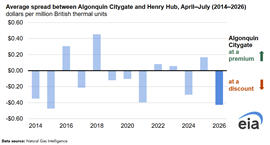
Low-cost Appalachian gas, record Canadian imports and softer New England demand pushed regional natural gas prices below the Henry Hub benchmark during much of the spring and summer, according to the U.S. Energy Information Administration (EIA).
Natural gas at Algonquin Citygate, a key pricing point for New England, averaged $0.43/MMBtu less than Henry Hub from April through July 2026. EIA said that was the second-largest discount for the four-month period in data from Natural Gas Intelligence dating to 1999.
The pricing trend represents a sharp contrast with conditions that can develop during New England winters, when heating demand and pipeline constraints can send Algonquin prices to substantial premiums over Henry Hub.
During warmer months, however, lower heating demand and increased renewable electricity generation generally reduce the region’s call on natural gas.
Appalachian supplies weigh on prices
Abundant Appalachian production has been a major factor in keeping New England gas prices relatively low.
Appalachia accounted for 31% of U.S. marketed natural gas production in 2025, more than any other U.S. producing region, according to EIA. Pipeline connections between Appalachia and the Northeast give New England access to that relatively inexpensive supply.
From April through July, the Appalachia regional average hub price was $0.77/MMBtu below Henry Hub. EIA said that represented the second-widest discount on record for the period.
Additional supply has been arriving from Canada. Citing S&P Global Energy data, EIA said net Canadian natural gas flows into New England averaged a record 0.4 Bcf/d from April through July. That was more than 2.5 times the volume imported during the same four months of 2025.
Gas demand declines
The increased supply coincided with weaker regional consumption. Total New England natural gas consumption from April through July was 5% lower than during the same period last year, according to S&P Global Energy data cited by EIA.
Power generation accounted for part of the decline. Gas-fired electricity generation in New England fell by 1.1 billion kWh, or 6%, compared with April through July 2025.
Renewable generation moved in the opposite direction. Wind generation increased by 0.7 billion kWh, or 59%, while utility-scale solar generation rose by 0.2 billion kWh, or 29%.
The combination of relatively inexpensive Appalachian production, higher Canadian imports and reduced regional consumption has consequently eased the supply-demand balance in a market better known for experiencing natural gas price constraints during periods of high winter demand.


CONNECT WITH THE TEAM