Ariel details advancements in smart compressor platform

January 22, 2026
Updated sensors, Modbus connectivity and predictive diagnostics
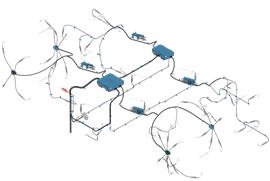
Ariel Corp. has continued to refine its Ariel Smart Compressor (ASC) technology since first introducing the platform in 2019, with more than 1,600 units now operating in the field. Jacob Shackelford, director of marketing for Ariel, outlined the latest updates during a presentation at the European Forum on Reciprocating Compressors (EFRC) in Hamburg, Germany.
The ASC platform is designed as an Ariel-installed monitoring and performance calculation system that runs directly on the compressor. Shackelford said most installations to date have been in the United States and Canada, with additional units in Argentina and the Middle East. Experience from those deployments has driven updates focused on more robust sensors, expanded connectivity, and simplified field retrofit options.
“We are providing greater access to performance data directly at the compressor,” Shackelford said. “The goal is to compare theoretical performance to real operating conditions and use that comparison to improve reliability, decision-making and response.”
Digital twin calculation onboard the compressor
At the core of the system is a digital twin that performs Ariel performance calculations in real time. The module continuously compares expected compressor performance to measured data. That calculation is then used to trigger alerts or shutdown signals through the unit’s existing skid controller, regardless of whether the site uses Allen-Bradley, PLCs or other control platforms.
ASC does not control the skid directly, Shackelford noted. “We send the signal. The operator or the PLC determines the action.”
The system communicates through Modbus over RS-485, providing access to roughly 1,500 registers for integration into SCADA systems, IoT gateways or proprietary monitoring environments. Every Ariel compressor shipped over the past two years has been “ASC-ready,” simplifying retrofits in the field.
A CSA-certified version is currently available, with HX and C certifications planned for international applications.
Focus on sensor improvements and field practicality
Newer ASC configurations include upgraded sensors for process pressures and temperatures, crankshaft and lubrication monitoring, and vibration measurements. Optional components include valve cap temperature sensors and packing vent temperature sensors, now available in sour gas-compliant versions.
A recently introduced isolation manifold block allows operators to troubleshoot or replace pressure sensors without shutting down and depressurizing the compressor. “This makes field service significantly more efficient,” Shackelford said.
ASC also includes onboard data storage. If a shutdown occurs, the module retains a “black box” record that can be retrieved via USB or transmitted through an IoT gateway to Ariel’s Fleet Manager online monitoring portal. The Fleet Manager system provides remote trend analysis and supports post-event evaluation.
Predictive diagnostics expanding
One of the platform’s most significant advancements is the calculation of a valve leak index. By performing a flow balance across the compressor and comparing valve cap temperatures, the system can indicate which valve is degrading. Shackelford said the system can also monitor torsional vibration and predict crosshead pin mount reversal events before they occur.
A new predictive model is being developed to identify packing leaks based on temperature profiles, using data collected across hundreds of operating compressors. This approach could reduce or eliminate the need for separate flow meters in many applications.
ASC is now pre-selected as a standard option on Ariel compressors shipped within the United States and Canada. It is also available for international shipments, and compatibility for older units depends on the model and age of the frame.
“Our intent is to make ASC flexible,” Shackelford said. “Whether an operator wants local visualization, SCADA integration, cloud connectivity, or just black-box capture, the system supports those modes.”
Supporting documents
Click links below to download and view individual files.


CONNECT WITH THE TEAM