Read this article in 中文 Français Deutsch Italiano Português Español
SwRI secures $1.75 million for hydrogen component testing projects

December 15, 2025
ENERGYWERX funding supports valves, meters, sensors and materials research
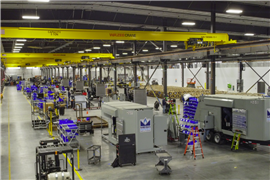
 The ENERGYWERX program has funded eight Southwest Research Institute projects related to hydrogen fuel. Many of the projects will be conducted in SwRI’s Metering Research Facility, a world-class, high-accuracy, high-technology flow measurement facility that simulates actual field conditions.
Southwest Research Institute has received $1.75 million in funding through the ENERGYWERX program to support eight hydrogen-focused research projects aimed at improving the safety, reliability and performance of emerging hydrogen energy infrastructure.
The projects center on testing critical components used across hydrogen production, transportation, storage and end-use applications. SwRI said the work is intended to accelerate deployment of hydrogen technologies by providing data-driven validation aligned with international standards.
ENERGYWERX is a U.S. Department of Energy initiative designed to expand cooperative research between the DOE and nonprofits, private companies, utilities and other organizations by accelerating the development and commercialization of clean energy technologies.
Several of the funded projects focus on high-pressure hydrogen systems used in refueling and underground storage applications.
SwRI will conduct pressure cycle testing on a hydrogen check valve designed for high-pressure gaseous hydrogen refueling. The testing will follow guidance from ISO 19880-3, an internationally recognized standard for hydrogen fueling stations. To support this effort, SwRI will commission a new test facility capable of evaluating valve integrity at hydrogen pressures of up to 15,000 psi. The project is led by Jacqueline Manders, assistant program manager in SwRI’s Fluids Engineering Department.
Manders will also oversee testing of valves used in underground hydrogen storage wells at the same facility. The work will evaluate valve reliability under repeated exposure to high-pressure hydrogen and extreme temperature conditions. These environments can embrittle metallic materials and degrade sealing elements, increasing the risk of leakage over time.
Another project expands SwRI’s liquid hydrogen testing infrastructure to support cryogenic component evaluation. The effort will establish new facilities and methodologies to test liquid hydrogen pumps, valves and related components using liquid hydrogen rather than surrogate fluids such as liquid nitrogen.
The project, led by Senior Research Engineer Brandon Ridens, is designed to generate performance data for cryo-compressed hydrogen storage systems. SwRI said testing with actual liquid hydrogen provides more representative results for safety, reliability and compliance with global standards.
Multiple projects address challenges associated with hydrogen-natural gas blending in existing pipeline infrastructure.
SwRI Assistant Program Manager Matthew Godush will lead testing of ultrasonic flow meters adapted to measure hydrogen-natural gas blends. Because hydrogen has significantly different flow properties than methane, conventional natural gas meters can produce inaccurate readings when hydrogen is introduced. SwRI will evaluate the meters’ performance using existing transmission pipeline technology to help utilities assess blending options without large-scale infrastructure replacements.
Godush will also lead testing of a gas analysis sensor designed to detect hydrogen and methane concentrations in blended gas streams. The project will evaluate the sensor’s ability to rapidly and accurately assess blend ratios under real-world operating conditions.
Additional work under Godush’s leadership includes validation of a hydrogen gas analysis sensor for sensitivity, response time and accuracy across a range of concentrations and environmental conditions. SwRI will also assess detection technologies for identifying hydrogen leaks under operational conditions, calibrating systems against known leak scenarios to strengthen safety protocols.
Another funded project examines the compatibility of O-ring materials in hydrogen gas environments. Fassett Hickey of SwRI is leading testing focused on polymeric sealing materials commonly used in aerospace, energy and industrial hydrogen applications.
Because hydrogen molecules are extremely small, they can permeate polymer materials, leading to blistering or rupture during rapid decompression events. SwRI will evaluate O-ring reliability and safety to support improved material selection and equipment design.
Many of the projects will be conducted at SwRI’s Metering Research Facility, a high-accuracy flow measurement center designed to simulate real-world operating conditions. Engineers and scientists from multiple disciplines are collaborating across the projects as part of SwRI’s broader hydrogen research program.
The ENERGYWERX-funded projects are underway and are expected to be completed by the end of 2026.


CONNECT WITH THE TEAM