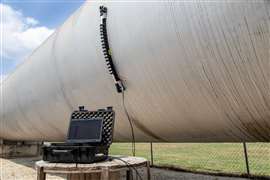
 Southwest Research Institute (SwRI) has created a magnetostrictive (MST) probe that uses guided wave technology to detect corrosion in storage tanks, creating a more cost-effective and efficient inspection method. SwRI’s probe attaches to the side of a storage tank and produces a highly detailed map of damaged areas inside.
Southwest Research Institute (SwRI) has developed a magnetostrictive transducer (MST) probe designed to detect corrosion in storage tanks without requiring operators to empty the tanks for inspection, a process that traditionally involves significant downtime and manual entry into confined spaces.
The technology uses ultrasonic guided wave inspection to identify corrosion and structural flaws from outside the tank wall. By eliminating the need to drain and clean tanks before inspection, the probe offers oil and gas operators a potential way to reduce maintenance costs while improving safety and operational efficiency.
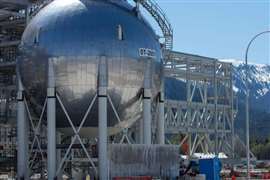
Storage tanks are widely used across the energy sector to hold crude oil, refined products, liquefied gases and other fluids. Industry regulations require periodic inspection to identify corrosion or structural degradation that could lead to leaks, environmental incidents or equipment failures. These inspections typically require tanks to be taken out of service, emptied and cleaned before technicians enter to perform manual measurements.
SwRI’s MST 8x8 probe is designed to address those challenges by enabling nonintrusive inspection. The device is a flexible strip containing eight ultrasonic sensors that attach to the outside of a tank wall. Once installed, the sensors generate acoustic waves that travel along the structure.
If corrosion or other flaws are present, the waves are reflected back toward the sensor array. By analyzing these reflected signals, engineers can identify anomalies within the tank structure.
The system uses shear horizontal guided waves, a form of ultrasonic wave particularly suited to structural inspection because of its sensitivity to defects and its ability to travel long distances through metal surfaces.
“Many industries require storage tanks to be inspected regularly,” said Dr. Sergey Vinogradov of SwRI, author of a recent paper describing the probe’s capabilities. “This can be a very expensive process, as it requires the tank to be emptied, cleaned and manually inspected. By allowing inspection without emptying the tank, our probe reduces expensive downtime and improves inspection safety, by avoiding work in hazardous, confined spaces.”
The probe’s eight-sensor configuration allows it to collect data from multiple angles simultaneously. This multi-sensor setup supports a technique known as full matrix capture, which records the signals from each transmitter-receiver combination in the array.
The collected data is then processed using an advanced imaging algorithm known as the total focusing method. This approach enables the system to generate detailed two-dimensional maps of the tank structure, highlighting areas where corrosion or material loss may be developing.
Rather than simply indicating the presence of a potential defect, the technology can produce a high-resolution image showing the location and approximate size of the anomaly. This level of detail allows operators to better evaluate structural integrity and determine whether maintenance or repairs are required.
“As a result, instead of just indicating the presence of an anomaly, it can create a high-resolution map of the structure, showing areas with potential corrosion,” Vinogradov said. “This helps users assess the extent of damage to decide when to schedule expensive, time-consuming tank repairs.”
SwRI conducted field testing of the probe on several storage tanks to evaluate its performance under real-world conditions. According to the institute, the system demonstrated the ability to detect corrosion and other structural issues without requiring internal access to the tanks.
The inspection approach also works on structures with complex geometries, including curved surfaces and areas with attachments such as brackets or fittings that can complicate conventional inspection techniques.
While the technology was initially evaluated on storage tanks, SwRI said the same inspection method could be applied to other large industrial structures. Potential applications include pipelines, ship hulls, wind turbine towers and aerospace structures.
For the oil and gas sector, the technology may be particularly relevant for facilities with large tank farms or terminals where taking tanks out of service can disrupt operations. Nonintrusive inspection tools that reduce shutdown requirements could help operators manage aging infrastructure while maintaining throughput.
SwRI said it plans to make the technology available to industry through equipment sales, licensing arrangements and technology transfer programs with inspection companies.