Read this article in 中文 Français Deutsch Italiano Português Español
NEA’s 560hs compressor targets midstream efficiency gains
April 19, 2026
U.S. Based gas storage project highlights flexible driver integration, reduced cylinder count and customized cylinder engineering
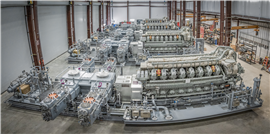
Neuman & Esser USA says its 560hs high-speed reciprocating compressor, first introduced in 2017 as a midstream-optimized platform, is gaining traction in storage and gathering applications where operators are seeking higher load capability, reduced footprint and lower lifecycle costs.
Since its introduction, NEA has deployed the 560hs frame across a range of natural gas applications. One recent project with a U.S.-based gas producer illustrates how the platform is being applied to storage duty, where wide operating ranges, driver flexibility and high-load capability are critical.
Project configuration and application demands
This particular installation required a mixed-driver configuration, reflecting the operational realities of storage assets that must balance flexibility with performance.
“The application required two electric motor-driven packages and four natural gas-driven packages equipped with Waukesha 16V275GL+ engines,” said Zach Heine, Key Account Manager for NEA USA, who led the sales effort.
After evaluating rod loads, gas loads, available driver horsepower, operating speeds and package constraints, NEA selected its VL560hs four-throw frame.
“Its wide operating speed range, from 600 to 1,200 rpm, makes it an excellent fit for both electric motors and natural gas engines,” Heine said.
The system was designed to address a challenging operating envelope, combining high flow requirements with elevated discharge pressures. According to NEA, the frame is capable of handling discharge pressures up to 10,000 psig, with horsepower per throw reaching up to 1,800 hp, positioning it for demanding midstream and storage duty cycles.
Design approach: fewer throws, higher loads
A central design philosophy behind the 560hs is reducing the number of throws and cylinders required to meet performance targets.
“The higher rod and gas load capacity of the 560hs frame produced meaningful CAPEX and long-term OPEX savings for the customer,” Heine said. “A key highlight was the elimination of 12 compressor cylinders from the maintenance cycle compared with the competition.”
The frame is rated for a combined rod load of 125,000 lbs per the API 618 definition. This capacity is enabled by the use of high-strength steel materials in the running gear and piston rod, along with hydraulic bolting for critical joints.
By increasing per-throw capability, NEA reduces the total number of compression elements required.
“With NEA’s history of robust, slow-speed API 618 compressors for downstream service, our goal is always to use the fewest number of throws required, minimizing installed wear components, simplifying maintenance and improving reliability,” Heine said.
From a lifecycle standpoint, fewer cylinders translate directly into fewer valves, packing elements and associated maintenance activities. While individual valve life remains comparable, the total number of valves in service is reduced, lowering spare parts inventory and labor requirements during overhauls.
Custom cylinder engineering and simulation
Rather than relying on a fixed cylinder catalog, NEA applies a fully customized approach to cylinder and piston design.
“NEA does not have a standard cylinder lineup but instead custom-designs cylinders for each application from a large internal library of patterns,” Heine said. “We try to extract as much efficiency as possible from every cylinder.”
The company uses its in-house KO3 design software to model compressor performance and evaluate multiple configurations. These designs are then validated using internal finite element analysis (FEA), particularly important for applications involving simultaneous high pressure and high flow.
“One of the unique challenges on this project was the need to handle both high pressure and high flow simultaneously,” Heine said. “This is an area where NEA excels due to our ability to customize cylinder and piston configurations using proprietary tools.”
Managing mixed-driver torsional dynamics
One of the more complex aspects of this installation was applying a single compressor frame across both electric motor and gas engine drives, each with distinct torsional characteristics.
Electric motors typically present stiffer systems with lower inertia, while gas engines introduce higher amplitude torque pulsations. These differences require careful torsional analysis and coupling selection.
“NEA performs torsional studies in-house,” Heine said. “Motor-driven systems require couplings that limit resonance amplification, while engines need couplings capable of absorbing higher torque pulses.”
To address these requirements, NEA selected elastomeric couplings, a technology the company has applied since the 1990s to dampen torsional vibrations across varying driver conditions.
In addition, the 560hs platform allows for customization of piston rod stroke to match driver speeds, helping maintain conservative piston speeds across the 600–1,200 rpm operating window.
Compact footprint and packaging advantages
Joseph Lesak, Director of Primary Market Sales, who was involved in the original development of the 560hs frame, said the move to a four-throw configuration was central to reducing both footprint and logistics complexity.
“The compact design and use of a four-throw arrangement instead of a six-throw frame helped minimize the space and cost required during packaging and transportation,” Lesak said. “Utilizing API 618 running gear allowed for the higher rod load capacity that made this possible.”
The reduced footprint is particularly relevant for storage and midstream installations where site constraints and modular packaging requirements can drive project economics.
“The compressor frame can handle the demands of both storing and withdrawing gas due to its robust design,” Lesak said.
Field performance and installation considerations
While these units have not yet been installed, NEA reports similar 560hs units operating in Northeast U.S., providing early performance indicators.
According to the company, vibration levels in those installations remain well within required tolerances, attributed in part to robust packaging design and foundation engineering.
The new units will be installed on engineered concrete foundations with added mass at key skid locations, following established best practices for vibration mitigation.
No major mechanical design changes have been required based on field experience to date, though control system updates have been implemented on the engine side.
Extending downstream philosophy into midstream markets
The 560hs reflects an effort to bring design principles traditionally associated with downstream API 618 compressors into midstream applications.
“The enhancements allow the frame to deliver more horsepower and capacity per throw, improving runtime and reducing spare parts consumption,” Lesak said. “This is critical in many downstream applications, so we wanted to bring this philosophy to the midstream market to lower total cost of ownership.”
As midstream systems continue to evolve — driven by storage flexibility, LNG demand and emerging applications — NEA sees continued opportunity for the platform beyond natural gas.
“We continue to place this frame not only in the natural gas market, but also in CO2, gas gathering and hydrogen applications,” Lesak said.
Building a broader platform
With its combination of high rod load capacity, wide operating speed range and application-specific customization, the 560hs is positioned as a flexible platform for evolving compression requirements.
The company said the design reflects a broader strategy of anticipating future operating conditions while reducing complexity at the equipment level.
By focusing on fewer throws, higher per-unit capability and tailored cylinder design, NEA is aiming to address a core challenge in midstream compression: delivering higher performance without increasing maintenance burden.
Image: NEA 560
Since its introduction, NEA has deployed the 560hs frame across a range of natural gas applications. (Image: NEA)

CONNECT WITH THE TEAM