Global methane regulations expand, but compliance challenges remain

October 13, 2026
International Gas Union report finds 67% of global natural gas production is covered by jurisdictions with adopted or proposed methane rules
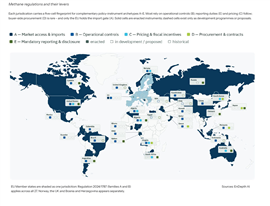
Methane regulations are expanding across the global natural gas industry, but differences in compliance requirements, emissions measurement and verification standards threaten to complicate international trade and increase costs for operators, according to a new report from the International Gas Union (IGU).
The report, The global state of methane regulation: Convergence or fragmentation?, found that jurisdictions accounting for approximately 67% of global natural gas production have adopted or proposed operational rules addressing methane emissions.
At the same time, global average upstream methane intensity has declined 10% since 2019, reflecting expanded emissions management programs, improved monitoring and greater adoption of internationally recognized reporting standards.
However, the report cautions that the growing number of regulatory frameworks could create overlapping requirements for natural gas producers, pipeline operators and LNG suppliers, particularly those serving multiple international markets.
The challenge, according to the IGU, is not necessarily a lack of agreement on the importance of reducing methane emissions. Rather, it is the absence of consistent methods for measuring emissions, verifying results and demonstrating compliance across jurisdictions.
Different approaches to methane regulation
The report identifies five principal regulatory approaches emerging across global natural gas markets: market-access requirements, direct operational controls, emissions-related taxes and charges, buyer-driven procurement standards, and mandatory reporting frameworks.
These approaches frequently overlap, with individual countries employing several mechanisms simultaneously.
The European Union has established the most extensive market-access framework, applying methane-related requirements to imported oil and natural gas under Regulation 2024/1787.
The regulation extends its influence beyond European production facilities by requiring importers to demonstrate compliance with applicable methane monitoring, reporting and verification requirements.
For LNG exporters and other international suppliers, this creates additional commercial pressure to document emissions performance throughout the supply chain.
Other jurisdictions have concentrated on operational requirements.
Canada finalized enhanced methane regulations in 2025, strengthening leak detection and repair programs, venting restrictions and other operational controls for onshore oil and natural gas production, processing and transmission. Key compliance provisions begin taking effect in 2028.
Nigeria has implemented upstream methane management guidelines and introduced additional measurement-based reporting requirements.
Norway employs a combination of operational regulations and taxation of natural gas released into the atmosphere, while Australia, South Africa and Vietnam have established broader greenhouse gas reporting frameworks.
In the United States, the regulatory approach remains different. Congress disapproved the 2024 rule implementing the federal Waste Emissions Charge, while subsequent legislation deferred the statutory charge until emissions beginning in 2034.
The IGU distinguishes between regulations that require operators to identify and correct methane emissions and those that primarily require emissions inventories and disclosure.
Reporting programs can establish the foundation for more extensive emissions controls, but they do not necessarily require operators to make equipment repairs or implement specific methane reduction measures.
Implications for compression operations
For natural gas compression operators, the expanding regulatory environment places greater emphasis on equipment integrity, leak detection, maintenance practices and documented emissions reductions.
Across different jurisdictions, recurring operational requirements include leak detection and repair (LDAR) programs, restrictions on venting and routine flaring, natural gas recovery and structured emissions reporting.
These requirements have direct implications for compressor stations, gas processing facilities and other installations where methane can be released through equipment leaks, maintenance activities and operational venting.
Although the report does not quantify emissions specifically attributable to compression equipment, its findings underscore the importance of operational practices that can identify methane releases and verify corrective action.
Operators increasingly must demonstrate not only that emissions have been measured, but also that identified problems have been investigated and addressed.
The IGU emphasizes that effective regulation should account for differences in equipment, infrastructure, operating conditions and regional capabilities rather than imposing identical requirements across all facilities.
It also argues that compliance methodologies should be available before associated obligations and penalties become enforceable, allowing operators sufficient time to implement monitoring systems and other necessary changes.
Measurement standards begin to converge
Despite differences among national regulations, the report identifies increasing alignment around measurement-based emissions reporting.
A principal example is the United Nations Environment Programme’s Oil and Gas Methane Partnership 2.0 (OGMP 2.0), which provides a framework for progressively improving the accuracy of methane emissions inventories.
The program’s reporting structure moves beyond general emissions estimates toward source-level quantification and measurement-based verification.
At Level 5, operators reconcile source-level emissions inventories with measurements conducted at the facility level, allowing discrepancies to be identified and investigated.
The European Union’s methane import requirements recognize a compliance pathway incorporating OGMP 2.0 Level 5 reporting together with the required independent verification.
However, the IGU cautions that membership in an international reporting initiative does not automatically establish regulatory compliance.
Other programs are also contributing to greater consistency in emissions data.
The Coalition for LNG Emission Abatement towards Net-zero (CLEAN), launched by Japanese utility JERA and South Korea’s KOGAS and coordinated by JOGMEC, collects emissions information from LNG suppliers through commercial relationships.
The initiative has developed project-level methane reporting intended to give LNG buyers greater visibility into emissions associated with their supplies.
Meanwhile, independent certification organizations such as MiQ provide voluntary methane emissions assessment frameworks.
The IGU notes that these initiatives perform different functions and should not automatically be regarded as interchangeable.
A reporting standard, commercial certification and legally recognized compliance determination may rely on similar technical information while imposing different requirements.
Satellite monitoring adds another layer
Satellite-based methane detection is becoming an increasingly important component of global emissions monitoring.
The United Nations Environment Programme’s Methane Alert and Response System (MARS) uses satellite observations to identify major methane emission events and notify governments and operators.
The objective is to establish a process that moves from detection and attribution to investigation, corrective action and confirmation that emissions have been addressed.
However, turning satellite observations into operational improvements remains a challenge.
The IGU cites UNEP data showing that responses to MARS alerts reached 12% in 2025, indicating a substantial gap between identifying potential emissions sources and obtaining documented responses.
The report argues that regulatory and voluntary programs should ultimately measure success through verified emissions reductions rather than the number of alerts issued or reports submitted.
For facility operators, this places additional importance on procedures for investigating identified emissions, documenting repairs and confirming their effectiveness.
International trade complicates compliance
Another challenge involves determining how methane emissions should be attributed to natural gas moving through complex international supply chains.
Natural gas produced at multiple facilities can enter shared pipeline systems, processing infrastructure and LNG export terminals before reaching an overseas customer.
As a result, connecting a particular shipment of natural gas with specific production-related emissions can be difficult.
The European Commission addressed some of these challenges in July 2026 guidance outlining potential approaches to emissions attribution and chain-of-custody documentation.
The guidance identifies two approaches: trace-and-claim systems that track information and quantities through commercial transactions, and certification systems that independently establish compliance attributes associated with traded gas.
Both approaches offer alternatives to physically segregating gas supplies, although their acceptance remains subject to regulatory criteria and assessment by the appropriate authorities.
The IGU argues that international compliance systems should recognize credible approaches while ensuring that emissions claims can be independently verified and are not counted more than once.
Five priorities for international alignment
To address regulatory fragmentation, the IGU proposes an international framework for methane measurement, monitoring, reporting and verification.
Rather than creating another independent reporting system, the organization recommends connecting existing standards and regulatory structures.
Its proposed framework centers on five priorities:
- Common measurement standards: Broader recognition of OGMP 2.0 Level 4 and Level 5 reporting across regulatory jurisdictions and LNG procurement frameworks.
- Mutual recognition of verification: Acceptance of qualified independent verifiers across jurisdictions, accompanied by expanded verification capacity.
- Consistent emissions-intensity calculations: Common underlying data and transparent methods for reconciling differences in reporting boundaries, measurement units and production-based calculations.
- Compatible chain-of-custody systems: Shared approaches for connecting emissions measurements, certification information and commercial transactions.
- Coordinated responses to major emissions events: Procedures that connect methane detection with investigation, corrective action and confirmation of results.
The report identifies independent verification capacity as a particularly important potential constraint as new requirements take effect in 2027.
Without sufficient qualified personnel and accepted verification procedures, companies could face delays in demonstrating compliance even when they have implemented appropriate emissions management systems.
Balancing emissions reductions and compliance
The IGU maintains that international methane regulations can support meaningful emissions reductions while allowing natural gas to remain available to importing markets.
Achieving those objectives, however, will require regulatory cooperation and greater recognition of equivalent measurement and verification systems.
The report also emphasizes that regulatory frameworks must accommodate differences in infrastructure, operating conditions and the resources available to individual jurisdictions.
For the compression industry, the continuing expansion of methane regulation reinforces the importance of reliable equipment, effective emissions monitoring and maintenance practices supported by verifiable operational data.
The larger question is whether national regulators and international gas buyers can establish compatible requirements before compliance obligations become increasingly complex.
While the industry’s measurement practices are moving toward greater consistency, the IGU concludes that significant differences remain in legal requirements, implementation and verification.
The ability to reconcile those differences could determine whether global methane regulation becomes a coordinated emissions-reduction effort or an increasingly fragmented collection of national and regional obligations.


CONNECT WITH THE TEAM