Design in Onshore vs. Offshore CCUS applications

October 12, 2026
Considerations for CO₂ compressor selection
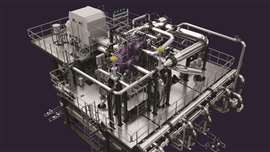 IGC package with interstage cooling.
Authors: Lukas Biyikli, Siemens Energy, and Marybeth Mcbain
CCUS continues to gain traction as a decarbonization pathway across a broad range of industries, including steelmaking, cement, power generation, and pulp and paper. Despite the momentum, many proposed CCUS projects worldwide have failed to reach a final investment decision (FID). Much of this is attributable to high capital costs, which pose a barrier to project viability and make it challenging to secure the necessary financing for facility development. Outside of the capture technology, CO₂ compressors are among the most critical pieces of equipment, as they represent a large portion of a facility’s capital expenditure (CAPEX) and operational expenditure (OPEX).
Technologies for CO₂ capture and transport onshore are well established and typically involve compressing CO2 into the supercritical state, where it behaves as a high-density fluid (i.e., neither a pure liquid nor a pure gas). Less experience has been accumulated in designing and operating CCUS systems for CO₂ liquefaction, which may be particularly appealing for offshore developments. Thermodynamic comparisons have shown that the total power required is comparable for CO₂ compression with high intercooling vs CO₂ liquefaction and pumping to the final injection pressure.
In both the onshore and offshore environments, critical decisions regarding compressor selection, design, and integration with pre- and post-treatment processes must be made and directly influence capital costs, power consumption, ease of start-up and turndown, and reliability. Depending on project priorities, one factor may take precedence over the others. Arriving at an optimal design requires developers and operators to work with compressor OEMs to reduce the total cost of ownership (TCO). Given the criticality of the CO₂ compression process to the overall project success, developers must select compressor OEMs with extensive experience – including in the design of inlet guide vanes for high turndown, packaged integrally geared systems, and impeller aerodynamic design for the transition to supercritical pressure.
Understanding CO₂’s thermodynamic properties
When designing a CCUS system, the compression path ultimately matters as much as the compressor type. A conventional centrifugal compression route with limited intercooling may reduce equipment complexity and footprint, but it consumes more power and generates higher temperatures. In contrast, a semi-isothermal gaseous compression route with more frequent intercooling can reduce power consumption, but requires additional coolers, piping, and plot space. A hybrid route, in which CO₂ is compressed to an intermediate pressure, liquefied, and then pumped to a higher pressure, can also reduce compression work but adds refrigeration and liquid-pumping equipment.
Technologies for CO₂ compression
CO₂ has a critical temperature of 31.1°C and a critical pressure of 73.8 bar. Above that point, it enters the supercritical (sCO₂) region, where it behaves as a dense compressible fluid with characteristics of both a gas and a liquid. The supercritical region creates design challenges for rotating equipment. Centrifugal compressors generally do not tolerate two-phase flow well. Reciprocating compressors are better at handling the changing compressibility factors in this transition region.
Temperature management is particularly important. CO₂ heats up rapidly during compression due to its real-gas behavior and high heat of compression. In practical terms, intercooling can reduce overall compression power by roughly 10–20%, depending on the configuration and pressure ratio.
Multiple compressor technologies can be applied across the pressure ranges required for CO₂ capture, transport, and storage.
Reciprocating compressors – Reciprocating compressors are typically used in CO₂ applications with flows below 0.2 MTPA or where high turndown is required. They are also well-suited for high-pressure-ratio duties in the supercritical region because they can tolerate changes in CO₂ compressibility.
Operating flexibility is another advantage. Recip compressors can achieve turndown up to ~85% through cylinder unloading, speed variation, single-acting cylinders, and other control methods. Additionally, they offer straightforward start-up and multiple load steps through individual cylinder operation. In dense-phase or supercritical service, cylinder valves can be designed for higher discharge densities. At the same time, interstage scrubbers are typically used in wet CO₂ service to remove liquid dropout and protect valve performance.
Reciprocating compressors are also well suited to modular, skid-mounted packages for smaller flows, particularly in upstream gas processing facilities where captured CO₂ may be delivered to a common supercritical trunkline. For flow rates of 0.05–0.2 MTPA, packaged units can integrate the motor drive and pulsation bottles on a single frame, with additional stages added to meet higher-pressure requirements.
Single-shaft centrifugal compressors – Single-shaft centrifugal compressors are commonly applied in large-volume CO₂ applications, including post-combustion capture from power generation, cement, and steel facilities, as well as offshore projects where footprint and weight are major constraints. Because CO₂ has a relatively high molecular weight and density, centrifugal compressors can generate high head at comparatively low circumferential speeds. This differs from lighter gases such as hydrogen, which require much higher speeds for equivalent head. However, adding intercooling between the casings of the single-shaft compressors will help lower the total power requirements.
The main advantages of single-shaft compressors are their small footprint, lower weight, and minimal interstage piping requirements. These features are especially valuable for brownfield sites and offshore facilities. Their lower seal count per impeller is attractive compared with multi-shaft compressors, and noise can often be managed through casing and stator design.
Multi-shaft centrifugal (integrally geared compressors) - Integrally geared compressors (IGCs) are often selected when minimizing power consumption is a priority. Their design allows multiple pinion shafts around a central bull gear, with each stage operating at an optimized speed. Because each impeller sits in its own volute casing, intercooling can be applied between stages, thereby lowering the process gas temperature and reducing the total compression work.
The ability to adjust individual impeller diameters and pinion speeds allows IGCs to maintain higher stage efficiency as volumetric flow decreases with increasing pressure. IGCs also reduce the number of stages required compared with single-shaft units for raising from atmospheric to pipeline pressure. They are often controlled by movable inlet guide vanes (mIGVs), which provide efficient turndown without the cost of variable-speed drives (VSDs). Turndown is typically around 40% and can be increased by applying mIGVs to limiting stages.
An alternative to fully compressing CO₂ in gaseous or supercritical form is to partially compress and cool the stream until it condenses into a liquid, then use pumps to raise it to pipeline or injection pressure. Because liquids are nearly incompressible, pumps require far less energy than compressors to increase pressure.
The trade-off is the need for refrigeration or cryogenic compression, which requires cooling CO₂ to approximately –20°C to –35°C, or lower depending on feed conditions and impurity levels. LNG has been considered for marine applications because of its availability as both fuel and cargo, while sCO₂-based refrigerant cycles may offer footprint and commonality advantages in some cases. For offshore use, refrigerant compressors, booster compressors, and pumps must be marinized and designed for higher structural loads and modular integration.
In summary, liquid pumping can reduce total energy consumption when high final pressures are required, particularly if the reduction in compression work outweighs the refrigeration duty. Pumps also offer mechanical advantages, are generally easier to maintain than large compressor trains, and avoid phase-boundary issues once the CO₂ is fully condensed.
Onshore vs. offshore CO₂ compression
For onshore pipelines with “low” flow rates, gaseous compression may be suitable. However, for higher flows, supercritical CO₂ represents the most efficient transport path because it reduces pressure drop per unit mass compared with gas-phase or two-phase transport. There is often a breakover point at which supercritical pipeline transport with pumping requires less power and lower CAPEX than low-pressure gas-phase transport. In such cases, initial compression to supercritical pressure remains significant, but downstream booster stations can use sCO₂ pumps at a lower power penalty.
Offshore CO₂ compression often necessitates different machinery than onshore gas/sCO₂ pipelines. In certain offshore applications, it may be advantageous to use compressors to raise the captured CO₂ product to an intermediate pressure or to the full sCO₂ pressure (i.e., a hybrid pathway), thereby making it ready for injection into an offshore reservoir.
Listed below are important process and technology considerations for a hybrid compression-liquefaction route in an offshore application.
- For any given CO₂ compressor (IGC, single-shaft or reciprocating), finite element analysis (FEA) of the frame, auxiliary components, and nozzle loads must be evaluated with the dynamic motion specifications of the offshore facility. Even if the CO₂ liquefaction route is selected, the machinery will still include a compression step from atmospheric capture pressure to the liquefaction pressure.
- IGCs, with the advantages of optimized speed and intercooling between CO₂ compression stages, face the design challenge of a high seal count and multiple stages connected by intercoolers and associated compressor nozzles. The nozzle loading for offshore units is higher, and each compressor package must deliver a more robust nozzle design.
- Traditional refrigerants (RF1- and R-290-based) are suitable for the offshore refrigeration cycle. However, there may be cases where less-flammable alternative refrigerants with lower environmental risk is a better option. For systems with a coefficient of performance (COP) below 4, an sCO₂-based refrigerant cycle using a small sCO₂ compressor may warrant further consideration given its obvious commonality advantages. The risks, performance, and technology readiness of each cycle to deliver LCO₂ at medium pressures (7-8 barg / 100–120 psig) should be thoroughly evaluated.
The impact of non-condensable impurities in the captured CO₂ stream should be evaluated to quantify their effect on liquefaction efficiency. Project-specific CO₂ disposal and injection specifications must also be reviewed to ensure the captured CO₂ meets required quality and impurity limits for reservoir injection.
The effects of corrosive impurities on construction materials should be evaluated. This has been the known culprit of availability issues in multiple high-profile CO₂ injection projects.
The performance and footprint for the LCO₂ tank pumps should be profiled to determine technology capabilities to deliver the full injection pressure of the offshore reservoir.
Conclusion
Compressor technologies present distinct trade-offs for onshore and offshore CCUS applications. CAPEX and total power consumption are the primary factors influencing CO₂ compressor selection for offshore CCUS projects. However, application-specific requirements such as modularity, turndown, operational flexibility, start-stop capability, and offshore footprint can also be decisive. The lowest-power routes are typically gaseous semi-isothermal compression or hybrid compression and liquefaction. In practice, the number of cooling stages often has a greater impact on total power consumption than compressor efficiency alone.
Ultimately, appropriate compressor selection supports optimal energy performance, lower operating costs, and improved reliability. Early collaboration between project stakeholders and experienced CO₂ compressor OEMs helps ensure the system is optimized to plant boundary conditions from the outset.
References:
Ergina, J., Bowman, T. “Improving CCUS Project Bankability Through Integrated CO₂ Compression and Dehydration System Design”. Presented at Gastech 2025. September 10th, 2025.
McBain, M., Macleo, I., Biyikli, L., Husmann, L., Nguyen, D. “Evaluating CO2 Compression Machinery for Onshore and Offshore Applications”. Asia Turbomachinery & Pump Symposium. May 20th, 2026.



CONNECT WITH THE TEAM