Read this article in 中文 Français Deutsch Italiano Português Español
Kawasaki begins demonstration of centrifugal hydrogen compressor for liquefaction plants

June 29, 2026
The centrifugal compressor is designed for the refrigerant hydrogen compression stage within hydrogen liquefaction plants
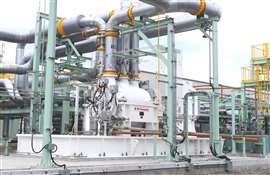 Demonstration facility of centrifugal hydrogen compressor (Harima Works).
Kawasaki Heavy Industries has begun demonstration testing of what it describes as the world’s first centrifugal hydrogen compressor designed specifically for hydrogen liquefaction plants, marking a milestone in the development of large-scale hydrogen infrastructure. The company said the KM Comp-H₂ has been operating on 100% pure hydrogen since January at a demonstration facility at its Harima Works in Japan.
The demonstration is part of a Green Innovation Fund project sponsored by Japan’s New Energy and Industrial Technology Development Organization (NEDO) and is intended to validate the compressor under real operating conditions before commercialization. According to Kawasaki, the system has operated without issues during the initial demonstration period.
The centrifugal compressor is designed for the refrigerant hydrogen compression stage within hydrogen liquefaction plants, where large volumes of hydrogen must be compressed efficiently while minimizing equipment footprint. Kawasaki said the unit achieves a pressure ratio of three using pure hydrogen, a significant engineering challenge because hydrogen’s low molecular weight requires much higher rotational speeds than conventional gas compression applications.
The company said the machine combines newly developed impeller technology with ultra-high-speed rotating equipment to compress large hydrogen volumes while reducing installation space to about one-seventh that required by conventional hydrogen compressors. Optimized cooling and compressor efficiency are also expected to reduce electricity consumption during the liquefaction process.
Hydrogen liquefaction is viewed as a critical step in developing global hydrogen supply chains because liquefied hydrogen enables economical transportation and storage over long distances. Improving compressor efficiency could help lower the energy intensity and cost of producing liquefied hydrogen, an area receiving increasing investment as countries pursue low-carbon energy strategies.
Kawasaki said the technology could eventually be adapted for other hydrogen infrastructure, including transmission pipelines, underground storage facilities, refineries, steel plants and ammonia production. The company plans to continue long-term testing of the compressor, including part-load operation and reliability evaluations, as it advances the technology toward commercial deployment.

CONNECT WITH THE TEAM